

The content is published under Creative Commons Attribution 4.0 International license.
Reviewed Article:
Between Function and Symbolism: Experimental insights from Mghvimevi
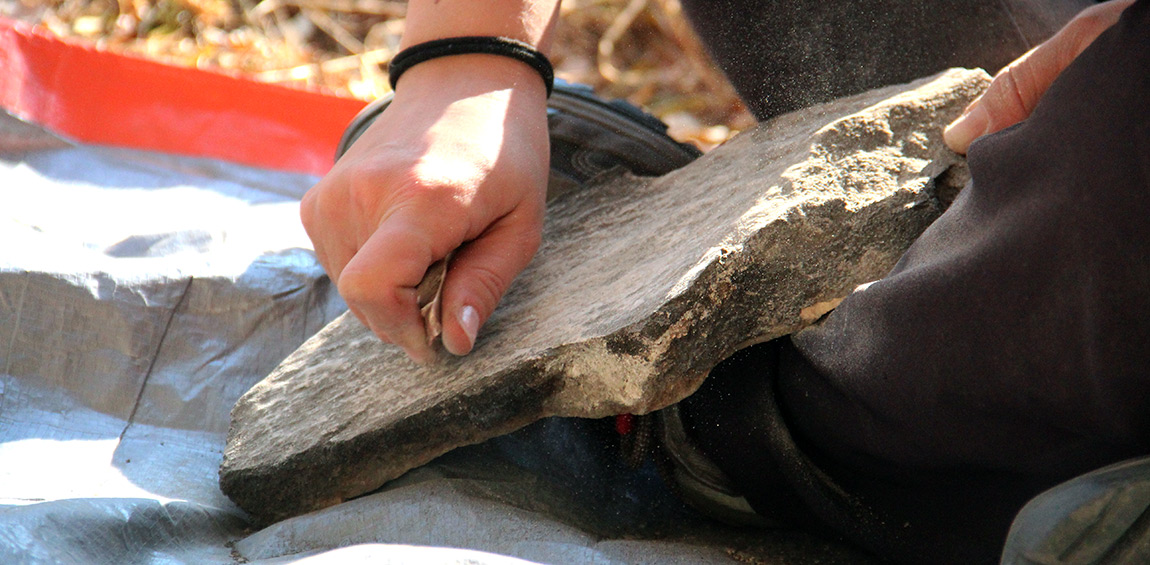
The Mghvimevi engravings represent the oldest known rock art in Georgia, dating to the Upper Palaeolithic. Fieldwork campaigns revealed 30 grooves consisting of parallel and intersecting lines. The nature of these grooves raises questions about whether they represent intentionally produced symbolic art or incidental traces of utilitarian activity. To address this issue, an experimental archaeology project funded by EXARC was undertaken. Activities included flintknapping, scraping, cutting, and deliberate incision-making using locally sourced flint from Chiatura. This study presents the results of the experimentation and offers a classification of the Mghvimevi grooves into several distinct groups.
Introduction: Mghvimevi Petroglyphs
The Mghvimevi cave complex is an archaeological site consisting of two caves and five rock shelters located in western Georgia, in the Chiatura municipality, within the Kvirila River gorge, at an elevation of 620 meters above sea level (See Figure 1). The site was initially identified during a survey campaign in 1934, when Sergey Zamyatnin, a fellow of the Institute of Anthropology and Ethnology of the then USSR Academy of Sciences, was dispatched to western Georgia to investigate Palaeolithic sites. At Mghvimevi, Zamyatnin collected Upper Palaeolithic surface material, including 56 flint tools, 89 flint blades and cores. More importantly, he recorded ten engravings in one of the rock shelters (Zamyatnin, 1937).
Despite the significance of this discovery, as the first identification of Palaeolithic rock art in the Caucasus, Zamyatnin did not pay enough attention to providing a detailed location of the engravings. This omission later led to misinterpretations by Georgian scholars (Nioradze and Nioradze, 2002; Chkhatarashvili, 2015; Gabunia, 2020), and until 2022, the rock art was considered lost or destroyed.
In 2022 and 2023, two fieldwork campaigns were carried out at Mghvimevi1 with the aim of rediscovering and studying the Mghvimevi petroglyphs. As a result, more than 20 engravings were documented on the limestone floor of Rock Shelter No.5 (See Figure 3). Upon close observation, all engravings were revealed to be linear, composed of vertical, horizontal, and diagonal lines - sometimes intersecting - ranging in length from 3 to 32 cm, with varying depths and widths from 0.1 to 0.6 cm (Zavradashvili, et al., 2023a; Losaberidze, Zavradashvili and Kenkadze, 2024).
A particularly significant find was a separate rock fragment bearing linear marks, which was discovered within the Upper Palaeolithic cultural deposit (See Figure 2). According to Zamyatnin, the fragment features two intersecting lines and an extensively scraped surface, as does part of the shelter floor (Zamyatnin, 1937).
The non-figurative nature of the motifs, their placement on the floor, the discovery of the separate rock fragment with engraving, and the hypothesis proposed by Zamyatnin that the surface may have been scraped prior to engraving, all raise the possibility that the Mghvimevi petroglyphs may not be purely symbolic but could also result from utilitarian activities.
Materials and Methods
The primary aim of this experiment was to examine the traces left on the limestone surface through various utilitarian activities and compare them to the Mghvimevi petroglyphs. Another aim was to make deliberate incisions using tools with different motions and characteristics to determine how tool use and movement influence the resulting grooves. The experimental procedures and surface analysis methods used in this study follow established protocols (d'Errico and Cacho, 1994; Peresani, et al., 2014; Katiyar, 2023).
The tools used in the experiments were made of flint collected from the outcrop near the Mghvimevi site. The Imereti region as a whole, and the surroundings of Chiatura, are rich with flint quarries, which explains the dominance of flint among Upper Palaeolithic assemblages in the region (Moncel, et al., 2015), including at Mghvimevi (Kiladze, 1948). Therefore, cobbles were gathered from the Kvirila riverbed, located approximately 500 m from the site.
The first phase of the experimentation involved knapping flint using simple percussion techniques and cobbles to strike flakes off. A total of 14 usable flint flakes were selected (See Tables 1 and 2 for sizes of tools), some of which were retouched, from the knapping debris for further testing (See Figure 4).
| Exp. N | Activity | Worked Material | Cutting Board | Tool | time (m) | |||||
| type | weight/size | surface | size (cm) | material | Utilized Surface | Direction of Motion | size (cm) | |||
| 1 | cutting | pork | 465 g | Not worked | 26x20 | flint flake | unretouched edge | Unidirectional/ Bidirectional | 3.3x2.5 | 11,1 |
| 2 | cutting | skin | 60 g | Not Worked | 42x26 | worked edge | Bidirectional | 11,17 | ||
| 3 | scraping | rock | 29x13 cm | flint flake | unretouched edge | Unidirectional | 6x4 | 4 | ||
| 4 | scraping | rock | 28x26 cm | flint flake | sharp unretouched edge | Bidirectional | 5.5x4.2 | 4 | ||
| 5 | cutting | pork | 315 g | Scraped (Exp. 4) | 28x26 | flint flake | unretouched edge | Unidirectional/ Bidirectional | 5.4x2.3 | 12,2 |
| 6 | cutting | beef | 800 g | Not worked | 21.5x15 | flint flake | sharp unretouched edge | Unidirectional | 6.5x4.5 | 24,3 |
| 7 | cutting | pork | 335 g | Scraped (Exp. 3) | 29x13 | flint flake | unretouched edge | Unidirectional/ Bidirectional | 7x4 | 11,2 |
Table 1. The data of experimental examination.
In total, 20 individual experiments were performed, encompassing a range of activities: scraping, cutting soft (pork, beef) and hard (pork skin) materials on a rock board, and making deliberate incisions. These activities are presented in chronological order (See Table 1, 2).
| Exp. N | Tool | Strokes | ||
| Material | Utilized Surface | Size (cm) | ||
| 8 | flint flake | sharp pointed end | 4x1.4 | single |
| 9 | multiple | |||
| 10 | flint flake | sharp edge | 4.3x3.5 | single |
| 11 | multiple | |||
| 12 | flint flake | retouched edge | 4.8x3.5 | single |
| 13 | multiple | |||
| 14 | flint flake | blunt pointed end | 4.2x3 | single |
| 15 | multiple | |||
| 16 | flint flake | blunt edge | 2.8x3.5 | single |
| 17 | multiple | |||
| 18 | flint flake | pointed end | 4.8x3.4 | multiple |
| 19 | flint flake | sharp edge | 4x2.8 | multiple |
| 20 | flint flake | sharp edge | 3.5x2; 3.2x2.5 | multiple |
Table 2. The data of experimental examination.
For the experimental rock boards, pieces of the same limestone on which the Palaeolithic engravings are observed were used. These were collected at the site - fragments that had broken off the rock surface.
Scraping activities (Experiment No. 3, 4) were conducted using unretouched flint flakes in both unidirectional and bidirectional strokes (See Figure 5). The objective of the experimenter was to smooth the rock surface to make it suitable for use as a cutting board. The experiment involved a stepwise scraping procedure, during which the tool was used for two minutes of continuous scraping. After this, the surface was examined and recorded both textually and microscopically. Subsequently, scraping resumed for an additional two minutes and continued until a smooth rock surface was achieved. In both scraping experiments, four minutes were sufficient to reach the desired outcome.
Cutting soft material (meat) on the rock board was performed four times, with variations in the type of flakes, meat material, and cutting boards. The movement of tools during cutting was not predetermined, as the experimenters used the flakes in the most practical and comfortable way for them.
Three pieces of raw pork (weighing between 315 and 465 grams; measuring 5-10 cm in thickness and 25-40 cm in length) were cut on rock boards (Experiment No. 1, 5, 7). In one particular instance (Experiment No. 1), the pork was placed on an unworked rock surface and cut with an unretouched flint flake (See Figure 6). Upon completion of 11:10 minutes of cutting, the piece was fully divided into 35 pork cubes. Furthermore, two pieces of pork were sliced on previously scraped rock fragments (Experiment No. 3, 4) using the edges of unretouched flint flakes (See Figure 7). In these cases, 14 (Experiment No. 5) and 29 (Experiment No. 7) pork cubes were obtained in roughly that same amount of time (See Table 1 for times).
A piece of beef was cut on the unworked rock surface (Experiment No. 6) using the sharp, unretouched edge of a flint flake. The tool was moved in a unidirectional motion, whereas pork cutting had been carried out using both Uni- and Bidirectional movements. A duration of 24:03 minutes was sufficient to complete the activity and acquire 22 beef cubes.
The final cutting experiment was performed on a hard material - a pork skin (Experiment No. 2), which was cut into 13 cubes on an unworked rock board using a previously utilised flint flake (See Figure 8). Bidirectional movement of the tool was the only motion employed in this activity, as it is more effective for cutting harder materials.
After completing the scraping-cutting experimental series, and prior to microscopically documenting the implemented traces on the cutting boards, the boards were washed with pure cold water and dried in the sun, as meat and skin are fat-rich products and had left the surfaces covered in grease. As a result, the boards were only partially clean, with some fat and grease still remaining.
Another experimental series was dedicated to deliberate incisions. Thirteen experiments involved producing engravings on the rock surface (See Figure 9 and Table 2). The experimental incisions were made by previously knapped flint flakes. Lithics with sharp pointed ends, blunt pointed ends, sharp edges, blunt edges, and retouched edges were engaged in a number of experiments. Each tool was employed to make an engraving with single and multiple strokes, while Experiment No. 20 focused on creating two intersecting engraved lines with the intention of understanding the chronological sequence of the petroglyph's production.
Ultimately, the experimental grooves were documented and analysed using the same procedures as those applied to the original incisions, including photographic documentation, macro- and microscopical analysis using a digital microscope.
Results
The experimental results correspond closely with those reported in prior studies (Peresani, et al., 2014; Katiyar, 2023), though detailed documentation of our own findings is warranted.
Scraping in a unidirectional motion using an unretouched flint flake led to the formation of sub-parallel striations on the rock surface, while bidirectional motion produced parallel but intersecting striations (the direction of the tool was changed accordingly) (See Figures 10, 11). The inner edges of the striations show the presence of micro-striations, indicating they were produced through artificial activity.
As previously mentioned, scraping was conducted step by step in two-minute intervals. However, the nature of the striations did not change after the first two minutes - only the number of striations increased. By the end of these experiments, smooth surfaces had been achieved, making them suitable for subsequent cutting activities.
The results of the cutting activities can be divided into three categories: cutting soft materials on an unworked surface (Experiment No. 1, 6), cutting soft materials on a scraped surface (Experiment No. 5, 7) and cutting hard material on an unworked rock board (Experiment No. 2).
Cutting soft materials on the unworked rock surface resulted in non-systematic, fine, and thin striations. The orientation of the striations was triggered by the manner in which the meat was sliced. Most of the striations exhibit a V-shaped profile, with the presence of inner micro- striations present along the edges and at the valley (i.e., the bottom of the groove). In some cases, the striations bear more U-shaped sections, with several micro-striations on the valley, likely caused by multiple strokes during the cutting process (See Figure 12).
In Experiment No. 6, the beef portion was larger (800 g) than in other experiments, requiring more time (24 minutes and 30 seconds) and additional strokes to cut it into smaller pieces. This resulted in a greater number of striations on the board. However, the nature of these striations was consistent with those observed in Experiment No. 1.
Scraped cutting boards display a similar number of non-systematic striations as the non-scraped ones. However, the striations are generally wider and occasionally deeper (See Figure 13). Multiple tool strokes within a single groove produced wide striations with a rectangular U-shaped profile, often bearing micro-striations on the valley, and sometimes showing a double-sectioned structure. Some of the striations also exhibit V-shaped profiles.
Overall, after conducting cutting activities on the scraped boards, the cutting marks appeared more prominent than the scraped striations. In certain instances, scraped marks were erased by the cutting striations, while some of them were sharpened. Thus, cutting activities modified the existing scraping striations.
The skin-cutting activity left wider and deeper striations, as it required greater application of force. The grooves have V-shaped sections with micro-striations on the valley (See Figure 14). The resulting traces on the rock board were markedly different from those produced in previous experiments and were clearly visible even to the naked eye.
A number of experiments were dedicated to deliberate engravings. A sharp pointed end of a flake was involved in Experiment No. 8 and 9. Initially, a single stroke was applied, followed by multiple strokes in an attempt to replicate the type of engravings found in the original context. In both cases, the resulting engravings displayed micro-striations. A single pass was insufficient to produce a clear incision, whereas multiple strokes produced a deeper and thicker groove. One engraving had a U-shaped double profile due to the flake tip breaking during the process (See Figure 15).
A sharp edge of a flint flake was used to make incisions through single and multiple passes of the tool. Making a groove with an edge produced a deeper and clearer incision than in the previous case. While 80 strokes were required to achieve a sufficiently deep engraving with a sharp pointed end, only 60 strokes were needed when using a sharp edge. Both engravings (Experiment No. 10, 11) have a V-shaped profile and display clear micro-striations on the valley and the inner edges (See Figure 16).
In contrast, the retouched edge of a tool required significantly more effort. A total of 170 strokes was needed to produce a comparable engraving. A single pass of the tool did not result in any distinct incision - only a rough, jagged scratch was visible on the surface. However, multiple strokes created a deep and satisfactory engraving similar to the original examples. This engraving also shows micro-striations on the valley and inner edges. Previous experience had suggested that a retouched tool would produce an engraving with a double-shaped profile - our experimental engraving (Experiment No. 13) has a V-shaped section (See Figure 17).
The blunt pointed end (Experiment No. 14, 15) left almost no micro striations in the U-shaped grooves (See Figure 18); only a few striations were detected along the inner edges of the engraving, which was made by multiple strokes (70) of the tool. In contrast, the sharp pointed end (Experiment No. 18) produced a groove with a U-shaped section that contained numerous micro-striations on the valley and inner edges of the engraving.
Similar results were obtained when engraving with blunt (Experiment No. 16, 17) (See Figure 19) and sharp edges (Experiment No. 19). The blunt edge of a flint flake left practically no micro-striations inside the groove, whereas the sharp edge produced many striations on the valley of the engraving. It is worth mentioning that during Experiment No. 19, the experimenter made an error, resulting in an engraving with two branches.
Experiment No. 20 was dedicated to creating a rough analogue of Mghvimevi Petroglyph No. 9. First, a horizontal line was engraved, followed by two vertical lines intersecting the first one. Under the microscope, it is clearly visible that the vertical lines cut into the horizontal line. This allows us to observe the chronological sequence of the engraved lines. The image was created using two flint flakes, as the first tool was damaged during the process. The grooves all have U-shaped sections but vary in width. They all bear micro-striations on the valley and edges (See Figure 20).
Discussion
The experimental study revealed that artificially made grooves have several distinguishing characteristics: a specifically shaped profile, which is hinged on the tool used, and micro-striations within the interior of the groove. However, grooves obtained through different methods have their own specificities. When identifying the nature of an incision, it is important to revise all relevant indicators together.
The results obtained through experimentation and microscopic analysis allow us to categorise the Mghvimevi engravings into three groups: scraping marks, cutting marks, and deliberate incisions.
Scraping the rock surface may have served different purposes: removing sediments from the surface or smoothing the rock surface for further use. Zamyatnin proposed that the surface was scraped to smooth it in order to make engravings (Zamyatnin, 1937). However, we cannot dismiss alternative interpretations regarding the reasons for scraping the bedrock.
Scraping striations can be either systematic or non-systematic. In general, numerous parallel striations on the surface are indicative of this type of activity. Similar traces were observed on the rock surface at rock shelter No. 5. For instance, the groove in Figure 21 shows similar striations to the traces left by experiments No. 3 and N4 (See Figures 10, 11).
Most of the Mghvimevi engravings show a resemblance to the striations left by cutting activities. The grooves shown in Figure 22 present non-systematic, thin intersecting striations. These may be the result of utilitarian processes and, most likely, represent butchery marks.
Deliberate incisions are the easiest of all to recognise. They show micro-striations on the valley and on the edges of the engraving. The shape of the profile reflects the type of tool used for incising, and their systematic positioning suggests symbolic meaning. Mghvimevi Petroglyph No. 9 is the clearest example of deliberate incisions (See Figure 23). It consists of three lines, one of which is thickest and deepest of all the Mghvimevi engravings. It has a U-shaped profile and presents micro-striations on the valley and on the edges inside. The other two smaller incisions are parallel to each other and intersect the thicker line. Under microscopic observation, it is clear that the thinner engraved lines were made after the thicker one, indicating the chronological sequence of production. The tools used for these engravings were likely different, as their groove profiles vary.
Regarding the tools, it is worth noting that engraving with the edge of a tool produces deeper and sharper incisions than engraving with the tip. In such cases, the resulting engraving typically has a V-shaped profile, which derives from the properties of lithic tools - thin edges and thicker bodies. This finding is consistent with previous experiments conducted by the authors (Zavradashvili, et al., 2023b).
Conclusion
The experimental samples described here provide a comparative reference collection for analysing grooves recovered at Mghvimevi and other archaeological sites. Scraping, cutting, and engraving striations can be differentiated through comprehensive analysis, including macroscopic and microscopic observation.
Not all of the Mghvimevi petroglyphs constitute deliberately incised marks; some of them show evidence of different kinds of activities. Therefore, we find it appropriate to refer to them as the Mghvimevi grooves rather than petroglyphs, as the latter term inherently implies symbolic meaning.
Acknowledgement
The research was funded by the EXARC under the Kiernan Experimental Archaeology Award. We thank the anonymous reviewers for carefully reading our manuscript and providing many insightful comments and suggestions. We are grateful to the EXARC team for their help and support. In addition, we would like to express our gratitude to Peggy Lucas for her assistance with English corrections.
- 1
With the funding from American Rock Art Research Association (ARARA) and Ivane Javakhishvili Tbilisi State University (TSU).
Keywords
Country
- Georgia
Bibliography
Chkhatarashvili, G., 2015. The earliest art and its examples from Stone Age sites in Georgia. Studies in Art Criticism, VI, pp.87-93.
D'Errico, F. and Cacho, C., 1994. Notation versus decoration in the Upper Palaeolithic: a case-study from Tossal de la Roca, Alicante, Spain. Journal of Archaeological Science 21 (2), pp.185-200.
Gabunia, M., 2020. Uncovered mystery of the fabulous petroglyphs. Archaeospectrum, pp.242-255.
Katiyar, Sh., 2023. Utilitarian or not. The engraved cortexes of the Mousterian Levels of Riparo Tagliente (stallavena di Grezzana, Verona, Italy). International Erasmus Mundus Master in Quaternary and Prehistory.
Kiladze, N., 1948. New Palaeolithic finds from the village of Mghvimevi. Dissertation.
Losaberidze, L., Zavradashvili, A., Kenkadze, V., 2024. Palaeolithic rock art from Mghvimevi, western Georgia. Archaeological Research in Asia 37, p.100499.
Moncel, M. H., Pleurdeau, D., Pinhasi, R., Yeshurun, R., Agapishvili, T., Chevalier, T., Lebourdonnec, F-X., Poupeau, G., Nomade, S., Jennings, R., Higham, T., Tushabramishvili, N. and Lordkipanidze, D., 2015. The Middle Palaeolithic record of Georgia: A synthesis of the technological, economic and palaeoanthropological aspects. Anthrpologie 53(1-2), pp.93-125.
Nioradze, M., and Nioradze, G., 2002. Upper Palaeolithic art from the cave sites of western Georgia. Dziebani 9, pp.5-14.
Peresani, M., Dallatore, S., Astuti, P., Colle, D, M., Ziggioti, S. and Peretto, S., 2014. Symbolic or Utilitarian? Juggling Interpretations of Neanderthal behavior: new inferences from the study of engraved stone surfaces. Journal of Anthropological Sciences Vol. 92, pp.233-255.
Zamyatnin, S., 1937. The rock shelters of Mghvimevi, near Chiatura. Soviet Archaeology III, pp.53-76.
Zavradashvili, A., Losaberidze, L., Kenkadze, V., Mamalashvili, T., Kukava, N., Kokhreidze, M. and Oktarisa, T. L., 2023a. A brief report of the newly rediscovered Palaeolithic rock art from Mghvimevi, western Georgia. La Pintura, pp.15-19.
Zavradashvili, A., Kukava, N., Kokhreidze, M., Mamalashvili, T., Kenkadze, V., Esakia, K. and Losaberidze, L., 2023b. Exploring Rock Art using Experimental Archaeology and Traceology: A case study of the Trialeti Petroglyphs. Moambe, bulletin of the Georgian National Museum, X (56-B), pp.1-28.