

The content is published under a Creative Commons Attribution Non-Commercial 4.0 License.
Reviewed Article:
The Art of Contrast: Experimental Insights into Partial Tinning on Roman Military Equipment
Roman armour was frequently richly decorated, with embossed designs being among the most striking examples. A more subtle technique, sometimes used alongside embossing, was partial tinning on copper alloys: the selective application of a tin layer to create a visual contrast with the base metal. Recent analysis reveals this method was more technically complex than previously assumed. This article presents experimental insights into how partial tinning could have been achieved using Roman-era technology.
Introduction
Tinning is a technique used to protect metal objects from exposure to the elements, which would have been especially useful for armour. The Romans, however, do not seem to have used tinning for this practical purpose on military equipment. Instead, they appear to have applied it mainly for decorative effect, using the silvery colour of tin to contrast with the warm golden tones of copper alloy, especially brass.
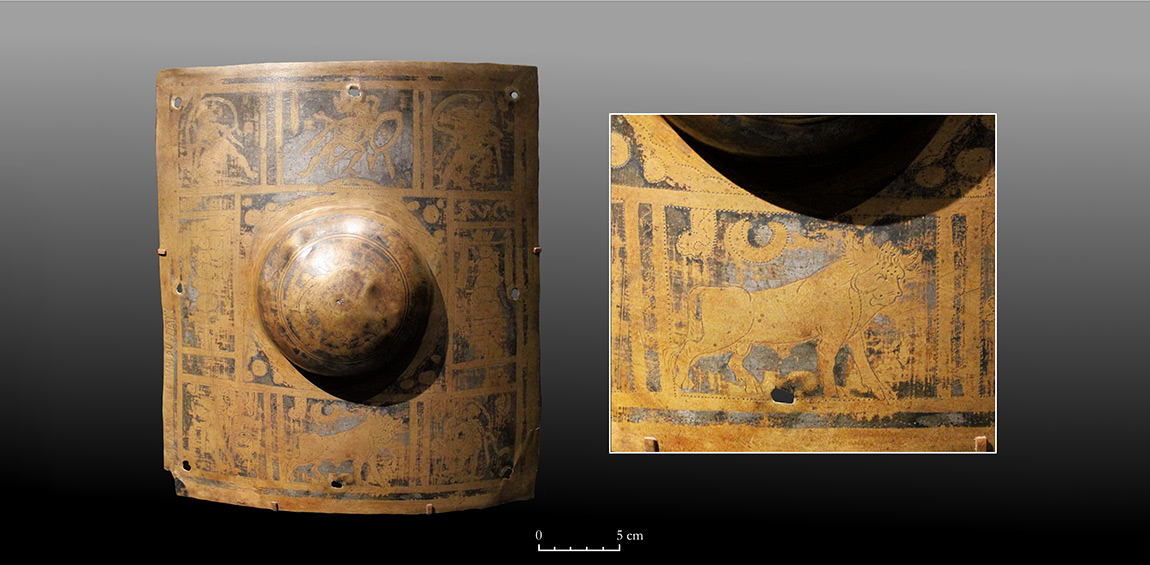
This form of partial tinning is particularly common on armour pieces often referred to in German as Paraderüstung, or parade armour (See Figure 1). These items are characterised by their elaborate decoration and frequently include embossed motifs with military themes (Garbsch, 1978; Schamper, 2015; D'Amato and Negin, 2017). The long-held assumption that such armour was used only in parades or cavalry games has been increasingly questioned. These pieces are now often considered to have been part of functional battle equipment (e.g. Fischer, 2019, p.198; Guillaud, 2019, p.218). Partial tinning is also found on smoother pieces of equipment, not only on those with heavy embossing. A good example is a shield boss found in the River Tyne near South Shields in the United Kingdom (See Figure 2), where partial tinning was used to draw attention to more delicate punched and incised designs (Klumbach, 1966, pp.175-178).
Traditionally, scholars have hypothesised that tinning in the Roman period was achieved either by dipping an object into molten tin or by rubbing small quantities of tin onto the surface and spreading it with a cloth while still liquid. The latter method is generally considered the most plausible for this period (e.g. Giumlia-Mair, 2005, p.360; Sim and Kaminski, 2012, pp.72-74). Nevertheless, partial tinning is a more complex process that cannot be achieved using either of these methods alone. Although it is occasionally mentioned in modern literature in passing to describe certain artefacts (e.g. Klumbach, 1966, pp.175-178; Garbsch, 1984, p.241; Vujović, 2000, p.263), no real thought has ever been given to how it was applied or the techniques used to create it.
In some modern reconstructions (typically employing non-Roman techniques) tinning is applied only to recessed areas, such as the background, leaving the raised or embossed features untreated (e.g. Junkelmann, 1996). This approach uses the tinning to create a visual contrast, making the relief stand out by colour difference. Numerous examples of partially tinned armour confirm that this is indeed one possible application. Surviving artefacts reveal, however, that the original technique was considerably more sophisticated than these reconstructions or passing mentions suggest. Partial tinning was not merely confined to recessed areas to enhance relief but was also used independently as a decorative element. In many cases, tinning appears on raised or flat surfaces where it does not serve as a background contrast but instead functions as ornamentation in its own right. This decorative use of tinning, independent of relief, is particularly evident on smooth pieces of defensive equipment, such as the shield boss from the River Tyne (See Figure 2).
This selective application of tin represents a previously undocumented decorative technique that has long gone unnoticed, despite partial tinning being mentioned in scholarly literature for decades. Its recognition challenges existing assumptions about Roman tinning practices and opens new avenues for investigating decorative metalwork in the Roman world. This article presents the results of experimental research aimed at understanding how such partial tinning could have been achieved using techniques and materials available in the Roman period.
Ancient sources
As a starting point for the experimental approach, multiple ancient sources were consulted to look for possible information about how partial tinning was carried out. Although tinning is mentioned in several texts (e.g. Anonymous, The Leyden Papyrus X, 27 and 42; Pliny, Natural History, 34.48; Vitruvius, On Architecture, 7.12), none make any reference to partial tinning, leaving the specific method entirely undocumented in the literary record. Unlike other sources, Pliny hints at tinning particularly as a decorative technique and provides a detailed account worth citing. He compares it to silvering and gilding, practices which he criticises for their excessive use:
"A method discovered in the Gallic provinces is to plate bronze articles with white lead [i.e. tin] so as to make them almost indistinguishable from silver; articles thus treated are called incoctilia. Later they also proceeded in the town Alesia to plate with silver in a similar manner, particularly ornaments for horses and pack animals and yokes of oxen; the distinction of developing this method belongs to Bordeaux. Then they proceeded to decorate two-wheeled war-chariots, chaises and four-wheeled carriages in a similar manner, a luxurious practice that has now got to using not only silver but even gold statuettes, and it is now called good taste to subject to wear and tear on carriages ornaments that it was once thought extravagant to see on a goblet!"
(Natural History, 34.48.162-163)
Taken together, the classical sources confirm the practice of tinning but provide few technical details on how it was carried out. Notably, none of the sources mention partial tinning, leaving us without any literary evidence for how this specific technique may have been accomplished.
Masking off or painting on?
Hypothetically, partial tinning could have been achieved in two main ways. One possibility is that specific areas of the armour were masked off prior to tinning, thereby preventing the tin from adhering to those sections. Alternatively, the tin layer may have been applied selectively, perhaps by brushing or painting it onto chosen areas of the surface and then heated to attach it permanently. This could have been similar to the use of shell gold, which has been attested from the medieval period (Eastaugh, et al., 2004, p.260). Both approaches, masking off and painting on, would have allowed for deliberate control over the decorative effect, enabling craftsmen to highlight or contrast particular features of the design.
To determine which of the two methods is supported by the physical evidence, a detailed analysis was conducted on a Roman chest plate from Mušov, Czech Republic (See Figure 3). Dating to the second half of the 2nd century AD, this artefact would have formed one of a pair used in armour designed to protect the upper torso. Discovered in the 1970s, the chest plate has been frequently featured in publications on the Roman army (e.g. Tejral, 1986, p.398; Bishop and Coulston, 2006, p.139). The presence of tinning, however, went unrecognised until 2023, when the piece was re-examined to assess its condition and features. Close inspection revealed faint traces of partial tinning, particularly along the lower edge (See Figure 4). Much of the original tinning had been visually erased due to surface damage, leaving remnants visible only in isolated areas.
To determine the full extent of the partial tinning and evaluate whether it had been applied by masking or painting, the entire chest plate was subjected to micro-XRF (X-ray fluorescence) mapping analysis. This is a non-destructive analytical technique that measures the elemental composition distribution of a surface with high spatial precision (up to 50 µm). It enables the detection of even faint or invisible traces of metal coatings, such as tin, that are no longer visible to the naked eye. The analysis was carried out at Bruker Nano Analytics in Berlin, using an M6 Jetstream spectrometer (See Figure 5).
The micro-XRF analysis revealed the extent of the partial tinning applied to the Mušov chest plate, offering insights into both the tinned areas and those intentionally left uncovered (See Figures 6-7). The results indicate that the partial tinning was achieved by masking off the areas meant to remain untinned. Two clear features of the chest plate decoration support this conclusion. First, in several places the untinned lines intersect, and in some instances a brush stroke slightly oversteps the boundary of the intersecting line, suggesting a masking substance was applied to prevent tin adhesion (See Figure 7, bottom). Second, a mistake made by the craftsman at the top of the chest plate shows another intersection of untinned lines, which could only have been created through the application of a mask (See Figure 7, top). The Mušov chest plate thus demonstrates that partial tinning was achieved through masking and not by painting the tin selectively onto the surface. A reconstruction of how this chest plate would originally have looked like, is presented in Figure 8.
Experimental setup for tinning
The exact method the Romans used to mask off areas of objects they wanted to leave untinned remains unclear. To investigate this, a series of experiments were conducted based on two main hypotheses about how the masking could have been achieved. The first hypothesis suggests using oxidation, where an agent oxidises the parts of the object meant to remain untinned, preventing the tin from sticking. The second hypothesis involves mechanical masking by applying a substance to the surface of the artefact that prevents the tin from adhering during application. The experiments aimed to determine which of these two methods, mechanical masking or partial oxidation, produced results that most closely resembled the original decorative technique while also considering practical aspects of the chaîne opératoire.
The setup followed established practices for hand tinning (e.g. Fuller, 1833, pp.20-21; Flanders, 1900; Brown, 1913, pp.58-59) (See Figures 9-10). Brass sheets, 0.5 mm thick to match the Mušov chest plate, were used as the base material. Each sheet was thoroughly cleaned first by light rubbing with steel wool, followed by chemical cleaning with sulphuric acid (vitriol). Heating was provided by a gas camping stove fuelled with propane-butane, chosen for its ease of temperature control. Additional tests were later conducted using a small open-pit charcoal hearth (See Figure 11).
Pure tin was used, initially shaped from an ingot into thin, flat rectangles several square centimetres in size and approximately 1 mm thick. These pieces were large enough to cover the object but thin enough to melt quickly and evenly. Attempts to apply tin by rubbing a tin bar directly onto the surface proved less effective, as this disturbed the crisp lines created by oxidation or masking, sometimes removing them entirely and resulting in complete tinning. The larger, flat tin pieces minimised rubbing and helped preserve these details, making this application method preferable.
Once the tin melted, it was spread evenly over the surface using a wiping cloth. Traditionally, moleskin fabric is used, and experiments confirmed that a soft cloth with a moleskin texture made from natural fibres produced the best results.
A traditional flux, rosin made from pine resin and likely available to the Romans, was initially employed. Rosin is solid at room temperature and difficult to apply directly, so it was dissolved in alcohol, a practice still used today. The rosin flux presented two challenges, however; first, the mildly acidic rosin solution affected the masked or oxidised lines, causing their edges to lose sharpness. Excessive rubbing or wiping during tinning often blurred or erased these lines. Second, when heated, the rosin itself oxidised. Prolonged heating caused the resin to act not as a flux but as a mask, preventing tin from bonding altogether. These problems might be overcome with greater skill or a different flux type. Since the specific Roman flux is unknown and flux was not the focus of this study, the experiment switched to a modern flux/deoxidant called Lötwasser. This flux was carefully applied only to the areas intended for tinning, avoiding the masked or oxidised lines.
Based on these findings, the following procedure was established to test mechanical masking and local oxidation (See also Figures 16-17):
- Mechanical cleaning of the sheet metal with steel wool, followed by chemical cleaning using sulphuric acid.
- Application of mechanical masking material or oxidation agent to areas to remain untinned.
- Application of flux to areas to be tinned.
- Placement of tin pieces onto the surface of the object.
- Heating the sheet metal on a gas stove until the tin melts.
- Wiping the melted tin to spread it evenly and remove excess, avoiding rubbing on masked or oxidised areas.
- Once cooled, removal of the masking, loose tin or oxidation residue with steel wool.
The piece can then be optionally polished for a high shine. The contrast between polished brass and polished tin is moderate. Light oxidation of the brass, however, enhances colour contrast. Over time, untreated brass naturally tarnishes, further improving the visual distinction. To speed up this process during the experiments, liver of sulphur was used.
Neither author is an expert in tinning, and there was a noticeable learning curve when practicing general tinning (See Figure 12, real try-outs timeline from left to right). After approximately eight hours of practice, both were able to successfully tin objects, showing that the basic technique can be mastered with dedicated effort before moving on to more complex partial tinning.
Experiments with oxidation-based masking
As mentioned above, the oxidation agents were applied to the cleaned brass sheet before the flux was added to the untreated areas. Several substances were tested: two types vinegar, baking soda, carbonite soda, and liver of sulphur. While the first are plausible within a Roman context, liver of sulphur (though widely used today) is not known to have been available in the Roman period. Each agent was allowed to react with the brass surface for two hours, with the exception of liver of sulphur, which reacts much more rapidly.
Although liver of sulphur yielded the most promising results, even these proved unsatisfactory (See Figure 13). The main issue lies in the interaction between the oxidation layer and the subsequent application of flux. Even when flux is applied carefully alongside the oxidised area, it tends to encroach upon and degrade the oxidation. This effect is further compounded during the tinning process: once molten, the tin must be wiped across the surface, and this wiping action inevitably spreads the flux into the oxidised zones, effectively erasing the intended mask. Given the relatively better performance of liver of sulphur, further tests were conducted to refine its use, specifically by adjusting the concentration and reaction time. It was found that an exposure of about 30 seconds produced the best results. This proved long enough to create a clear visual boundary, but not so long as to form a oxidation crust. Such crusts proved problematic, as they allowed flux to seep underneath, making them unreliable for masking purposes.
In conclusion, while liver of sulphur produced the clearest effect among the agents tested, even these results fall short of replicating the crisp masking observed in Roman examples of partial tinning. The inherent purpose of flux is to remove oxidation to allow the tin to bond, making the use of oxidation for masking fundamentally problematic. Although further experimentation with alternative agents may prove worthwhile, the available evidence suggests that partial tinning was unlikely to have been achieved through oxidation-based masking.
Experiments with mechanically applied masking
A variety of materials were tested for their potential to mask specific areas during the tinning process. These included carbon powder in water, haematite powder in water, clay slip, honey, sugar water, milk, egg yolk, and egg white (See Figure 14).
Carbon, haematite, and clay slip performed poorly. Once dry, these substances could be wiped away with a simple touch, making them unsuitable for masking. Honey and sugar water also proved ineffective. When the brass sheet was heated for tinning, the water in both substances began to boil and spread uncontrollably, forming amorphous blobs and losing any clear definition.
Somewhat better results were achieved with milk, and particularly with egg yolk and egg white, although even these were unable to fully withstand the effects of flux and the mechanical action of wiping molten tin across the surface. To improve their resistance, these three substances were subjected to an additional step: after application to the brass sheet, but before applying the flux, they were heated to "bake" them onto the surface. This method significantly improved their adherence and durability. Of the three, egg white performed best and was therefore subsequently tested on a larger surface to assess its effectiveness with a more complex masking pattern (See Figure 15). While not flawless, it came closest to replicating the crisp masking seen on Roman examples of partial tinning.
In conclusion, mechanical masking using organic materials such as milk or egg, with egg white showing the most promise, can provide a viable method for achieving partial tinning when heat-treated prior to flux application. However, the results remain inferior to those observed on archaeological artefacts. Even the baked egg white occasionally failed to withstand the flux and subsequent wiping. This could undoubtedly be improved, at least in part, through the authors' increasing proficiency with time.
From egg white to masking with egg glaire
Since the best results were achieved using egg white, this prompted further exploration. One of the authors is an avid bookbinder, and in bookbinding, refined egg white is often used as a heat-activated adhesive for gold tooling, that is applying decorations and lettering in gold leaf to the leather cover of a book (Cockerell, 1971, pp.198-200; Middleton, 1992; Mitchell, 1995, pp.52-54). It can also be used to gild the edges of pages (e.g. Mitchell, 1993, p.22; Geraty, 2004). This refined form of egg white is known as egg glaire, a term that comes from Old French and ultimately derives from the Latin clarus, meaning 'clear'. It entered the vocabulary through the verb clarificare, meaning 'to clarify'.
Although there are several methods for preparing egg glaire, they all follow the same basic principle: the egg white is beaten into a stiff foam, which is then left to rest overnight. During this time, it separates into a clear liquid that settles at the bottom (the glaire) and a solid foam that is discarded. We used this same method to prepare the egg glaire for our experiment.
The tests comparing unprocessed egg white to egg glaire showed a clear advantage for the latter. Egg glaire proved significantly more resistant to rubbing and wiping during the tinning process, making it more suitable for this type of application. Figures 16 and 17 show the complete chaîne opératoire of partial tinning using egg glaire, demonstrated on a larger surface with a complex pattern.
Several trials using egg glaire revealed key variables influencing its effectiveness. First, application was found to be more consistent using a simple wooden stick rather than a brush. Brushes tended to remove too much of the substance, resulting in an overly thin layer. In contrast, a stick allowed for a more even and controlled application (Fig 16.3). The width of the stick's tip could be adjusted to produce lines of varying thickness.
Second, heating proved critical to the performance of the glaire. Prior to heating the glaire is transparent and difficult to see (See Figure 16.4). As a heat-activated glue, its adhesive properties are only fully realised through proper thermal processing. Optimal results were achieved when the glaire was heated to a medium to dark brown colour (Fig 16.5-6). If heated too briefly, the layer lacked resistance to wiping; if overheated, it became brittle and more prone to flaking under pressure during wiping.
Once the desired colour was achieved and the glaire allowed to cool, flux was selectively applied to the areas intended for tinning (See Figure 16.7). The entire object was then reheated to generate the temperature needed to melt the tin, which could then be wiped across the surface (See Figure 16.8-9). After tinning, the object was left to cool and then lightly scrubbed to remove any remaining glaire and to polish the finished surface. Interestingly, although some masked areas received a thin coating of tin, the egg glaire beneath remained intact and could be removed without difficulty during scrubbing (See Figure 17.1-2). Finally, the object was then trimmed to its final shape (See Figure 17.3-4), As mentioned above, over time the artefact will develop a light oxidation layer, further enhancing the contrast between the tinned and untinned brass areas. Liver of sulphur was applied to expedite this natural process (See Figure 17.5-6).
The results achieved using egg glaire as a masking agent came closest to replicating the effects observed on Roman artefacts. While the quality of our tinning did not fully match that of the archaeological examples, this is likely due to the technical demands of the process rather than limitations of the method itself. With increased experience and skill, it seems plausible that partial tinning using egg glaire could produce results comparable to those seen on Roman objects.
Conclusions
It has been hypothesised that parts of an object meant to remain untinned were masked either through oxidation or mechanical methods. The experiments using oxidation, however, yielded unsatisfactory results. Although oxidation could offer some masking effect, it failed to withstand the acidity of the flux required for successful tinning. It also proved too fragile to endure the additional rubbing needed to distribute the molten tin evenly across the surface. These findings suggest that oxidation was unlikely to have been the method used by the Romans for partial tinning.
In contrast, better results were achieved using mechanical masking agents, although the effectiveness varied significantly depending on the material. Some agents were removed with minimal friction and did not withstand rubbing, while others became unstable when heated and failed to maintain clean boundaries. The most successful results were obtained using egg white, especially in its refined form as egg glaire, which proved to be the most likely candidate for how partial tinning was carried out in the Roman period (See Figure 18).
In addition to the experimental results, several other factors support the use of egg white or egg glaire. First, eggs were readily available in the Roman world. Second, both egg whites and yolks were used as binders for pigments in paint production during this period, as is evidenced by scientific examination of ancient paints (e.g. Scott, et al., 2009; Tamburini, et al., 2014; Delaney, et al., 2017). Masking during partial tinning is essentially a form of painting, though in this case, a 'negative' painting, where areas are protected rather than coloured. Finally, the transparency of egg glaire may explain errors such as the one observed on the Mušov chest plate. Since it is difficult to see once applied, it is easy to overlook areas that have already been masked.
Discussion
It is important to keep in mind that experimental archaeology can demonstrate how something could have been done, but not necessarily how it was done. While the experiments showed that using egg glaire as a masking agent best replicated the appearance of the partially tinned archaeological artefacts, this remains only one possible explanation. Other techniques, possibly still unknown or untested, might have produced similar results.
Furthermore, egg glaire is not mentioned in any ancient written sources, casting doubt on whether it was used or even known during the period in question. The earliest references to egg glaire (refined egg white clarified by beating) appear only in medieval texts, typically in the context of gilding or manuscript illumination (e.g. Anonymous, Liber Illuministarum, 43; Cennino Cennini, Il Libro dell'Arte, 10 and 131; Theophilus, The Various Arts, 23 and 29).
Nonetheless, ancient written sources do confirm that egg white was used as a binding agent, for example in paints, also confirmed by scientific analysis mentioned above (Pliny, Natural History, 35.46) and is even particularly referred to as a binder for paint to create golden letters (Anonymous, The Leyden Papyrus X, 58, 63 and 74). The Romans were evidently aware of its adhesive properties, particularly in gilding practices, where it served a similar function to its use in later bookbinding. Pliny, for instance, notes that while proper gilding should employ quicksilver (mercury), some fraudulent gilders used liquid egg white instead (Natural History, 33.32.103-104). He also advises egg white as a medium for gilding marble (Natural History, 33.20.64).
The association between gilding a copper alloy object with egg white, whether refined into glaire or not, and using it for partial tinning on copper alloy artefacts requires only a small conceptual shift and is, therefore, not implausible. In light of this, while ancient sources do not confirm the use of egg glaire, it remains a plausible hypothesis for partial tinning grounded in known Roman practices and deserving of further investigation.
Acknowledgements
We are grateful to Bruker Nano Analytics, Berlin, especially Mareike Gerken and Roald Tagle, for the micro-XRF analysis of the artefact.
Funding statement
This work was supported by the Czech Science Foundation under grant 24-11397S (Warfare as a catalyst of innovation: The evolution of Roman armour during the Middle Roman period through the lens of the Marcomannic Wars), and by the AV21 Strategy programme ‘The Power of Objects: Materiality between Past and Future’ (project: Identification of the production, wear, damage processes and deterioration of protohistoric armour using comparative archaeological and technological analysis and the study of the physical properties of materials).
Country
- Czech Republic
- United Kingdom
Bibliography
Bishop, M.C. and Coulston, J.C.N., 2006. Roman military equipment: From the Punic Wars to the fall of Rome. Oxford: Oxbow Books.
Brown, W.N., 1913. A handbook on japanning for ironware, tinware, wood, etc with sections on tinplating and galvanizing. London: Scott, Greenwood and Son.
Cockerell, D., 1971. Bookbinding, and the care of books. London: Sir Isaac Pitman and Sons Ltd.
D'Amato, R. and Negin, A.E., 2017. Decorated Roman armour: From the age of the kings to the death of Justinian the Great. Yorkshire: Frontline Books.
Delaney, J.K., Dooley, K.A., Radpour, R. and Kakoulli, I., 2017. Macroscale multimodal imaging reveals ancient painting production technology and the vogue in Greco-Roman Egypt. Scientific Reports, 7, 15509.
Eastaugh, N., Walsh, V., Chaplin, T. and Siddall, R., 2004. Pigment compendium: A Dictionary of historical pigments. Oxford: Elsevier.
Fischer, T., 2019. Army of the Roman emperors: Archaeology and history. Oxford: Oxbow Books.
Flanders, W.T., 1900. Galvanizing and tinning: A practical treatise on coating with tin and zinc, with a special chapter on tinning gray iron castings. New York: D. Williams company.
Fuller, J., 1833. Art of coppersmithing: A practical treatise on working sheet copper into all forms. New York: D. Williams company.
Garbsch, J., 1978. Römische Paraderüstungen. München: C.H. Beck'sche Verlagsbuchhandlung.
Garbsch, J., 1984. Ein römisches Paradekettenhemd von Bertoldsheim, Ldkr. Neuberg-Schrotenhausen. Neuburger Kollektaneenblatt, 136, pp.239-253.
Geraty, P., 2004. Edge gilding and edge coloring of books. Providence, Rhode Island: Guild of Worker's 24th Standards of Excellence Seminar.
Giumlia-Mair, A., 2005. Tin rich layers on ancient copper based objects. Surface Engineering, 21(5-6), pp.359-367.
Guillaud, L., 2019. Militaria de Lugdunum: Étude de l'armement romain et de l'equipement militaire à Lyon (Ier s. av. - IVe s. ap. J.-C.). Drémil Lafage: Éditions Mergoil.
Junkelmann, M., 1996. Reiter wie Statuen aus Erz. Mainz am Rhein: Verlag Philipp von Zabern.
Klumbach, H., 1966. Drei römische Schildbuckel aus Mainz. Jahrbuch des Römisch-Germanischen Zentralmuseums Mainz, 13, pp.165-189.
Middleton, B.C., 1992. The gold tooling of books. Interdisciplinary Science Reviews, 17(4), pp.343-348.
Mitchell, K., 1993. Edge decoration. Five Oaks: The Standing Press.
Mitchell, K., 1995. An introduction to gold finishing. Five Oaks: The Standing Press.
Schamper, J., 2015. Studien zu Paraderüstungsteilen und anderen verzierten Waffen der römischen Kaiserzeit. Rahden: Verlag Marie Leidorf GmbH.
Scott, D.A., Warmlander, S., Mazurek, J. and Quirke, S., 2009. Examination of some pigments, grounds and media from Egyptian cartonnage fragments in the Petrie Museum, University College London. Journal of Archaeological Science, 36(3), pp.923-932.
Sim, D. and Kaminski, J., 2012. Roman imperial armour: The production of Early Imperial military armour. Oxford: Oxbow Books.
Tamburini, D., Łucejko, J.J., Modugno, F., Colombini, M.P., Pallecchi, P. and Giachi, G., 2014. Microscopic techniques (LM, SEM) and a multi-analytical approach (EDX, FTIR, GC/MS, Py-GC/MS) to characterise the decoration technique of the wooden ceiling of the House of the Telephus Relief in Herculaneum (Italy). Microchemical Journal, 116, pp.7-14.
Tejral, J., 1986. Neue Erkenntnisse zum römischen Stützpunt am Burgstall bei Mušov in Südmähren. Archeologické rozhledy, 38, pp.395-410, 463-466.
Vujović, M.B., 2000. O paradnom oklopu iz Ritopeka - Pohvala vernosti ili Carmen Saliare. Singidunum, 2, pp.255-264.
Classical sources
Anonymous, Der 'Liber Illuministarum' aus Kloster Tegernsee. Edited and translated by A. Bartl, C. Krekel, M. Lautenschlager and D. Oltrogge, 2005. Stuttgart: Franz Steiner Verlag.
Anonymous. The Leyden and Stockholm papyri. Greco-Egyptian chemical documents from the early 4th century AD. Translated by E.R. Caley, 2008. Cincinnati: University of Cincinnati.
Cennino Cennini, Il Libro dell'Arte: Volume 2: The craftsman's handbook. Translated by D.V. Thompson, 1933. New Haven: Yale University Press.
Pliny, Natural History, vol. 9. Edited and translated by H. Rackham, 1952. London: The Loeb Classical Library.
Theophilus, The Various Arts. Translated by C.R. Dodwell, 1961. London: Thomas Nelson and Sons Ltd.
Vitruvius, On Architecture, vol. 2. Edited and translated by F.S. Granger, 1962. London: The Loeb Classical Library.