
The content is published under Creative Commons Attribution 4.0 International license (CC BY 4.0).
Reviewed Article:
The Neolithic Snowshoe from Gurgler Joch (Italy) - Reproduction and Usage
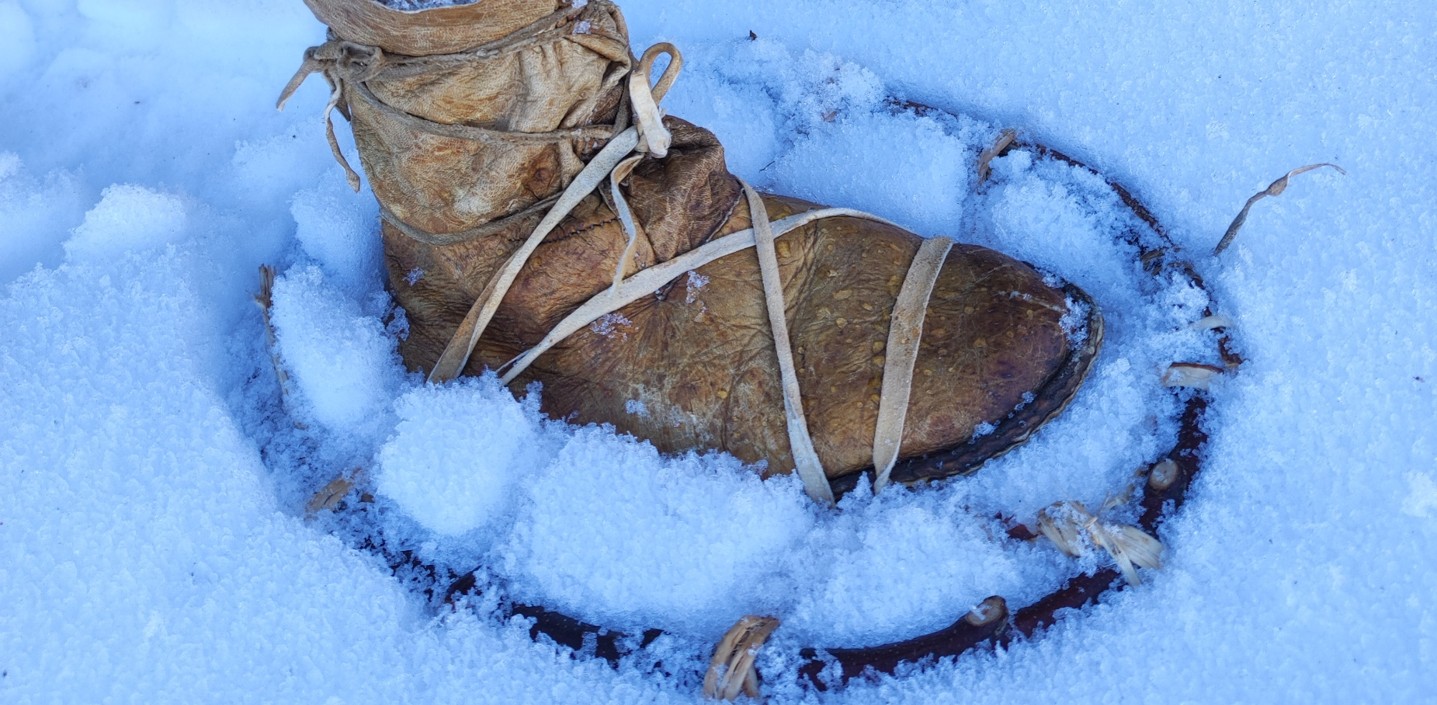
The Archaeological Museum of Southern Tyrol (Italy) houses an object identified as a snowshoe. This wooden artifact has been dated to the late Neolithic. It is made from bent and twisted birch (Betula) branches. Experimental reconstruction of the object sheds light on its mode of manufacture and the tools involved. Furthermore, experimental usage offers insights into its practicability and placement within the wider context of Neolithic material culture.
Introduction
During land surveys in 2003 on the Gurgler Ice Pass (3,134 m above sea level) in the ÖtztalAlps of Tyrol (Italy), a wooden object was found by a hiker. It was years before the item cameinto the possession of the Institute of Archaeology in Bolzano, where it was scientificallyexamined in 2015. Radiocarbon dating revealed that the object originates from the late Neolithicperiod. It is dated to about 3800-3700 B.C. (Steiner, Marzoli and Oeggl, 2016, p.451), therebypredating the Iceman complex by 500-600 years. The Gurgler Pass is located only about 13kilometres from the Tisenjoch Pass, where the Iceman was discovered in 1992.
The oval-shaped object was referred to as a snowshoe or snow-hoop. This well-preserved object is considered a significant find, as it is presented to the public as the oldest snowshoe in the world (See Figure 1). The identification of the object as a snowshoe is based on its location in the snowy heights of the mountains as well as on morphological analogies. It shows a pronounced similarity to almost identical historical snowshoes from the Alpine region, as well as other areas. Nevertheless, it should be mentioned that the object might have served a totally different purpose. Ethnography features comparable rounded hooped and interlaced objects serving purposes such as trays, game hoops or parts of transportation devices (Culin, 1975, p. 441-525; Miles, 1963, p.223; see Wied, 1975, p.16).
Through reconstruction attempts by the author, questions regarding the production and use of such wooden objects were investigated. In particular, the choice of material, the method of manufacture, the production time and the necessary tools were examined in more detail. Furthermore, the practicality as a snowshoe with regard to snow conditions, durability, and wearing comfort was explored.
The Snowshoe from Gurgler-Joch – A Description
The following is the most complete and detailed description of the object, as summarized by Steiner, Marzoli and Oeggl (2016, p.447-449) in their paper. For an English translation by the author see below.
Für die Herstellung des Schneereifens verwendete man einen rund 1,5 m langen Birkenast, der am dicken Ende eine maximale Stärke von 1,7 cm besitzt. Seitenäste wurden z. T. abgerissen, z. T. präzise abgetrennt.. Das dicke Ende erscheint schräg abgehackt. Dieser Teil ist auf einer Länge von 27 cm auf die Hälfte verjüngt. Der Ast wurde anschließend zu einer runden Form gebogen und beide Enden in den Ring eingeflochten. Dieser Verschlussteil umfasst rund ein Drittel des Gesamtumfanges. Durch die Halbierung des dicken Astendes wurde die Biegsamkeit dieses Teiles deutlich verbessert. Nun fügt sich das dicke Astteil besser in die runde Form ein, gleichzeitig wird die Stärke des Gesamtringes regelmäßiger.
Das dünne Ende des Astes wurde um den Rahmen geschlungen, um ein Öffnen des Ringes zu verhindern. Zusätzlich wurde der Verschlussteil mit einem der Länge nach gespaltenen Birkenast um wickelt. Der rundovale Schneereif hatte ursprünglich einen Durchmesser von ca. 29 cm × 32 cm, im heutigen Zustand ist ein Teil im Bereich des Verschlusses nach außen geknickt. Um den Holzring als Schneereif tauglich zu machen, wurde das Innere mit Strängen bespannt: Als Binde material verwendete man wiederum Birkenzweige, die der Länge nach gespalten wurden. Zwei Stränge wurden im Bereich des Verschlusses angebracht, die zudem verhinderten, dass sich der Ring öffnen konnte. Diese wurden in Form einer einfachen Schlinge mit zulaufendem Auge am Rahmen befestigt. Damit konnte der Strang festgezogen und optimal verankert werden. Am gegenüberliegenden Teil des Rahmens befindet sich ein weiterer, ebenso durch eine Schlinge befestigter Strang. Darüber hinaus blieb ein Querstrang wiederum aus Birkenholz durchgehend erhalten: An einer Seite wurde er mittels Schlinge am Rahmen befestigt und festgezogen. An der gegenüberliegenden Seite wurde er um den Rahmen geschlagen und anschließend mehrfach um die eigene Achse gewickelt, um ein Lösen zu verhindern. Aufgrund der ovalen Form sowie aus praktischen Erwägungen ist davon auszugehen, dass der Verschlussteil des Schneeschuhs an der Rückseite lag. Zudem gibt die ovale Form vor, dass ursprünglich drei Querstreben vorhanden waren. Der durchgehende Strang war in der Mitte des Reifens fixiert. Die Position eines weiteren wird durch kennzeichnende Abdrücke am Rahmen im vorderen Drittel markiert. In diesem Bereich sind auch deutliche Abnutzungsspuren am Rahmen zu be obachten. Die beiden im Bereich des Verschlusses befestigten Stränge blieben in ihrer originalen Position erhalten. In der Umwicklung sind noch Reste der Rinde zu erkennen. Diese dürfte ursprünglich zur Gänzevorhanden gewesen sein. Vermutlich ist sie infolge der Nutzung des Schneereifens und durch die Lagerung abgefallen. Der Schneereif war aller Wahrscheinlichkeit nach mit zwei Längs und wohl drei Quersträngen ausgestattet.
For the production of the snowshoe, a birch branch approximately 1.5 m long was used, which has a maximum thickness of 1.7 cm at the thick end. Side branches were partly torn off, partly precisely cut off. The thick end appears to have been chopped off at an angle. This part has been thinned down for a length of approximately 27 centimetres. The branch was then bent into a round shape, and the ends twisted into the hoop. This enclosure section comprises approximately one-third of the total circumference. By whittling down the thick end of the branch, flexibility was significantly improved. The thicker branch section now fit better into the round shape, while simultaneously making the overall thickness of the ring more consistent.
The thin end of the branch was looped around the frame to prevent the ring from opening. Additionally, the closure area was wrapped with a birch branch split lengthwise. The oval snow hoop originally measured approximately 29 cm x 32 cm; in its current state, a section near the closure is bent outwards. To make the wooden hoop suitable as a snowshoe, the interior was strung with cross pieces. Birch branches, split lengthwise, were used again for this purpose. Two cross ties were attached around the closure, which also prevented the ring from opening. These were fastened to the frame in the form of a simple loop with a narrowing eye. This allowed the pieces to be tightened and optimally anchored. On the opposite part of the frame, there is another cross piece, also fastened with a loop. In addition, another cross piece of birch wood was retained perpendicular to the others. On one side, it was attached to the frame with a loop and tightened. On the opposite side, it was wrapped around the frame and then wound multiple times around its own axis to prevent it from coming loose. Due to the oval shape and practical considerations, it can be assumed that the fastening part of the snowshoe was located at the back. In addition, the oval shape indicates that there were originally three crossbars. The continuous strand was fixed in the middle of the frame. The position of another is marked by characteristic impressions on the frame in the front third. In this area, there are also noticeable wear marks on the frame. The two strands attached near the fastening remained in their original position. In the wrapped areas, remnants of the bark can still be seen. This was likely originally present in its entirety. Presumably, it fell off due to the use of the snowshoe or during storage. The snowshoe was most likely equipped with two longitudinal strands and probably three cross strands.
The Reconstructions
The primary source of information for the reconstructions was the above-cited paper, which includes several detailed photographs of the snowshoe. Furthermore, the author was able to have a look at the object in person during a visit to the Bozen Museum of Archaeology (See Figures 2 and 3). Comparative material regarding historical wooden snowshoes of similar construction from various geographical regions like Norway and southern Germany was used (Gaaren, 2014; Steiner, Marzoli and Oeggl, 2016, p.455; Pilø, 2020). Ethnographic sources, primarily from North America, as well as impressions from the contemporary bushcraft scene, provided further valuable insights (Boas and Teit, 1996, p.73; Grunde, 2015; Kochanski, 2008; Lyford, 1945, pp.62-64; Miles, 1963, p.223; Woodhead, 1995; Mason, 1896, p.388-411; Steiner, Marzoli and Oeggl, 2016, p.455). Regarding choice of material, the following can be postulated: The object from Gurgler Joch is constructed from wood well suited for the purpose. According to master basket makers Gaby and Roland Witt (Witt, 2024, birch is preferred for stable and load-bearing constructions over other materials used for general weaving work, such as willow. Additionally, in contemporary Europe, birch can still be found at higher alpine elevations of up to 2200 meters, as compared to willow (1400 meters) or other plants which could provide correspondingly resilient shoots, such as ash or dogwood (Rudow, 2024). In this context, it can only be speculated whether the snowshoe was originally manufactured at lower elevations or higher up in the mountains when conditions called for its use.
In the context of this paper, three sets of snow hoops were manufactured. The first was to be regarded as a test run to get familiar with the materials and production process. The second pair was to be made to the original dimensions using materials gathered in early summer. A third pair was manufactured to be used experimentally, therefore it was made slightly larger to accommodate the increase in body size since the Neolithic. In this case, material was collected in winter (mid-February). With regard to the seasonality of the material, no significant difference in workability could be detected.
The Tools Used
It is unknown what kind of tools were used to create the object from Gurgler Joch. The authors Steiner, Marzoli, and Oeggl believe they could detect chopping, tearing, precise cutting, as well as splitting processes on the object (see quote above). Nevertheless, no systematic examination of the mentioned manufacturing marks has been carried out. Therefore, the author decided, according to his personal experience and in correspondence with Neolithic tool typology, what tools to use for manufacture.
It became evident during the three reconstruction attempts that only a minimal set of tools was required to create artifacts comparable to the Gurgler Joch object. As a matter of fact, similar objects can be produced using no tools at all. In the first reconstruction attempt, the following tools were used: a lightweight adze with a head made from ground stone; one blade of Baltic flint, with a laterally retouched working edge and a bone awl. Awls are often used during weaving and basket work but are also associated specifically with the manufacture of snowshoes in subarctic North America (Woodhead, 1995, p.88) (See Figure 5).
From the experience of this first replication experiment, the tool arsenal for the two subsequent reconstructions was reduced accordingly. The adze was discarded first and the bone awl was replaced with an ad hoc manufactured pointed stick.
An interesting topic which came up spontaneously during manufacture relates to the use of teeth as an aid in crafting. The non-masticating function of human dentition as a third hand, to improve pliability or give a corresponding bending direction, is archaeologically and ethnologically well documented (Klinger, Teegen and Schultz, 2008; Merbs, 1983, p.145; Molnar, 2011; Morrison and Germain, 1995, p.61). It proved very helpful during crafting. However, the examination by Steiner, Marzoli, and Ögel does not indicate manufacturing marks suggesting such manipulation, so this topic remains speculative.
Manufacture of the Base Hoop
While searching for the appropriate raw materials, it became evident that mature and large birch trees generally do not provide branches of the necessary dimensions within easy reach as they often grow high above the ground. Therefore, very young trees proved particularly suitable in regard to accessibility of branches of the required length and diameter. Likewise, sprouting saplings also pose a viable choice, with the slender trunk itself being usable for the base hoop. A single young tree can be sufficient to provide the materials needed for the manufacture of a pair of snow hoops. In total, seven branches are necessary for one hoop (See Figure 6). A sapling or branch for the base hoop is quickly cut with the adze or the retouched flint blade and freed from side shoots, followed by the tapering of the thicker end according to the dimensions mentioned above.
To bend the hoop into shape, it can be helpful to find a tree trunk of suitable diameter, around which the branch is bent by laying it over the trunk, thereby pre-bending it. This can help to prevent unwanted breakage. Once the desired diameter of the hoop is established, the thinner end is now wrapped around the overlapping area, closing the hoop and securely locking it.
During the replication experiments, it became apparent that sufficiently long pieces that allow for exact replications of the original are not readily found. Nevertheless, a hoop can quickly be manufactured from shorter sticks if using a different locking method. Therefore, it seems likely that the archaeologically existing object is the result of a basic construction pattern with a certain range of tolerances and variations. This argument is also supported by comparative data from ethology, showing that occasionally similar hoops were constructed without prior thinning of the thicker end (Harrington, 1911, Fig.63, p.46; Mason, 1996, Plate 21, p.411). Materials were gathered in June and subsequently in February in the author’s immediate surroundings in southern Germany at about 600m elevation. All branches were used immediately after harvesting.
Insertion of the Longitudinal and Transversal Strands
According to the above description of the object, the strands interwoven into the hoop are also made from birch twigs. Six branches are needed per snowshoe for weaving. Of the only completely preserved strand, it is said:
"On one side it was attached to the frame using a loop and tightened. On the opposite side, it was thrown around the frame and then wound several times around its own axis to prevent it from coming loose."
No information regarding the dimensions of these intertwined twigs is given; therefore, measurements were judged in accordance with the photographs. Twigs measuring 7-11 millimetres at the thicker ends were chosen for this purpose.
Before use, these thin branches or twigs are split by hand starting from the thicker end. No tools are necessary for this, as they are simply pulled apart by hand. Nevertheless, patience and a steady hand are required to keep them from shearing off to one side. (See Figure 7). When inserting the strands, care needs to be taken to keep the halved branches from snapping, splintering or breaking during the many bending processes, as the material is subjected to a lot of stress at this stage. This challenge naturally calls for the use of teeth to pre-shape the material to facilitate tight fitting. It would be advisable to examine the original for corresponding production marks (See Figure 8). When inserting the longitudinal and transverse strands, it does not seem necessary to follow a specific order (See Figure 9).
To ensure optimal stability of the overall structure, it is necessary to interweave the strands at their crossing points rather than just placing them over each other (See Figure 10). For this purpose, a small pointed tool (awl or twig) is helpful to push apart tightly locking material. This interlocking at the crossing points cannot be observed in the original but is visible in the modern snowshoe rims from South Tyrol and Norway and corresponds to snowshoes that are strung with rope or cord. (Steiner, Marzoni and Oeggl, 2016, See Figure 7).
To submit the technical quality of the reconstruction to professional scrutiny, the most successful reconstruction (No. 2) was submitted to a professional basket weaver (Basket Weaving Master Workshop Gabi and Roland Witt Freiburg i. Br.). The Witt couple confirmed that it was a reasonably solid execution, which they themselves could not perform any better. Thus, this reconstruction was also selected for practical use (See Figure 11, 12, and 13).
Total Manufacturing Time
From the time the required material is collected, approximately 40 minutes are required to manufacture a pair of base hoops. Another 80 minutes are required to attach the strands filling the hoop. Therefore, approximately two hours are required to build a pair of snow hoops similar to the Gurgler Joch find. These times are averages based on the production of three pairs of snow hoops. Attaching a binding is not included in these times.
Using the Snow Hoops
The principle of snowshoes is to spread the wearer´s weight over a larger surface, thus enabling him to walk on top of the snow rather than sinking in with each step.
With regard to the experimental use of the reconstructed snow hoops, the following can be postulated. On the original, no binding was preserved which would hint at the way in which the hoop was connected to the foot during use. Thus, an experimental solution had to be found. Similar wooden snowshoes of more recent indigenous origin are most often fixed to the foot using some kind of leather strap binding (Mason, 1889, 388-404). It can be assumed that the hoop was firmly attached to both the instep or toes and the heel to ensure the most secure hold (See Figure 15). The snowshoe is thus lifted completely off the ground with each step. (Gaaren, 2014)
This contrasts with the binding method of larger and more elongated oval snowshoes, in which only the toe area is connected to the snowshoe, similar to cross-country skis, whereby only the front part of the snowshoe is lifted while walking, and the back end is allowed to drop and drag over the ground (See Figure 17).
To securely fix the reproductions to the foot, simple leather thongs were used. During use, it became apparent, that a construction like the Gurgler Joch object is not suitable for walking when large amounts of powdery snow are on the ground. Due to their small diameter and the large open spaces between the interlaced strands, buoyancy is minimal. It would be possible to adapt the hoop design to these conditions by reducing the size of the mesh by adding additional interlacing material. Gaaren reports similarly shaped snowshoes from Norway that, due to their small size and coarse-meshed weaving, provide little buoyancy but facilitate walking on crusty and compacted snow and, due to their small size, are particularly suitable for steep terrain (Gaaren, 2014). The round-oval shape corresponds in a certain way to the so-called Bear Paw snowshoes of North America, which are particularly suitable for walking in dense forests and hilly and uneven bushland. They allow for good manoeuvrability and ease in overcoming obstacles. (Woodhead, 1995, p.88; Gillpatrik, 2010, p.4.)
The small size and light weight of the hoops make walking with them very easy and natural after a short period of getting used to them. They also provide improved traction and grip on icy and compacted ground, especially when walking uphill. Their morphology also makes for unobstructive packing and carrying when not in use.
With regard to the general use of snowshoes, it needs to be kept in mind that their dimensions need to correspond to the body weight of the user to work properly (Gilpatrick 2010, p.8). This aspect needs to be kept in mind when testing reproductions of the Gurgler Joch find. Humans in the Neolithic period were smaller on average and lighter than humans today (Egg and Spindler, 1992, p.27; Marciniak, 2022). The Iceman, for example, being approximately 1.60 cm in height, corresponds quite well to the average of his time. He weighed around 50-60 kg when alive and had a shoe size of 38 (continental) (Zink and Maixner, 2021, p.15; Ruf, 2006; Egg and Spindler, 1992, p.27; 2009, p.72; South Tyrolean Museum of Archaeology, n.d.). The author weighs 75 kg and has a shoe size of 45 (continental) (See Figure 16).
Once the finished snowshoes are allowed to dry for an extended period, such as in enclosed rooms, by the fire, or in the sun, the shrinkage of the wood results in some joints loosening and knots potentially coming undone. It is therefore likely that such objects were stored in a damp state to avoid this kind of damage.
Conclusion and Discussion
The construction of objects similar to the Gurgler Joch find can be achieved with minimal technical effort. Based on the authors’ extensive experience in experimental Stone Age craft practices, it can be argued that the manufacture of artefacts such as the Gurgler Joch find did not require specialist knowledge. It can be assumed that the skills required were within the general scope of manual skills and material knowledge of the time.
The rather rustic appearance of the object, with the bark not being removed, for example (Steiner, Marzoli and Oeggl, 2016, p.448), as well as the overall design, including the short time necessary for production, could point to an object created ad hoc for a specific situation. Of course, this remains speculative, but ethnographic accounts and the contemporary survival scene indicate the use of twigs and branches to form disposable emergency snowshoes when the situation calls for such a solution (Boas and Teit, 1996, p. 73; Lyford, 1945, p. 64; Kochanski, 2008; Hafner, 2015). From an experimental perspective, the object from Gurgler Joch can be regarded as a functional snowshoe.
Country
- Italy
Bibliography
Boas, F. and Teit, J., 1996. Coeur D’Alene, Flathead and Okanogan Indians . Fairfield: Ye Galleon Press.
Culin, S., 1975. Games of the North American Indians . New York: Dover Publications.
Egg, M. and Spindler, K., 1992. Die Gletschermumie vom Ende der Steinzeit aus den Ötztaler Alpen Jahrbuch des Römisch-Germanischen Zerntralmuseums , 39. Jahrgang, Teil 1.p. 3-100. 2009. Kleidung und Ausrüstung der Kupferzeitlichen Gletschermumie aus den Ötztaler Alpen . Monographien des Römisch-Germanischen Zentralmuseums. Band 77
Gaaren, T., 2014. Traditional Norwegian Snowshoes . Available at <http://livingprimitively.com/2014/01/traditional-norwegian-snowshoes/>…; [Accessed 14 April 2024]
Gillpatrick, G., 2010. Building wooden Snowshoes and Snowshoe Furniture . East Petersburg: Fox Chapel Publishing.
Grunde., 2015. In Praise of the Humble Withy, Available at <https://bushcraftuk.com/community/threads/in-praise-of-the-humble-withy…; [Accessed 18 April 2026]
Hafner, A., 2015. Schnidejoch und Lötschenpass. Archäologische Forschungen in den Berner Alpen . Band 2.
Harrington, M. R., 1911. Snowshoes. The Museum Journal II , no. 4, pp. 82-94.
Klinger, S., Teegen, W. and Schultz, M. 2008. Teeth as Tools in an Early Neolithic Population from Central Germany . Project Dental Anthropology. Poster. Institute for Prehistory and Protohistory, University of Leipzig
Kochanski, M., 2008. Sticks as Tools and Implements . [DVD]. Karamat Wilderness Ways.
Lyford, C.A., 1945 . Iroquois Crafts . Washington D.C.: Bureau of Indian Affairs. Division of Education.
Mason, O.T., 1896. Primitive Travel and Transportation. Report of the U.S. National Museum, pp. 237-593.
Marciniak, S. Bergey, C.M., Silva, A.M. and Perry, G.H., 2022. An integrative skeletal and paleogenomic analysis of stature variation suggests relatively reduced health for early European farmers. Proceedings of the National Academy of Sciences . htttps://doi.org/10.1073/pnas.2106743119
Merbs, C. F., 1983. Patterns of activity-induced pathology in a Canadian Inuit population. national museum of man mercury series , Archaeological Survey of Canada , Paper No.119. Ottawa: National Museums of Canada.
Miles, C., 1963. Indian and Eskimo Artifacts of North America . New York: Bonanza Books.
Molnar P., 2011. Extramasticatory dental wear reflecting habitual behavior and health in past populations. Clin Oral Investig . 15(5): pp. 681-9. doi: 10.1007/s00784-010-0447-1. Epub 2010 Aug 13. PMID: 20706752.
Morrison, D. and Germain, G., 1995. Inuit – Glimpses of an Arctic Past . Quebec: Canadian Museum of Civilization.
Pilø, Lars. 2020, The Hunt for the Lost Mountain Pass. https://secretsoftheice.com/news/2020/04/16/mountain-pass/ ; accessed 17. November 2026
Rudow, A., 2024. Dendrologie Artenportraits. Morphologische und ökologische Eigenschaften der Gehölzarten Mitteleuropas. Hrsg. Dendrologie und Vegetationskunde , Professur für Waldökologie, ETH Zürich. 197 S.
Ruf, C., Holt, B.M., Sládek, V., Berner, M., Murphy Jr, W.A., zur Nedden, D., Seidler, HG. and Recheis. W., 2006. Body size, body proportions, and mobility in the Tyrolean Iceman. Journal of Human Evolution 51(1):91-101. DOI:10.1016/j.jhevol.2006.02.001
Siegmund, F., 2010. Die Körpergröße der Menschen in der Ur- und Frühgeschichte Mitteleuropas und ein Vergleich ihrer anthropologischen Schätzmethoden . Books on Demand, Norderstedt , S, 81, Tab. 38.
South Tyrolean Museum of Archaeology, n.d. The Body . [online] Available at: < https://www.iceman.it/en/oetzi/the-body > [Accessed 15 April 2026]
Steiner, H., Marzoli, C. and Oeggl, K., 2016. Ein jungsteinzeitlicher Schneereif vom Gurgler Eisjoch (3134 m) im Pfossental / Schnals (Südtirol ). Archäologisches Korrespondenzblatt 46. pp.445-463.
Woodhead, H. ed., 1995. Hunters of the Northern Forests. Time Life Books
Witt, G. and R., Birch Hoop Reconstruction (Personal communication, 5. March 2024)
Zink, A., and Maixner, F., 2021. Ötzi- Noch immer voller Rätzel. In Gletscherarchäologie. Archäologie in Deutschland . Sonderheft. 2/2021. pp.14-21