

The content is published under Creative Commons Attribution 4.0 International license (CC BY 4.0).
Reviewed Article:
Split Pine Lath Technology: Experimental Replication of Mesolithic-Neolithic Laths used in Fishing Structures from the European and Central Russian Boreal Forest Zone
This experimental research investigates the production and functional interpretation of the refined split-pine lath technology employed in stationary fishing structures at Mesolithic and Neolithic wetland sites across the Boreal Forest, from Purkajasuo (Finland) to Zamostje 2 (Central Russia). Despite the prevalence of these highly technologically complex split pine laths, the tools and techniques required to make them at scale remain poorly understood. Through a framework of experimental replication informed by practitioner expertise and ethnographic parallels, this research challenges the previously proposed manufacturing model using 45° bevelled bone tools. Controlled experiments demonstrated that a more intuitive wedge-shaped tool and a technique of cleaving along natural growth rings achieved superior results. This intuitive method proved more parsimonious, requiring less skill and achieving a higher success rate with greater morphological parity to the archaeological examples. Furthermore, we argue that the exceptional uniform quality of the archaeological laths represents a technical surplus for simple fish fences, suggesting they served as components for complex basket traps. Our experimental production model furthers our understanding of wetland sites where split pine laths are present within the European and Russian Boreal Forest Zone by providing a new diagnostic tool for interpreting fragmented organic assemblages. Ultimately, this technology is presented as a stable, cross-regional response to the material constraints of the Boreal environment.
Introduction
Fishing formed a central component of Mesolithic and Neolithic subsistence strategies across north-west Europe and the boreal forest regions of Europe and Central Russia. Archaeological evidence from wetland environments demonstrates the widespread use of diverse fishing technologies, including leisters, hooks, nets, basket traps, and substantial stationary structures such as fish fences and weirs (See Table 1). These installations often represent considerable investments of labour and materials, implying that passive fishing structures were efficient, dependable, and repeatedly exploited within local subsistence systems.
| Site | Evidence | Reported Date | References |
| Skoklefald, Sweden | fish hooks | c.7050–6750 BP | Glørstad 2010, 73 |
| Tybrind Vig, Denmark | fish hooks, leisters, fishing structures | 7400-5900 BP | Andersen 2013 |
| Zamostje 2, Central Russia | Fish hooks, nets, traps, barbed points | c.7900-5500BP | Lozovski et al. 2013 |
| Ozerki 17, Central Russia | Fishing net | 8840-8830BP | Zhilin 2014, 100; 1996 |
| Rönneholms Mosse, Sweden | Notched points | 9054±47BP | Larsson et al. 2019 |
| Antrea, Finland | Fishing net | 9140±135BP | Miettinen et al. 2008 |
| Star Carr, UK | Barbed points | c.9200BP | Elliott and Little 2018 |
| Lake Lubāns, Latvia | Harpoon points | 10014±49-9780±38BP | Meadows et al. 2014 |
Table 1: Examples of sites with archaeological evidence of fishing technologies
Fishing structures were constructed using long, straight, and highly uniform split pine laths at a number of Mesolithic and Neolithic wetland sites (See Table 2). Archaeological examples from sites such as Zamostje 2 in Central Russia and Purkajasuo in Finland show notable consistency in width, thickness, and length, frequently exceeding one metre. At Zamostje 2, the laths were a maximum of 2.5 m long, between 1-2 cm in width and 0.5 cm thick (Lozovski, et al., 2013, p.61). At Purkajasuo, the laths are reported as being between 0.6-2.8 m long and on average 2 cm wide and 12 mm thick (Koivisto, 2012, p.32). Whilst they are slightly thicker at Purkajasuo, this is not significantly so; dimensionally and functionally, there is remarkable parity between the two sets. The discrepancy could also be because the Purkajasuo dimensions are averages of all the laths found, whereas the measurements from Zamostje 2 are specifically from the fish trap basket laths. In any case, the precision and regularity of these elements indicate a high level of technical control and practical understanding of raw materials. However, despite the frequency with which these laths occur in the archaeological record, the techniques and tools used to produce them remain insufficiently explored.
| Site | Reported Date | References |
| Sārnate, Latvia | 4365-2850 cal BC | Bērziņš 2008 |
| Purkajasuo, Finland | 3934-2679 cal BC | Koivunen and Viljanmaa, 2004; Koivisto 2012 |
| Zamostje 2, Central Russia | c.7900-5500BP | Lozovski et al. 2013 |
| Zvidze, Latvia | 6535±60-6350±60BP | Lozovski 1999, 139; Koiviso 2012, 39 |
| Sventoji, Lithuania | 3110- 2930 cal BC | Lozovski 1999, 140; Piličiauskas et al. 2019, 124; Piličiauskas et al. 2025 |
| Sakhtish, Central Russia | Late Neolithic | Lozovski 1999, 142 |
| Järvensuo, Finland | 3330-2460 cal BC (?) | Koivisto 2021, 18, 21 |
Table 2: Examples of archaeological sites with split pine lath technology
Previous experimental work has attempted to replicate split pine laths using specific archaeological tool forms, most notably 45° bevelled bone tools proposed for use at Zamostje 2 (Maigrot, et al., 2013). While such studies provide valuable insights, they offer limited published evidence demonstrating that these methods can reliably reproduce the dimensions, uniformity, and finish observed in archaeological examples. As a result, there remains a methodological gap between the recognised sophistication of the archaeological material and experimentally tested models of production.
This gap is well suited to investigation through experimental archaeology. Understanding how split pine laths could have been manufactured has direct implications for interpretations of labour investment, skill, material selection, and technical decision-making in wetland fishing communities. Furthermore, experimentally grounded insights into production methods can assist in the interpretation of sites where fishing structures are fragmentary or where basket traps themselves are not preserved.
This paper presents a programme of experimental work designed to explore how split pine laths of the type documented archaeologically could have been produced in practice. The study evaluates a previously proposed manufacturing method alongside an alternative approach developed through hands-on experimentation and informed by green woodworking experience and ethnographic parallels. Both methods were assessed in terms of their ability to consistently and efficiently produce laths comparable to archaeological examples.
The results of this experimental work are applied to the interpretation of the Purkajasuo wetland site in Finland, with comparative reference to Zamostje 2. Of particular interest at Purkajasuo is the presence of exceptionally uniform laths alongside larger and more rudimentary split-pine fencing (Koivisto, 2012, p.32; Groom, Kirby and Findlay, 2018). This technical discrepancy could be indicative of alternative functions for the more refined laths that have previously not been much explored. Although the two sites are geographically and temporally distant, the close technological similarities between these assemblages provide an opportunity to examine whether comparable environmental conditions and functional requirements may have encouraged similar practical solutions. By focusing on experimental replication and process-based evaluation, this study aims to contribute to broader discussions of prehistoric fishing technology and craft practices in boreal wetland environments. Ultimately, this study proposes a parsimonious model for a technology that likely represents a common, efficient response to environmental constraints across vast temporal and geographic distances.
The primary aim of this study is to investigate how the highly uniform split pine laths documented in Mesolithic and Neolithic wetland fishing structures could have been manufactured in practice.
Specifically, the experimental work seeks to:
- Test previously proposed lath-production methods by practically replicating them and assessing their suitability for producing pine laths comparable to archaeological examples in terms of dimensions, regularity, and finish.
- Develop and evaluate an alternative production method informed by hands-on green woodworking experience and ethnographic parallels, to establish whether a more reliable, repeatable, and materially efficient approach exists.
- Assess experimental outcomes against archaeological criteria, including dimensional consistency, production reliability, tool durability, and failure rates, rather than against pre-defined tool typologies.
- Apply experimental results to archaeological interpretation, particularly in relation to the Purkajasuo site, to explore how manufacturing processes may inform understanding of fishing structures where direct evidence is incomplete or fragmentary.
By focusing on practical replication and process-based evaluation, this study aims to clarify the technological requirements involved in split pine lath production and to contribute experimentally grounded insights into prehistoric wetland fishing practices.
Site Background and Material Evidence
The primary purpose of this research is to identify how the split pine laths seen in the archaeological record could have been made, and in so doing, to further our understanding of the Purkajasuo site and other wetland sites where such laths have been identified (See Table 2).
To evaluate the split pine lath technology experimentally, the archaeological examples had to be scrutinised to establish morphological features and characteristic dimensions. This section examines the evidence from the primary study site of Purkajasuo, Finland, and draws on Zamostje 2, Central Russia, for comparison. Whilst the sites are temporally and geographically distant, the split pine lath technology is almost identical and may represent technological stasis and environmental determinism.
Purkajasuo, Finland
The Purkajasuo wetland archaeological site, excavated in the late 1990s and early 2000s, yielded exceptionally well-preserved wooden pine artifacts of international significance (Koivunen and Viljanmaa, 2004). At the time of habitation (3934-2679 cal BC), the site would have been a shallow coastal river estuary, c.1m deep and brackish (Koivisto, 2012, p.30; Karinen, 2000, pp.67-69). The pollen data indicate the most common tree species were pine and birch at that time (Karinen, 2000). Large quantities of the split pine laths were recovered in the submerged layers; many were loose, but others were part of complex fish fence panels (Koivunen and Viljanmaa, 2004; Koivisto, 2012). Tragically, only a few of the original examples survive due to a cleaning error in the conservation labs at the University of Oulu (Viljanmaa, 2025, pers. comm.).
Aside from the examples already noted by Koivisto (2012, p.32) in the introduction, one example was examined at the Kierikki Stone Age Centre (See Figure 1). Approximate measurements of this are c.186 cm long, c.1.5-2 cm wide, and c.1 cm thick. It may display some signs of possible bindings (See Figure 1b). It also appears to be split longitudinally from a single straight-grained pine log with very few knots, probably split down the growth rings to achieve the desired thickness. From the drawings and pictures of the fish fences, the other examples that have not been preserved often exhibit similar dimensions, certainly in thickness and width (Koivunen and Viljanmaa, 2004).
Zamostje 2, Central Russia
Zamostje 2, dating broadly to the Late Mesolithic and Neolithic, is a well-documented riverine archaeological site in Central Russia that has exceptional organic preservation and stationary fishing structures (e.g. Lozovski, et al., 2013). Again, pine and birch were abundantly available raw materials, according to the pollen record (Ershova, 2013, pp.189-190).
Examples of conical basket fish traps, radiocarbon dated to 5615-5468 сalBC and 5483-5331 сal BC have been found there in the context of broader fishing structures, exhibiting split pine laths up to 2.5 m long, 1-2 cm wide, 0.5 cm thick, made of pine and spruce (Lozovski, et al., 2013, pp.51-69). Not only are these amongst some of the best preserved, but also some of the most extensively documented and analysed (e.g. Lozovski, et al., 2013; Lozovski and Lozovskaya, 2016; Conte, et al., 2016).
Comparison of the Sites and Evidence
While separated geographically and temporally, the striking morphological similarities between the laths from Zamostje 2 and Purkajasuo suggest comparable functional and material constraints, warranting experimental investigation into whether similar production methods could independently emerge in such environments. Both sites were situated in a similar environment during their occupation; firstly, the Boreal forest provided similar raw materials, crucially Pinus sylvestris, and secondly, the extensive permanent fishing structures at both sites are indicative of shallow water fishing playing a crucial role in the subsistence strategies (Koivisto, 2012, pp.42-3; Lovoski, et al., 2013, p.21; Koivisto and Nurminen, 2015, p.68). Therefore, to some extent, the raw material and the targeting of fish in Northern Forest wetland environments predetermined the types of fishing structures that would be built.
If an efficient model of trapping fish using split pine lath stationary fishing structures was discovered as early as the Mesolithic at Zamostje 2, it is plausible that there was no need for this technology to evolve over thousands of years if it reliably provided fish. Thus, Zamostje 2 is not being applied as a “sister site” here, but rather as a more archaeologically complete and better analysed technological key. It remains entirely plausible that the split pine lath technology essentially peaked during the Mesolithic. This could help explain the morphological similarities between the two sites.
At both the sites studied, fishing technologies, including trapping, were being employed in shallow water (Lozovski, et al., 2013, p.25; Koivisto and Nurminen, 2015, p.68). Therefore, if the material requirements of the fishing structures were essentially the same at both sites, it follows that the pine lath splitting technology may represent convergent evolution. Simply put, given the overlap in environment, subsistence strategy, and material availability, the split pine lath technology was an inevitable outcome of different people groups trying to overcome the same problems.
At Purkajasuo, despite less extensive excavation and poorer post-excavation processes, the split pine laths are still present in large quantities (Koivunen and Viljanmaa, 2004; Koivisto, 2012). Therefore, even though there are surviving archaeological examples of fish fences from Purkajasuo, it is plausible that under the unexcavated area, there may in fact also be fish trap baskets as seen at Zamostje 2. Due to the morphological parity of the laths at the two sites, this seems a likely scenario. Especially if one considers that the Purkajasuo laths arguably technologically far exceed the needs of a simple fish fence, as is demonstrated, for example, by the far rougher versions that have also been found and previously experimentally replicated by Groom, Kirby and Findlay (2018).
In essence, the function of fishing structures in Northern wetland environments is universal, and thus the technology had no need to evolve. This may represent a stable technological complex rather than an unlikely direct cultural link over thousands of kilometres and years.
Methodology and Materials
The experimental programme presented here was designed as a controlled, practice-based investigation into the manufacture of split pine laths, rather than an attempt to reconstruct a single definitive prehistoric technique. The methods tested and developed were grounded in archaeological dimensions, raw material constraints, and use contexts derived from the archaeological record, while allowing for informed practitioner decision-making during the splitting process.
The experiments prioritised process, repeatability, and material response over tool typology, and were evaluated against explicitly defined archaeological criteria rather than modern standards of efficiency or finish. Variation arising from wood quality, grain structure, and localised weaknesses was treated as an intrinsic component of the experiment rather than as experimental noise. Failed attempts, tool breakage, and loss of control were therefore documented and considered analytically meaningful.
The use of modern tools was restricted to clearly defined preparatory stages and applied consistently across all experiments. Their role was explicitly separated from the experimental variables under investigation. As such, the results are not presented as proofs of specific archaeological tool use, nor as evidence for direct cultural transmission between sites, but as experimentally supported demonstrations of plausible manufacturing processes under comparable environmental and material constraints, intended to contribute replicable and transparent data to broader discussions of prehistoric wetland fishing technologies.
Overview of the Experimental Approach
The research followed a three-stage methodology combining literature review, experimental replication, and interpretative analysis.
First, a review of archaeological literature was undertaken to identify sites where split pine lath technology had been documented, with particular focus on well-preserved wetland assemblages dating to the Mesolithic and Neolithic in the European and Central Russian boreal forest zone. This review established the characteristic dimensions, materials, and use contexts of the laths, supplemented by ethnographic data and informed selection of comparative case studies.
Second, a programme of controlled experimental work was designed and carried out to replicate the manufacture of split pine laths. A previously proposed production model and an alternative experimental method, informed by ethnography and the practitioner’s woodworking experience, were tested using the same raw material and under comparable conditions.
Finally, the experimental results were evaluated against the archaeological evidence and applied to the interpretation of the Purkajasuo site, with comparative reference to Zamostje 2.
Experimental Design and Criteria for Success
The central objective of the experimental work was to determine whether split pine laths of the type observed archaeologically could be produced consistently and efficiently using realistically achievable tools and techniques. Despite our experience as practitioners, the exquisite craftsmanship of the archaeological laths presented a significant replication challenge, necessitating an intuitive experimental approach.
Experimental success was assessed using the following criteria, derived directly from the archaeological material:
- Dimensional accuracy: laths were evaluated on their ability to match the length, width, and thickness ranges observed archaeologically.
- Uniformity and regularity: successful laths exhibited consistent thickness and straightness along their length.
- Repeatability: the method needed to produce comparable results across multiple attempts.
- Material and tool failure rates: a low rate of lath breakage and tool damage indicated success. recorded.
- Level of skill required: methods were evaluated in terms of control, effort, and reliance on skilled manipulation. A low degree of difficulty and the skill required indicated success.
Prior to testing specific tool typologies, a pilot study was conducted using modern tools (axe and knife). This served as a feasibility test to confirm that the material and our skill set were theoretically capable of producing replica pine laths that matched the archaeological examples. This approach prioritised the quality and reliability of the finished laths rather than adherence to specific tool types.
Materials
All experimental laths were produced from Scots pine (Pinus sylvestris), selected to match the species identified in the archaeological assemblages from Purkajasuo and Zamostje 2. A straight-grained, relatively knot-free pine trunk was chosen to reflect the material properties implied by the archaeological laths. The log measured approximately 304 cm in length, tapering from 14 cm to 9 cm in diameter, and was worked while still green.
Tools
Two main tool types were used during the experiments (See Figure 2):
- 45° bevelled bone splitting tools replicated based on examples from Zamostje 2 and interpretations proposed by Maigrot, et al., (2013). These were manufactured from elk (Alces alces) leg bone using modern tools due to time constraints. While not exact replicas of archaeological tools, the material and form were considered suitable for testing the proposed tool concept.
- Alternative bone wedge-shaped splitting tools, developed intuitively during experimentation to better suit the task of controlled longitudinal splitting along growth rings.
Modern tools, including an axe and wooden wedges, were used to initially quarter the log. Their use was limited to preparatory stages and clearly documented to distinguish them from the experimental splitting phase.
Overview of the Lath Production Method
The successful lath production method was established in a brief pilot study. This consistent sequence was followed across all the experiments and used to evaluate the different tool types and tested against previously proposed lath production models.
The main steps of producing a split pine lath can be seen in Figure 3. The pine log was first split lengthwise into quarters by exploiting natural weaknesses in the end grain and growth ring structure. Wedges were used to initiate and extend splits along the length of the log. Once quartered, the heartwood was separated from the sapwood layer by inserting wedge-shaped tools between growth rings. This technique mirrors the traditional method used in Finnish pine splint basketry for blank production and is similar to ethnographic lath production in North America (Alix, 2007, p.386; Anon., 2023).
Individual lath blanks were then carefully split longitudinally from the sapwood, primarily by hand, following the initial separation. Throughout this stage, tactile feedback played a critical role in maintaining control and preventing lateral breakage. At this stage, practitioner experience is paramount to gauge the material's response; while the laths are longitudinally strong, they remain laterally vulnerable, especially when encountering grain irregularities or knots.
This sequence reliably and consistently produced split pine laths that were morphologically and dimensionally identical to the archaeological examples from Purkajasuo and Zamostje 2. All stages of the process were recorded through notes and photographs, including tool wear, breakage, and variation in lath quality.
Application to Archaeological Interpretation
Experimental results were compared directly with archaeological laths from Purkajasuo and published data from Zamostje 2. Attention was given to morphological similarities, manufacturing traces, and the implications of production reliability for large-scale construction of fishing structures. Rather than seeking to identify specific tool types in the archaeological record, this study treats manufacturing technique and material behaviour as primary interpretative factors, consistent with EXARC’s emphasis on practice-led experimental archaeology.
Results and Discussion
Once the techniques had been perfected by the practitioners, it was possible to produce split pine laths that achieved morphological parity with the archaeological examples from the Purkajasuo and Zamostje 2 sites. It was found to be possible to replicate the dimensions and uniformity of the laths consistently and to experimentally identify the most parsimonious production method and tool type.
Experimentally splitting Laths according to Maigrot, et al., (2013)
Initially, an attempt was made to follow the production method according to Maigrot et al. (2013, pp.135-9). This involved using the 45° bevelled tools to chisel two parallel grooves longitudinally down the length of the halved pine log (See Figure 4). However, immediately, problems were encountered with the tool type. Contrary to Maigrot, et al., (2013, p.135), the tools were found to be relatively poor for grooving, and one snapped almost immediately, due to the force of the blows necessary to achieve a groove (See Figure 5). Therefore, upon encountering a breakage, a new 45° bevelled tool had to be made to continue the work and to determine whether the previous tool had been defective.
From these results, it was observed that, while the 45° bevelled tool type was technically functional for grooving and carving, it proved ineffective for inducing a split; possibly because a shallower bevel angle would be more effective at splitting the wood grain apart. In addition, unless there are many spare tools on hand, a breakage is a significant inconvenience, as either regrinding or a whole new tool is required before production can continue. Tools breaking regularly, and the breakage patterns matching the archaeological examples at Zamostje 2, were also observed by Maigrot, et al., (2013, p.135).
Based on the success of the methodology we established in the pilot study, it was decided that the parallel groove technique employed by Maigrot, et al., (2013) probably would work, but appeared to be far less efficient than the splitting technique we employed, which was ethnographically informed by Finnish split pine basket makers (Anon., 2023).
Therefore, it was decided to see if the 45° bevelled tool type could be employed according to our methodology. The new tool was found to be slightly better for grooving the end grain of the log, which eventually resulted in a split (See Figure 6). It was found to be a laborious technique when compared to the pilot study results. Maigrot, et al., (2013, p.135) note that the correct material choice is vital for success. This was considered, however this is unlikely to have been the cause of our difficulty, as suitable pine laths from the material were achieved in the pilot study.
Up until this point, the experiments had been carried out solely by CW, but it was decided to give the 45° tool type to PG, an experienced green woodworker. The sole instruction given was to attempt to produce the split pine laths, using intuition and experience to determine the method.
Instinctively, PG applied the tool as a wedge to the end grain of the log and soon caused a longitudinal split (See Figure 7). Once the split had been started with the bone tool, it was possible to widen it with the addition of wooden wedges and split the halved log into quarters (See Figure 8). Whilst this method did work with the tool type, it was observed that it made a relatively poor splitting wedge, as the 45° bevel encouraged runout (See Figure 9). This was more pronounced when the split had to be more accurate, e.g. when splitting out the heartwood, or when getting the split started on the sapwood laths.
Due to the nature of the tool, the process for the removal of the heartwood was laborious. In order to induce the split between the growth rings, a row of accurate indentations had to be made (See Figure 10). However, once the heartwood had been removed, the tool proved adequate to start the longitudinal splits required for splitting off individual laths from the sapwood. It should be noted at this point, however, that for splitting individual laths apart, most of the work was done without the use of a tool. Once the split had been started, this was primarily done by hand and using a series of levering actions, to feel how the wood responded to the forces being applied to it (See Figure 11).
Functionally, the tool type was a moderate success, as it was possible to produce seven laths that replicated the archaeological counterparts relatively well (See Figure 12). They were c.155 cm long, 12-30 mm in width, and 8-12 mm thick. However, it was an awkward and cumbersome tool to use for the job and required much skill and accuracy to successfully produce suitable pine laths.
Applying Woodworking Experience and Experimental Intuition to Split Laths
Based on the mixed results of Maigrot, et al., (2013), the ethnographic evidence (Anon., 2023) and the researcher’s prior experience (e.g. Groom, et al., 2018), it was speculated that the efficiency, consistency and success rate of pine lath production could be improved further. This was explored through intuitive experimentation, letting the end product dictate the method and tool selection, as opposed to the other way around. Thus, the tool and method were, in a sense, hypothetical, but solely designed for optimum and reliable pine lath production.
The hypothetical bone splitting tool differed from the 45° bevelled Zamostje 2 type tools studied by Maigrot et al. (2013) in two key ways (See Figure 2). Firstly, the primary bevel had a far shallower angle, perhaps 10° and secondly, that 10° bevel ran the width of the chisel end. Our hypothetical chisel represented more traditional splitting geometry, whereas the 45° bevel more closely resembled the geometry of a skew chisel.
The hypothetical bone splitting chisel we designed was based intuitively on what chisel head shape would be best suited to splitting. The much narrower angle allowed the bevel to effectively split the wood fibres along the grain. This meant the half log could be quartered with relative ease by getting the split started with the chisel and then employing wooden wedges to widen the split (See Figure 13).
Similarly, the chisel proved effective at removing the heartwood, with a small number of precise hits, from the quarters by accurately splitting down the growth rings (See Figure 14). The butt end of the chisel did fracture due to repeated blows, but initially, this did not affect the tool’s performance (See Figure 15).
Due to its thin wedge shape, the tool type also proved serviceable for splitting the growth rings of the sapwood apart to achieve the desired thickness of the laths (See Figure 16). Again, at this point, the tool became more of a “split-initiator” to effectively split nine pine laths from the sapwood that matched the archaeological dimensions. The width was a maximum of 25 mm and the thickness no more than 15 mm, typically falling into a range of 10-20 mm wide, 8-12 mm thick and c.155 cm in length.
The tool tip did break after significant use, and an attempt to regrind the remainder of the chisel was made, but it is likely there were pre-existing weaknesses that caused it to promptly fracture longitudinally a second time (See Figure 17). Therefore, a new, slightly smaller tool was ground with the same bevel geometry as the first, and this one proved effective for the remainder of the experiments.
In summary, this tool type was highly effective at initiating all the longitudinal splitting necessary to produce pine laths efficiently and consistently and to a uniformity that matched the archaeological counterparts.
Comparison of the Tool Types and Methods
The two experimental tool types had drastically different splitting geometry (See Figure 2). Overall, it was far easier to produce consistent, uniform split pine laths using the intuitively designed tool when compared with the 45° bevelled Zamostje 2 type tool.
Although the researchers managed to manufacture suitable pine laths using the 45° bevelled tool type, it was broadly felt that it was an unsuitable splitting tool, due to the high angle on the primary bevel. The intuitively designed tool proved to be far better at splitting apart the wood fibres, due to its shallower bevel angle and narrower profile overall. Consequently, this meant less force was required when battoning the tool, which may extend tool life.
Whilst time was not recorded during the production process, it was felt that the 45° bevelled tools were less efficient, as splitting had to be initiated by first creating a number of notches; this contributed to it appearing to be a far more laborious tool to use.
Furthermore, the tool devised during this research was easier to apply with greater accuracy, as the tool had to be hit with less force to enact a split. The shallower bevel angle meant the tool was less likely to cause unpredictable runout to the side. Therefore, it required less skill to produce the pine laths using the intuitively designed tool.
As per Maigrot, et al., (2013, p.138), it was found that the 45° bevelled tools could be used to help lever individual pine laths apart (See Figure 11a). However, to enact any kind of split with this tool type, a groove or a line of indentations had to be made first (See Figures 6 and 10).
Interestingly, the breakage rates of the tools were the same (n=2) during the experiments. They appeared to demonstrate similar breakage patterns as observed by Maigrot, et al., (2013). Given that the Zamostje 2 type tools had to be hit harder to enact splitting, it was expected that these would break more, but this was not found to be the case. The reasons for this are beyond the scope of this research. However, the sample sizes produced are not statistically significant enough to draw any firm conclusions.
Experience in splitting and material choice were found to be paramount in successful lath production regardless of tool type and method. The importance of selecting material that was straight-grained and with few knots was also noted in the previous experimental model and ethnographically (Alix, 2007, p.386; Maigrot, et al., 2013, p.135). To eliminate material bias, we used the same log for all our experiments. To eliminate skill biases introduced through practice, we alternated between the methods and tool types.
Overall, whilst it was possible to achieve pine laths with the 45° bevelled Zamostje 2 type tools that were morphologically similar to the archaeological examples studied, it was more efficient and consistent to produce these using our slightly adapted tool type and method, which was informed by the process used in Finnish pine baskets.
Discussion of the Tool Types and Methods
The experimental work specifically sought to further our understanding of the split pine lath production method, as this has not been suitably explored in the literature to date. One experimental production method, using the 45° bevelled bone tools, has been proposed by Maigrot, et al., (2013). However, reviewing the previous experimental work, it was not clear how successfully the uniform split pine laths replicated the archaeological examples. For example, no images of successful replicas were published. This means that the efficacy of the tool type and production method employed to achieve lath replicas that consistently match the archaeological record cannot be easily verified or replicated.
Through intuitive experimentation, we propose an alternative production method and tools. Previous experimental work proposes that the 45° Zamostje 2 type tools were used for woodworking, such as splitting, grooving and extracting pine laths (Maigrot, et al., 2013, pp.139-140). In light of our experiments, we agree that this tool type was likely for woodworking in terms of grooving and carving but propose that it seems unlikely it was used for splitting the pine laths, as it appears to possess the wrong geometry for this task. We tested both production methods and tool types and found our method to be more successful in consistently producing the split pine laths observed archaeologically.
Even though our tool does not appear to be represented archaeologically, its geometry could have easily been replicated in a wooden wedge, as is seen ethnographically (Alix, 2007, p.386). Therefore, preservation bias may be at play, or a more thorough review of the archaeological tool assemblages than was within the scope of this research may reveal such a tool.
We also found our method required less skill when compared to the previous model and had a lower failure rate in terms of pine laths. Specifically, the 45° angle frequently caused runout and was harder to control accurately, whereas our intuitive tool split more consistently and with less force required, which made breakages less likely. Further, from one half of a log, using the 45° Zamostje 2 type tool, we were able to produce seven successful laths, whilst using the intuitive tool, we were able to produce nine from the other half of the log (See Figure 18). The pictures reveal that our tool and method produced more consistent and uniform laths than were achievable with the experimental 45° bevelled tool.
Additionally, all of the replica laths fell within comparable measurements of the archaeological example from Purkajasuo that we measured (c.186 cm long, c.1.5-2 cm wide, and c.1 cm thick), and the Zamostje 2 examples, (up to 2.5 m long, 1-2 cm wide, 0.5 cm thick; Lozovski, et al., 2013, pp.51-69). While the same thickness in experimental lath was achieved with both tool types (8-12 mm), we were able to achieve a thinner width with our experimental tool type (10-20 mm), compared to the 45° bevelled tool type (12-30 mm). Therefore, by replicating and testing the previously proposed model, we experimentally determined a more reliable method.
A final point of note was that the use of the different tool types could actually be identified on the experimental replicas. While the 45° bevelled tool left a distinctive, rounded, crushed indentation, our tool type produced a cleaner longitudinal mark (See Figure 19). It may be that this is represented in the archaeological examples.
Overall, the experimental research challenges the previously proposed model through controlled experimentation. Not only were we able to demonstrate a more efficient method, but our experimental replicas more closely matched the archaeological examples in dimensions and quality than using the previously proposed model and tool type. We believe the success can be partially attributed to our tool’s geometry better exploiting the natural weaknesses in the wood. For example, the grain and the growth rings are probably more easily split apart by a narrower tool, leading to a higher success rate and more consistent laths, as can be seen in Figure 18.
Discussion of the Implications for Interpretation
The results of this experimental study further our understanding of wetland sites in the European and Central Russian boreal forest, where the split pine lath technology is prevalent, by providing tools for their interpretation.
At Zamostje 2 and Purkajasuo, the exceptional level of skill and craft required to produce the split pine laths has been noted in previous research (Koivisto and Nurminen, 2015, p.64; Lozovskaya and Lozovski, 2016, pp.67-72). As experienced woodworkers, the authors marvelled at the consistency and accuracy of the archaeological pine laths. Using this as our starting point, we sought to reverse-engineer the production process logically and intuitively. While previous models successfully identified the 45° Zamostje 2 tool type for general woodworking (Maigrot, et al., 2013), it does not logically follow that this specific tool was used for the highly specialised task of lath production.
In the previous section, we have established that our intuitively devised tool and method efficiently and consistently produced laths that match the archaeological record morphologically and dimensionally. Arguably, this makes it a more parsimonious method than the previously proposed model, as it achieves higher productivity with a lower skill requirement and less material waste. Therefore, we propose our method and tool type as the most likely model for how the laths were made at Purkajasuo, Zamostje 2 and other wetland sites in the region where the lath technology is present.
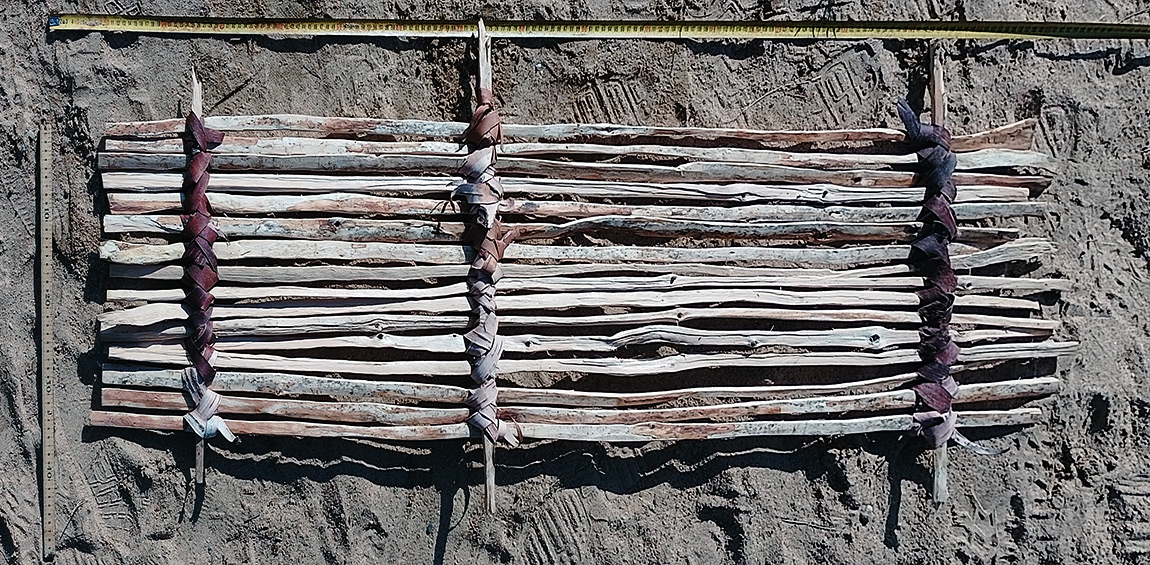
The physical properties of the laths themselves are important to consider when discussing their use. By splitting along the grain and growth rings, our method preserved the natural integrity of the material. Whilst the laths are individually longitudinally relatively strong, laterally they are vulnerable, especially if there is a weak point in the wood, such as a knot. However, when lashed in parallel with other laths and reinforced laterally, they form a strong and slightly flexible structure (See Figure 20). This is seen in the basket fish traps and fish fence panels at Zamostje 2 and Purkajasuo (Koivisto, 2012, p.32; Lozovski, et al., 2013;). Considering the labour involved to produce the thin, uniform split pine laths, it is perhaps surprising that they are merely used as fish fence panels at Purkajasuo. Arguably, it is not necessary to have such thin and delicate laths for use in weir systems. Indeed, at Purkajasuo, a rougher and larger lath type also appears to have been employed (Koivunen and Viljanmaa, 2004, p.66). An example of the larger laths can be seen at the Kierikki Stone Age Centre. Groom, Kirby and Findlay (2018) experimentally replicated this type by roughly splitting young pine trees and provided measurements: c.114 cm long and 3-4 cm wide. Clearly, at least two lath types were employed at Purkajasuo. Broader speculation as to why (e.g. for a more permanent weir structure, or because a stronger weir was required in a faster flowing part of the river) is beyond the scope of this research. The thinner, more uniform lath type we produced morphologically matches the type employed at Purkajasuo in fish screens (Koivunen and Viljanmaa, 2004, pp.68-74). However, this type closely resembles the laths at Zamostje 2, which were employed in fish trap baskets (Lozovski, et al., 2013). Therefore, the presence of these specific laths at Purkajasuo, despite the absence of intact baskets, strongly suggests they may have been part of the fishing structures at Purkajasuo. The possibility of fish trap baskets at Purkajasuo has also been previously contemplated by Koivisto (2012, p.41).
Several factors could explain why no fish trap baskets have been discovered at Purkajasuo. Firstly, due to a lack of funding, large areas of the site remain unexcavated and are in danger of degrading over the coming decades due to the land being drained (Koivunen and Viljanmaa, 2004, pp.22-3). Taphonomic and post excavation factors may also have played a role, as some of the wooden structures were so delicate they could not be excavated or preserved (Koivunen and Viljanmaa, 2004, p.66). Therefore, preservation biases may play a role. Additionally, a severe flood probably broke apart and scattered the fishing structures at Purkajasuo (Koivisto, 2012, p.23). Therefore, it appears that the Zamostje 2 site represents a more complete and intact site. Finally, perhaps the strongest archaeological indicator is the presence of other fishing technologies, such as leisters and net floats (Koivisto, 2012, p.41). Often, where fishing has been noted to play a significant role in subsistence, numerous fishing technologies are employed, for example, at Tybrind Vig in Denmark (Pickard and Bonsall, 2007). Therefore, arguably, it might be considered unusual to have stationary fishing structures and other technologies such as nets and leisters represented archaeologically, but not fish trap baskets.
Given that the split pine lath technology is temporally and geographically widespread throughout the region (See Table 2), this represents a standardised technological culture. As discussed in the background section, the technology may be the peak of passive fishing in European and Central Russian boreal environments. As it is probably the best way of trapping fish in slow moving water with stationary fishing structures made from split pine laths, this represents both environmental determinism and technological stasis. Alongside this, we propose our method and tool type as the optimal way to produce the split pine laths required. Overall, we believe the presence of pine laths on sites in the region with the same morphological signature as at Purkajasuo should be considered an interpretative indicator of basket fish traps, even in the absence of direct evidence. Finally, we believe our method to be the most likely manufacturing method at these sites, and that if morphologically similar tools are present, it is likely they were employed in pine lath production.
Conclusions
In conclusion, the experimental method and tools explored in this study represent a step forward in our understanding of the production of pine laths in NW European and Central Russian wetland contexts. Through intuitive experimentation, we identified a simple and efficient method to produce pine laths that match the archaeological examples from Purkajasuo and Zamostje 2. Therefore, we propose this as the most likely method for split pine lath production on the large scale required for the stationary fishing structures. These results are intended to provide methodological clarity to ongoing discussions of prehistoric woodworking, while remaining open to further testing, replication, and refinement by the wider research community.
Furthermore, this parsimonious model offers a more robust explanation than previously proposed experimental methods. By demonstrating higher productivity, lower skill requirements, and a superior success rate, our method suggests that this technology was a simple and highly refined tradition.
We have also furthered the discussion on this highly engineered and skilfully made pine lath type possibly being an indicator of more than fish fences. We argued that the quality and precision of the lath type far exceed the qualities necessary for a simple fish fence. Thus, we suggested they may be indicative of complex basketry, as is seen at Zamostje 2. Finally, we suggested that when these lath types are found in wetland contexts in the wider region, they may be indicative of complex fish trap basketry. Ultimately, this study argues that the refined splitting tradition represents a stable technological complex, a common, parsimonious solution to shared environmental and material constraints across the Boreal region. Therefore, we propose that when sites are encountered with less fortuitous preservation conditions than the sites examined in this paper, the presence of lath type alone may be indicative of complex fishing structures, including fish trap basketry.
Acknowledgements
The Mesolithic Resource Group would like to thank the Kierikki Stone Age Centre, Finland, for hosting this research project as part of a wider heritage education programme of workshops and demonstrations delivered under the 'Stone Age Survival Skills' initiative, which was funded by the European Union’s City of Culture Programme (Oulu 2026). Specifically, we would like to thank the director of the skills initiative Patrik Franzén and Sami Viljanmaa, along with all the other staff at Kierikki, who generously hosted us and greatly assisted with the delivery of our heritage education programme.
About Authors and Funding
This experimental project investigates the highly sophisticated pine lath technology used in basket fish traps and trapping structures found on wetland sites dating to the Mesolithic and Neolithic in the European and Central Russian Boreal Forest. Led by Chris Woodland (MA) and Peter Groom (PhD) of the Mesolithic Resource Group, the research draws on their wealth of experience in prehistoric fishing technologies and practical craft backgrounds. The programme was conducted during the Summer of 2025 at the Kierikki Stone Age Centre in Finland as part of the 'Stone Age Survival Skills' initiative. This work was delivered through a programme of heritage education and experimental archaeology funded by the European Union’s City of Culture Programme (Oulu 2026).
Keywords
Country
- Finland
- Russia
Bibliography
Alix, C., 2007. Ethnoarchéologie de la production des objets en bois dans l’Arctique nord-américain. [Ethnoarchaeology of the Production of Wooden Objects in the North American Arctic]. In: Beyries, S. and Vaté, V. (Eds). Les Civilisations du renne d’hier et d’aujourd’hui: approches ethnohistoriques, archéologiques, anthropologiques. [Reindeer Civilizations of Yesterday and Today: Ethnohistoritical, Archaeological, and Anthropological Approaches]. 27th International Meeting of Archaeology and History of Antibes. 2007. Antibes: APDCA Publishers. pp.377–391.
Andersen, S.H., 2013. Tybrind Vig: Submerged Mesolithic settlements in Denmark. Jysk Arkaeologisk Selskab.
Anon., 2023. Manufacture of pine splint basket from hand-split splints. [Online]. Wiki-inventory for living heritage. Available at: < https://wiki.aineetonkulttuuriperinto.fi/wiki/... > [Accessed 14 June 2026].
Bērziņš, V., 2008. Sārnate: living by a coastal lake during the East Baltic Neolithic. University of Oulu.
Conte, I.C., Lozovski, V.M., Ballbè, E.G., Mazurkevich, A.N. and Lozovskaya, O.V., 2016. 13. Prehistoric fish traps and fishing structures from Zamostje 2, Russian European Plain: archaeological and ethnographical contexts. Wild Harvest: Plants in the Hominin and Pre-Agrarian Human Worlds
Elliott, B. and Little, A., 2018. Barbed Points. In: N. Milner, C. Conneller and B. Taylor, eds. Star Carr: Studies in Technology, Subsistence and Environment. Vol. 2. York: White Rose University Press, pp. 273–295.
Ershova, E., 2013. Zamostje 2, 2013. Results of the botanical and pollen analysis. In: V.M. Lozovski, O.V. Lozovskaya and I.C. Conte, eds. Zamostje 2 Lake Settlement of the Mesolithic and Neolithic Fisherman in Upper Volga Region. St. Petersburg: Russian Academy of Sciences. pp.183–193.
Glørstad, H., 2010. The structure and history of the late mesolithic societies in the Oslo fjord area 6300–3800 BC. Lindome: Bricoleur Press.
Groom, P., Kirby, E. and Findlay, J., 2018. The construction of a replica section of the middle Subneolithic Purkajasuo lath screen fish weir at Kierikki Stone Age Centre, Finland. EXARC Journal, 2018 (4). [Online]. Available at: < https://exarc.net/ark:/88735/10378 >
Karinen, S., 2000. Yli-Iin Purkajasuon kivikautisen muinaismuistoalueen maaperägeologiasta. [On the soil geology of the Yli-Ii Purkajasuo Stone Age ancient monument area.]. University of Oulu.
Koivisto, S., 2012. Subneolithic fishery in the Iijoki River estuary, northern Ostrobothnia, Finland. Journal of Wetland Archaeology, 12(1), pp.22–47.
Koivisto, S., 2021. Järvensuo revival: reinvestigation of the Neolithic wetland site of Järvensuo 1, south-west Finland. Fennoscandia archaeologica, (XXXVIII).
Koivisto, S. and Nurminen, K., 2015. Go with the flow: stationary wooden fishing structures and the significance of estuary fishing in Subneolithic Finland. Fennoscandia Archaeologica, 32, pp.55–77.
Koivunen, P. and Viljanmaa, S., 2004. Yli-Ii Purkajasuo YP-04 Kaivauskertomus [Yli-Ii Purkajasuo Excavation Report]. University of Oulu, Archaeology Laboratory.
Larsson, L., Sjöström, A. and Nilsson, B., 2019. Lost at the bottom of the lake. Early and Middle Mesolithic leister points found in the bog Rönneholms Mosse, southern Sweden. In: D. Groß, H. Lübke, J. Meadows and D. Jantzen, eds. Working at the sharp end: From bone and antler to early Mesolithic life in northern Europe. Wachholtz, pp. 255–262.
Lozovskaya, O.V. and Lozovski, V.M., 2016. The use of wood at the Zamostje 2 site. Iskos, 21. [Online]. Available at: < https://journal.fi/iskos/article/view/99561.> [Accessed 14 June 2026]
Lozovski, V., 1999. Archaeological and ethnographic data for fishing structures. Bog Bodies, Sacred Sites and Wetland Archaeology, pp. 139–145.
Lozovski, V. M., Lozovskaya O., Clemente-Conte I., Maigrot, Y., Gyria, E., Radu, V., Desse-Berset, N., Gassiot-Ballbè E., 2013. Fishing in the late Mesolithic and early Neolithic of the Russian Plain: the case of site Zamostje 2. In: V.M. Lozovski, O.V. Lozovskaya and I.C. Conte, eds. Zamostje 2 Lake Settlement of the Mesolithic and Neolithic Fisherman in Upper Volga Region. 4. St. Petersburg: Russian Academy of Sciences. pp. 19-45.
Lozovski, V. M., Lozovskaya O., Clemente-Conte I., Mazurkevich A., Gassiot-Ballbè E., 2013. Wooden fishing structures on the Stone Age site Zamostje 2. In: V.M. Lozovski, O.V. Lozovskaya and I.C. Conte, eds. Zamostje 2 Lake Settlement of the Mesolithic and Neolithic Fisherman in Upper Volga Region. 4. St. Petersburg: Russian Academy of Sciences. pp.47–75.
Lozovski, V.M. and Lozovskaya, O.V., 2016. New evidence of the fishing economy of Stone Age waterlogged sites in central and North-Western Russia: The example of Zamostje 2. Iskos, 21. [Online]. Available at: < https://journal.fi/iskos/article/view/99563 >.[Accessed 14 June 2026]
Maigrot, Y., Conte, I. C., Gyria E., Lozovskaya O., Lozovski V 2013. Analyse fonctionnelle des outils biseautés à 45° de Zamostje 2. [Functional analysis of Zamostje 2 45° beveled tools.]. In: V.M. Lozovski, O.V. Lozovskaya and I.C. Conte, eds. Zamostje 2 Lake Settlement of the Mesolithic and Neolithic Fisherman in Upper Volga Region. St Petersburg: Russian Academy of Sciences. pp.121–141.
Meadows, J., Eriksen, B., Zagorska, I., Dreves, A. and Simpson, J., 2014. Dating Late Paleolithic Harpoons from Lake Lubāns, Latvia. Radiocarbon, 56(2), pp. 581–589.
Miettinen, A., Sarmaja-Korjonen, K., Sonninen, E., Jungner, H., Lempiäinen, T., Ylikoski, K., Mäkiaho, J.-P. and Carpelan, C., 2008. The palaeoenvironment of the 'Antrea Net Find'. Iskos, 16, pp. 71–87.
Pickard, C. and Bonsall, C., 2007. Late Mesolithic coastal fishing practices. On the road. Studies in honour of Lars Larsson. Acta Archaeologica Lundensia, 4(26), pp.176–183.
Piličiauskas, G., Vaikutienė, G., Kisielienė, D., Damušytė, A., Piličiauskienė, G., Peseckas, K. and Gaižauskas, L., 2019. A closer look at Šventoji 2/4-A Stratified Stone Age Fishing Site in Coastal Lithuania, 3200-2600 CAL BC. Lietuvos archeologija, (45).
Piličiauskas, G., Peseckas, K., Kalinauskas, A. and Osipowicz, G., 2025. Neolithic Fishing Stations at Šventoji, Southeastern Baltic. Heritage, 8(11), p. 442.
Viljanmaa, S., 2025. Discussion on the Excavations of the Purkajasuo Site: Archaeological Remains, Conservation, and the Lack thereof. [conversation] (Personal communication, July 2025).
Zhilin, M. G., 1996. The Western Part of Russia in the Late Palaeolithic - Early Mesolithic. In: L. Larsson, ed. Earliest Settlement of Scandinavia: and its relationship with neighbouring areas. Stockholm: Almquist and Wiksell International (Acta archaeologica Lundensia. Series 80), pp. 273–284.
Zhilin, M.G., 2014. Early Mesolithic Hunting and Fishing Activities in Central Russia: A Review of the Faunal and Artefactual Evidence from Wetland Sites. Journal of Wetland Archaeology, 14(1), pp. 91–105.