

The content is published under Creative Commons Attribution 4.0 International license (CC BY 4.0).
Unreviewed Mixed Matters Article:
Book Review: Forsøgets Fremtid – Fra Eksperiment til ny Arkæologisk Vide by Henriette Lyngstrøm and Camilla Fraas Rasmussen (eds)
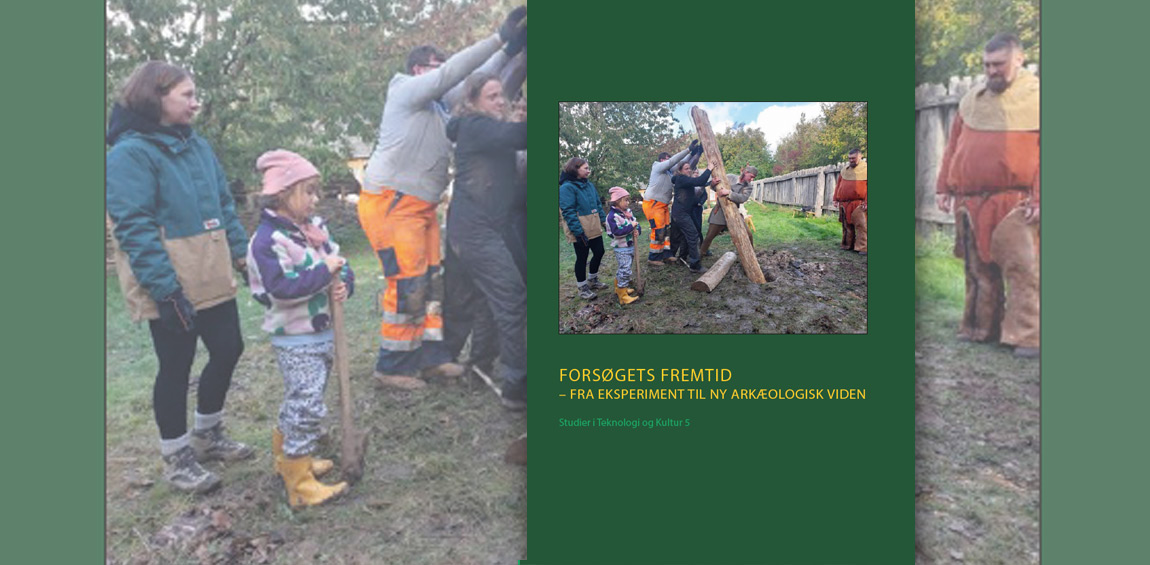
This book is the result of a seminar with the same title, hosted in Sagnlandet Lejre. It contains a repository of articles focussed on hands-on experiments and experiences covering a range of periods from the Neolithic to the modern era. In addition to this some articles address timeless subjects, dealing with more theoretical frameworks and cooperation such as the second article by Lucas Garbrecht Overvad, and high-tech solutions such as the fourth article by Sofie Louise Andersen. A rough summary and commentary are presented below.
The first article is a summary of previous works on reconstructing Viking Period ships, specifically Skuldelev 3. The earlier reconstruction is presented alongside the most recent one, along with many valid observations about workflow and the need for many different crafts.
The second article by Lucas Overvad presents arguments about the framework of projects and the importance of involving craftsmen in research, he himself being employed as a craftsman at Sagnlandet Lejre. He presents a unique perspective on collaboration between archaeologists and craftsmen.
The third article by Maria Ojantakanen about harps/lyres from the Viking Period is very hard to understand for a layman, given the many unique terms used in music. She includes many illustrations to help understand the subject matter.
One article focuses on high tech solutions in what many academics and laymen would deem a “hobby field” (experimental archaeology). The fourth article in the collection, by Sofie Louise Andersen, looks at registering movement using motion capture technology during weaving by a professional craftsman. This innovative approach was especially interesting and a welcome addition to the more standard experimental archaeological papers which can be quite tedious to those who do not have a specific interest in the subject matter.
A more traditional work in this publication is the work of Henriette Lyngstrøm who, in the sixth paper, deals with bog iron and the work involved in refining it from a slaggy mess into a usable knife and stirrups. The paper is structured and obviously written by an individual used to writing academic papers. In contrast, a traditional early research project is the fifth article by Camilla Frass Rasmussen and Sofie Nielsen, presenting their work on making a ‘four post structure’, with all the problems and successes related to it. The project is in its early stages but is none the less interesting, though one might suggest looking into the problem of burying greenwood in soil and using it unhardened for heavy duty works such as digging postholes.
The seventh article by Gustav Hejlesen Solberg attempts to summarize what a ‘battlescape’ is and how this is important for understanding defensive structures and landscapes. The project simulates three tactics for getting through an open fence. The article has some interesting points about how the landscape and manmade structures influence how a skirmish can be conducted but, as noted by Solberg himself, the number of participants was quite low, and a skirmish of several hundred, may yield entirely different results, not limiting the immediate fighting to the opening.
Alexander Grove Lauridsen (in the eighth article) presents his experiment with Late Neolithic flint arrowheads and pitch-glues. As a whole his project was beset by a lot of challenges such as needing a professional archer, being limited to indoor shooting and simulated bone and antler along with fund and time limitations. The project is nevertheless good and piques interest in how to structure such an experiment and, as Lauridsen notes himself, mistakes are how we learn.
The illuminating ninth article by Karl Jakob Lamberth deals with just that, fire as a source of light. Testing various glass vessels, oils and wicks suspended in chains from the ceiling of a room, he analyses which work the best and reflects on future variables to test. The idea is interesting though it does not feature comparative materials such as ceramic vessels as Lamberth’s focus was the ‘super wealthy elite’ who could access materials such as blown glassware.
The archaeology of skis is the subject of the tenth article by Laurent Mazet and could be a tough read given the many references, dates and figures. This article is extremely professionally written and is in-depth research into the technology of skis originating from various places on earth. Though no definitive conclusion is reached, the methodology is sound and despite a lack of knowledge of skis and skiing, I would be interested in learning future research results.
Dogsledding is another subject foreign to me personally, but Emma Vitales’ article (the 11th) presented it interestingly. The article is, along with the tenth and sixth, among the more professional papers and obviously builds on a larger experience and funding than some others do, but is unfortunately limited by archaeological findings, which are extremely rare.
Magnus Hjorth’s paper (the 12th) presents finds of recycled wood, which he assumes are from a torn down house. These timbers bear a resemblance to pieces of timber from ‘house 17’ which is reconstructed by Sagnlandet Lejre. The idea is interesting though as Hjorth notes he cannot be certain and would like to do more research.
The final paper in the publication (the 13th) is by Nanna Kirkeby and Lone Blom Kristensen who investigate the use of lamb intestines as thread. The results seem to match the archaeological evidence from Haraldskær which comprises a complex cape of various pieces of skin/leather.
Remarks and Conclusion
Having little to no knowledge of how to build a 14-meter coastal trading boat from the Late Viking Period (the first article, Sørensen et. al.), or how to create a thread for capes using intestines (the 14th article, Kirkeby & Kristensen), the book takes you on an interesting journey into new subjects of interest, methods and experiment structures. One is left wanting some structure, perhaps ordering the articles more logically, but given the very broad collection of subjects it would not be possible to satisfy everyone. One negative point is that the quality of illustrations is generally low; it is obvious low DPI graphs have been hastily added, rather than remade to a suitable resolution, but this is a minor problem.
Overall, the language complexity in the articles is appropriate and the articles are well written so everyone, craftsman or layman, could understand them. I like to see this in publications of this nature, since good storytelling is essential to keep people interested.
In the spirit of the seminar from which the articles have sprung, all the articles include a reflection on how experimental archaeology can benefit our understanding of ancient crafts, what it can be used for in the future, and what future experiments could be. These reflections are very interesting to me, because when I make use of experimental archaeology, I am very focused on what the product is for me and my own needs, for example a reference collection of ceramics, an article about the work and future efforts. The addition of “the next step” is very important and I am glad it is included in these works as it allowed for not only a presentation of past and current works, but also where the researchers want to go next.
The collection of ambitious early research and structured well-managed projects is definitely worth the paper is printed on.
Book information:
Forsøgets Fremtid – Fra Eksperiment til ny Arkæologisk Viden (The Future of Experimentation - from experiment to new archaeological knowledge). 2025. Editors: Henriette Lyngstrøm and Camilla Fraas Rasmussen. University of Copenhagen, Faculty of Humanities.
To order: https://webshophum-dk.ku.dk/shop/forsoegets-fremtid-fra-3470p.html
Keywords
Country
- Denmark