
The content is published under a Creative Commons Attribution Non-Commercial 4.0 License.
Unreviewed Mixed Matters Article:
Event Review: Experimental Archaeology in Denmark 2025
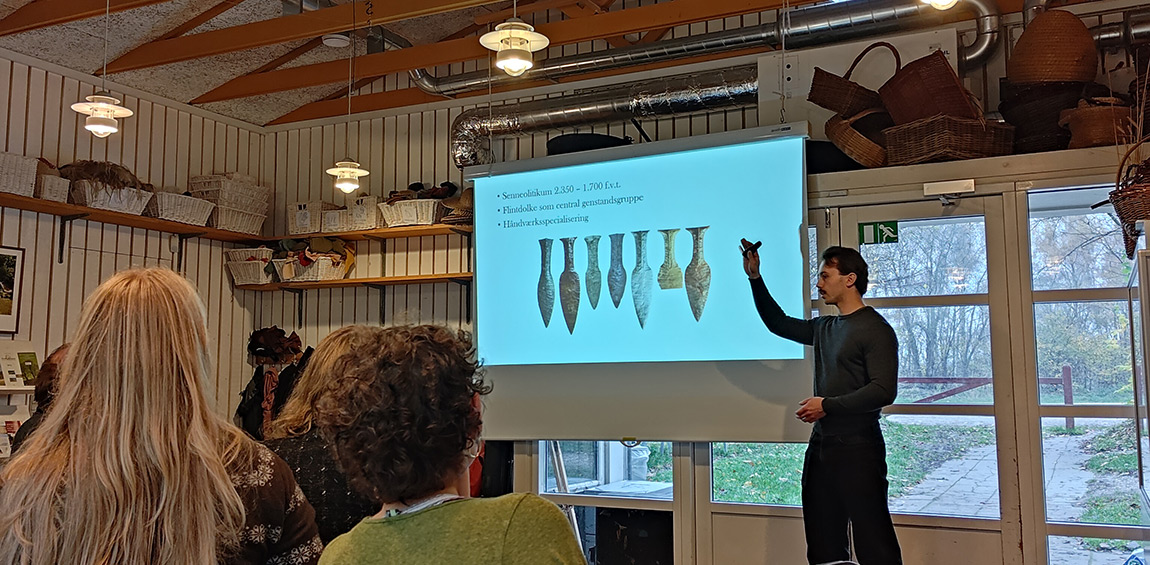
The fifth annual meeting of Experimental Archaeology in Denmark (EAD) took place from 7 to 9 November 2025. This event followed previous meetings held at Ribe Vikingecenter, Middelaldercenteret, Bork Vikingehavn, and Vikingeborgen Trelleborg. The meeting serves as an opportunity for researchers, students, craftspeople, and others interested in experimental archaeology to meet and exchange ideas.
Flint: Fractures and Manufacture
The first two presentations focused on lithic technology. Sofus Stenak (Museum of Copenhagen) examined how to identify individual craft specialists and networks in Late Neolithic southern Scandinavia, with particular reference to flint daggers. Through experiments in which different flintknappers attempted to replicate a single original dagger, Stenak made a compelling case that such data can reveal distinctive traits attributable to specific craftspeople.
Alexander Grove Lauridsen (University of Copenhagen) presented preliminary results from his ongoing MA thesis project, which explores the use of macrofractures as diagnostic tools on Neolithic arrowheads. His experiments demonstrated characteristic fracture patterns and offered promising indications regarding the potential to connect these patterns with archaeological examples.
Viking Village in Albertslund
As is customary at EAD’s annual meetings, a guided tour of the host museum was arranged. Mette Jehrbo and Karl Jakob Lamberth (Vikingelandsbyen i Albertslund) led participants through the open-air museum, highlighting its numerous past experiments. They showcased reconstructions of pit houses, four-post structures, and the impressive reconstruction of the bridge from Ravning Enge, among others, including a demonstration of Lamberth’s experiments with Viking-Age glass lamps.
Maria Ojantakanen (Vikingelandsbyen i Albertslund) presented her 25 years of work on Viking-Age harps. The audience was introduced to the few surviving archaeological finds, the processes of reconstruction, and a short demonstration of the instrument’s sound and musical potential.
Insights from Crafts
Once again, EAD’s annual meeting demonstrated valuable insights that can be gained from craftspeople. Joel Hermansen (Historical craftsperson) guided the audience through a series of projects focused on reconstructing Viking-Age craft practices, including textile production, woodworking, and stone cutting.
Kari Marie Helland (Buskerudmuseet, Vestfold Museerne) provided a demonstration on the use of cooking stones. Alongside the ubiquitous posthole, cooking-stone pits are among the most common features encountered in Danish field archaeology. The live demonstration vividly illustrated how such features may have functioned, offering many field archaeologists in attendance a new perspective on this common archaeological phenomenon.
Christian Rompf (Bork Vikingehavn) discussed his work on metal embossing in the reconstruction of Iron and Viking-Age jewelry. Drawing on his practical experience, he examined the production processes behind archaeological examples and demonstrated how hands-on experimentation enhances our understanding of the artefacts in question.
Iron and Steel
On Sunday, Gustav Hejlesen Solberg (National Museum of Denmark, Trelleborg Viking Fortress) presented preliminary findings from his PhD project, which investigates the evolution of weapons and combat techniques throughout the long Viking Age (AD 600–1200). Rather than focusing on specific experiments, Solberg illustrated how experimental archaeology underpins his entire research framework and informs his understanding of Viking-Age martial practices.
This was followed by a presentation from Johannes Lyngby (University of Copenhagen) on the practices of iron production. Inspired by an Iron Age find, an experiment was conducted at Lejre: Land of Legends, in which a smelting furnace was enclosed by a fence. Although the experiment did not result in successful iron production, it nonetheless prompted fruitful discussion regarding the potential purpose of the fenced enclosure surrounding the ironworkers.
Perspectives and Possibilities
Several presentations addressed broader perspectives and themes related to experimental archaeology, beyond individual crafts or experiments.
Jannie Marie Christensen (Stenvad Mosebrug) discussed methods for integrating experimental archaeology into museum exhibitions, drawing on two case studies. The first concerned a new exhibition at Stenvad Mosebrug about the Huldremose bog body and her clothing; the second explored experiments on indoor climate within reconstructed Viking-Age houses. On the following day, Christensen also gave a presentation on sources of funding for experimental projects and the importance of publishing one’s experimental results.
With the rapid development of artificial intelligence (AI), it was inevitable that its potential applications within experimental archaeology would be discussed. Christian Rompf offered a presentation exploring various ways AI might be utilised in experimental archaeological research. Important questions were raised concerning its limitations, issues that will require continued attention as technology advances.
Daniel Serra presented his experiments involving linseed and walnut oils. Serra’s methodology integrates both archaeological materials and historical written sources, thereby bridging the disciplines of experimental archaeology and historical research.
Join EAD
The next annual meeting will take place from 6 to 8 November 2026. The location will be announced in due course. To join EAD’s mailing list, please send an email to: jannie.marie.christensen@gmail.com
Join EAD’s facebook group here: https://www.facebook.com/groups/456991953229090
Keywords
Country
- Denmark