

The content is published under Creative Commons Attribution 4.0 International license (CC BY 4.0).
Reviewed Article:
Investigation of the Practical Functions of Fluting on Throwing Sticks and on Other Ethnological Wooden Artefacts
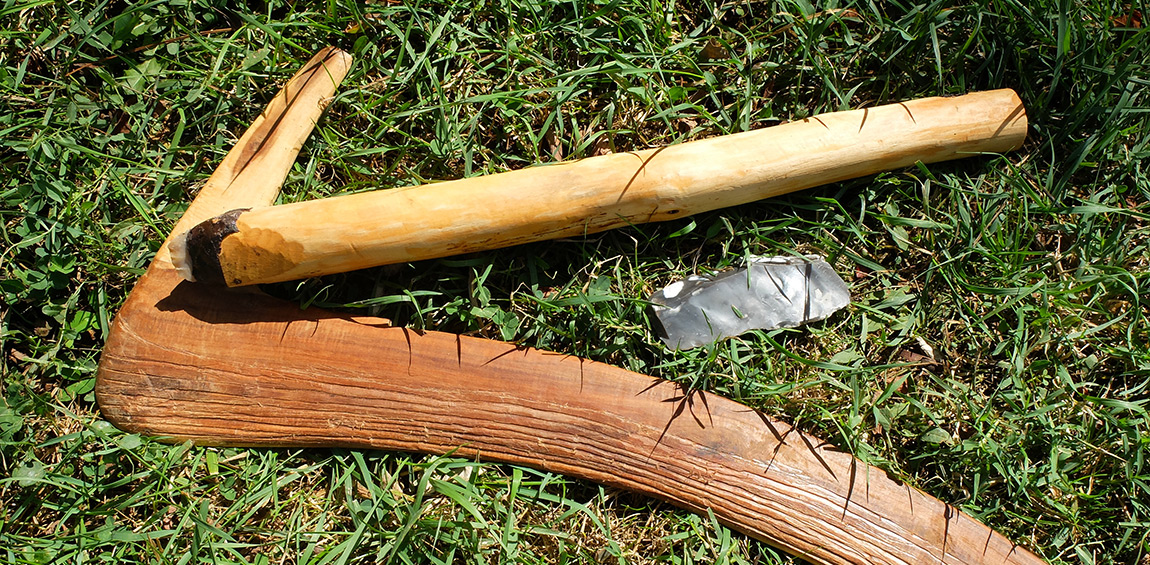
Why are the surfaces of some Australian throwing sticks fluted? According to a previous research, this feature could positively influence their flight, but this effect does not explain the function of fluting on other wooden artefacts (shields, clubs, containers) which are not used as projectiles. The former function of flutes is probably to be found among others type of wooden implements from which it has been transferred to throwing sticks. So, what is the origin of flutes on wooden artefacts? And for what functions? In this research, the diversity and manufacture of fluting will be investigated as well as possible functions. We found that common functions of different types of fluted artefacts could be originally related to weight reduction with maintaining their shock resistance as well as prevention of wood checking during environmental exposure. These results could pave the way for a better comprehension of flutes and grooves not only on ethnographic wooden artefacts, but also on future archaeological discoveries and shed light on an ancient technology, still in use on modern materials today.
Introduction
Engraved parallel patterns can be divided into two main types: Ripple grooves or flutes, which are shallow U shaped grooves with concave sections wider than the ridges formed between them (See Figures 1A-1C(1)), and rib grooves, which are deep, narrower than the ridges (See Figures 1C(2)-1D). Some artefacts can be completely covered by such grooved pattern or have only partially covered surfaces (See Figure 1E). Finally, when removed lines in wood are not observed in a parallel pattern, the term engraving is used.
The function of flutes on throwing sticks and especially on kylies1 from Australian central desert have been subject to speculation about their influence of the flight of these projectiles (Thomas, 1985) and experimental investigations undertaken by Nelson (2001). This last author found, after an experiment in a wind tunnel, that these features tend to reduce the drag of throwing sticks, and by consequence increase their aerodynamic lift, enhancing their range by a diving effect. However, no real throwing experiment were undertaken to observe the real flight behaviour and to confirm the results obtained in a laboratory.
Furthermore, if this aerodynamic effect might have contributed to the continuation of the traditional fluting practice among Australian indigenous people, this is does not reveal the former function (or functions) of the fluting. Indeed, many other wooden artefacts (i.e., shields, clubs, containers) were fluted and have no aerodynamic requirement, a fact which is recognised by Nelson. Therefore, to understand better the functionality of flutes, it is required to list which ethnographic wooden artefacts have this feature and find if there is common functions reported. Additionally, properties of fluted and grooved surface are still in use today both on artificial wood panels and other materials (e.g., cardboard, plastic, metal) and could also help to shed light on the function of this feature on ethnographic artefacts.
Ethnology on fluted wooden artefacts
Throwing sticks and throwing clubs
In central Australia, different type of throwing sticks are grooved: The most famous being the kylies (See Figure 2A) and wirlkies2 (See Figure 2B) from the central desert region, which have been diffused through almost all the continent (Davidson, 1936; Jones, 1996). Such a grooved pattern is characterized by 3-5-millimetre-wide shallow flutes (ripple profile) with a 0.2-0.5 millimetre depth, resulting in a density of 2-3 flutes per centimetre, with narrow parts and extremities having a denser pattern. The wideness of these grooves leads them to be classed as flutes or ripple grooves. No symbolic function for this feature has been revealed from ethnographic studies (Jones, 1996). The recognised function of the flutes on kylies of central Australia include the production of rhythmical scraping sound between two throwing sticks (McCarthy, 1961) in addition to their use as clap sticks (Van der Leeden, 1967).
Flute manufacture in central Australia can be divided in two steps, initiation and regularisation: on throwing sticks, observation of unfinished fluted kylies/karli show that the fluting process for wide shallow flutes is directly linked to the adzing process to remove wood in the shaping (airfoil and thickness reduction) (Bordes, 2021). Adzes are composed of a handle made of strong and heavy wood with a specific scraping flake at their extremity named tula (See Figure 3C-D). On the Australian continent, older archaeological examples have been dated to between 3700 and 3500 years ago. Originating from central Australia, the use of this tool spread to Western Australia and South East Queensland (Mulvaney & Kamminga, 1999; Moore, 2004; Veth et. al., 2011). Consequently, it is not surprising to find these kinds of fluted patterns distributed in the same way as the use of the adze across Australia.
The adze could have been equipped with different stone tula wideness according to the different regions of Australia using this technique, wider in central Australia than in Kimberley (North Western Australia). Since after the colonisation (i.e., 19th century), indigenous people of Australia have been using metal tulas on their adzes using steel blades from truck shock absorbers which make deeper cutting marks on adzed surfaces. The use of the adze llikely replaced the tedious scraping process for shaping wooden artefacts using stone axes, that were used for coarse shaping, but cannot be used for this second step of manufacture, as they could create cracks and breaks on the worked piece. Flutes are initiated from the continuous adzing strokes along lines on the surface (See Figure 3A), most likely proceeding from the one extremity to the other, as it possible to observe on unfinished fluted intrados3 surfaces (See Figure 3E).
On a second step, they are further regularised using the same tool by careful scraping action (See Figure 3B). This was observed in my experiment as a wide tula can be used to create small flutes by using only a side part instead of their whole.
Throwing sticks can be either fully fluted over both surfaces (extrados and intrados)3, or partially grooved on the extrados only. Some examples are not grooved on the proximal extremity where the handling takes place (Nelson, 2001; Bordes, 2021). This could be explained by the grooving effort economy and probably for better grip comfort on a smoother surface. The intrados surface is often less carefully fluted than the extrados (irregular flutes) meaning that this surface was done secondarily, and sometimes unfinished.
However, fully finished kylies and wirlkies in collections exist, confirming that the fluting is formerly meant to cover the entire surface of these implements. This points to a flaw in the experiments and conclusions of Nelson (Nelson, 2000) as these experiments only used a kylie with a fluted outer surface (extrados). The progressive retreat of fluting from the inner side (intrados) and handling extremities is another argument to reject the function of the flutes as aerodynamic. Indeed, Nelson (2000) cites the lack of fluting on the extremities as a method of tempering the additional aerodynamic lift provided by the fluting, but in this case both extremities would have been affected by the lack of fluting, which is very rare, and instead, only the handling is more much common.
In Northwest Australia, in the Kimberley region, V shaped Kimberley throwing sticks with pointed extremities (Davidson, 1936; Jones, 1996) are another type of fluted throwing stick. They are generally fluted on both sides with smaller flutes (2-4 mm wide for a density of three flutes per centimetre) than those of the central desert (See Figure 2C). They have been manufactured in the same way as in Central Australia but probably with narrower tula or using only a part of its active edge.
South Australia is another region where fully fluted archaic double pointed throwing sticks, from lake Eyre Copper Creek area, can be observed. Some type of throwing club (or throwing stick with a head bulge) are also fluted. But these two last types of projectiles belong to archaic types of throwing sticks (Bordes, 2024) only developing limited aerodynamic lift and according to some tests of their flight, are not influenced by the fluted surface and their throwing range stayed unchanged (according to my experiment).
Some throwing sticks from Queensland with bevelled extremities also have narrow flutes (See Figure 2D). These narrow flutes are manufactured differently to the wider flutes found in central Australia, as the entire surface is first smoothed by scraping and shaving and then they have been carefully incised in a second step on the prepared surface with an engraver tool (stone or bone).
Outside Australia, in Africa, some Sudanese throwing sticks are fluted (See Figure 2E). In Southwest America, ancient grooved clubs and rabbit sticks among Pueblos Indians and Californian tribes are grooved. Their known function for this last region include melee combat, throwing stick, and deflecting incoming projectiles. Unlike the Australian fluted throwing sticks, these grooved patterns on American artefacts are rib grooves. They can either cover the whole surface or made in sets of three or four parallel grooves which can be broken into sets between sinew binding reinforcement (Heizer, 1942; Bordes 2021) (See Figure 2F-G). These reinforcement wrappings were designed to prevent splitting as a result of hard shocks caused by impact when thrown, so it's possible that the function of grooves might be related to the capacity of resistance to impact. According to Heizer (1942), the tradition of grooves could have been propagated from the clubs to the throwing clubs and further to rabbit sticks through the evolution of these projectiles. This is an additional indication that any aerodynamic function of the grooves/flutes is secondary to a former function related to some other uses (as fighting stick/club (i.e., close fighting and parrying).
Fighting clubs
Some fighting clubs with double pointed conic extremities from Southern Australia are fluted (See Figure 4A), and some light types can be used as projectiles. Their circular section does not generate enough aerodynamic lift to get any benefit from surface fluting as observed by Nelson. However, they are a weapon designed to received high impact damage from fighting and have a high resistance requirement. Club handles are sometimes also lack grooving in the same way as the handling blade of the kylies of central Australia and probably for the same reason.
Shields and defensive weapons
Another fluted category of artefact requiring high resistance are Australian indigenous aboriginal shield from the central and western desert (See Figure 4B). The outer side exposed to shocks is more often grooved/fluted, through the inner side can received the same carving, even on the handle. This observation could indicate that the function flute is not only related to the resistance against impact but could play other roles.
Container
Coolamon are another category of wooden artefact from Australian central desert fluted generally on all surfaces both inside and out. Interestingly, some examples have wide flutes on the outside, but narrow flutes on the inside (See Figure 4C).
Tools
Some Aboriginal tools in Australia such as stone axes are fluted (See Figure 4D). Tapa threshers used in Oceania, to soften and elongate bark to create textiles, are grooved with narrow deep grooves which are distinct from fluted patterns on other previous artefacts. The known function of the grooves for these particular artefacts is to break bark fibres to soften it without damaging the bark (See Figure 1D). However, an apparent common point seems to be again the resistance needed for a heavy duty daily work.
Architecture elements
Indigenous wooden houses of the Northwestern American continent, are built with roof beams and column which can be fluted (Stewart, 1984). It possible to observe that the flutes on these architectural elements are oriented longitudinally on the part close to their extremities, but also transversally in the middle. (See Figure 5A) The practical function of flutes for these elements have not been documented, but it might be close to those investigated for Greek Doric column (see next section). It is also clear that this feature enhances the aesthetic of these architecture elements.
Other examples of use of fluting surfaces in historical times
Architecture
Among the elements of architecture, stone Greek Doric columns are fluted (See Figure 5B). This feature is known to originate from archaic wooden columns which were also shaped by adzing, so the fluting could have arisen from a function linked with the original wooden material. However the property of fluting is still valuable on stone material as the classic Greek Doric columns have been observed as more resistant to stress and stiffer than ones with flat surfaces (Kourkoulis and Moupagitsoglou, 2009).
Medieval armour
In a completely different context, In Europe, a type of early 16th-century German plate armour, possibly first made for the Emperor Maximilian, is decorated with many flutings that may also have played a role in deflecting the points and blades of assailants and increasing the structural strength of the plates (See Figure 5C). This illustrates another advantage of fluted surfaces, which might better in evenly distributing the stress of shock and is more difficult to deform than a flat surface and may offer less friction contact to incoming blows. This could have been also beneficial for aboriginal artefacts when used to parry (i.e., shields throwing sticks, clubs). The shallow parallel channels that covered almost the entire armour were not only decorative but actually strengthened the metal.
Modern use of fluting and grooved surface
In the present day, this technology is used on wooden panels or on tiles for decorative purposes (See Figure 6A-B), but also to enhance their resistance to environmental exposure in industry. Indeed, it is now assumed that flutes and grooves prevent checking of exposed deck boards (See Figure 6C). An interesting result for wooden decks is the increasing limitation of checking with the narrowing and depth of grooves but an increasing of the cupping effect relatively to wider, swallower flutes (Cheng, 2016; Heshmati et al., 2018). Avoiding cupping on throwing sticks might explain the choice of wider, shallower flutes on these implements over the narrow grooves. This also could be an explanation of the existence of different fluting profiles on wooden artefacts in Australia (narrow or wide flutes) and on other continents. Furthermore, it might explain the presence of wide flutes on the external surface of coolamon containers with narrow fluting on the inside surface where checking could be more critical and cupping deformation not an issue. However, we need to remain cautious with the results of such modern studies applied on highly transformed European wood (i.e., Douglas fir, western hemlock, white spruce) which would need to be investigated more in detail on hard dense acacia raw wood used for aboriginal implements. Apart from wooden panels, fluting is used nowadays on cardboard for packaging (See Figure 6D) and on metal roof covering (See Figure 6E) which still contributes to a better resistance to shock without increasing the thickness of the material that would negatively affects its flexibility (cardboard) or its weight (roof covering).
Methodology
As achieving the fluting by the alignment of adzing strokes is a difficult skill, and would need a long training, the fluting for our experiment was done following the second technique used in Australian Queensland region for narrow flutes: A first step of shaving to smooth the surface before a second step to initiate narrow grooves with denticulate flake used as a saw. These were finally widened and regularized to modify them as flutes with a metal or a stone adze (See Figure 7A-D). In this experiment, we focused on wide flute as found on kylie and wirlki throwing sticks (See Figure 7E-F). But another type and narrow flute pattern has been manufactured as a replica of a crescent shaped throwing stick from Queensland (See Figure 2D, 7G).
Results: Throwing experiments with kylie and wirlki hand replicas
Another indication of the secondary nature of the aerodynamic function of the flutes for throwing sticks is given by an experiment conducted with projectiles before and after fluting.
Several informal throwing tests with replicas of kylies and wirlki, which are traditionally fluted, show that this feature has little influence on the maximum range reached of these projectiles. However, for this research, two specific replicas were tested before fluting and after fluting to check these first observations in depth. A kylie replica reaching a maximum range of 100-110 m, was been tested without any fluting and the flight behaviour observed (See Figure 7E) (AU38, table1). A general observation is that the aerodynamic lift of throwing sticks tends to increase at the end of their trajectories, due to high rotation and speed. Also, depending of the blade tuning, a climbing effect is frequently observed at the flight end. This deviation lowers the accuracy of these projectiles for ground hunting, which is the main function of kylies and wirlki traditionally fluted in the central desert region of Australia, which are not meant for bird hunting and folding unlike their lighter counterpart and boomerangs. This climbing deviation was observed without the fluting (Fig 8B(2)). The effect of fluting observed during experimental session with the same long range kylie replica shows that this climbing deviation is attenuated and that the trajectories of the projectile tend to stay closer to the ground and straight which is beneficial to the accuracy and efficiency of throwing sticks in the final phase of their flight (See Figure 8B(1))(AU38m, table1). Explanation of this fluting effect, in keeping the trajectory, could be a drag effect of the flutes, decreasing the aerodynamic lift, and preventing the climbing deviation, in contrast to the role of these features concluded by Nelson (Nelson, 2001). Another experiment was carried out with a heavier short range wirlki without fluting made by a wanambi aboriginal man at the Al Currung community (named George), and purchased in 2018 (See Figure 7F) (AU54, table1). This original wirlki was fluted and tested in the experiment. Considering that the wirlki rotation is slowed because of its greater weight, the additional thickness at the extremity of its short blade and the presence of the additional hook, this throwing stick is shorter ranged than the tested kylie, and follows a straight and low trajectory. A final climbing deviation was not observed, because the aerodynamic lift is not sufficient on this heavier projectile to produce such effect. The test with the same wirlki but now fluted, first on extrados only and secondly with both sides didn't change anything in the flight trajectory, and kept the same range (Fig8, A) (AU54-1, AU54-2, table1). This observation tends to confirm that the fluting is not playing any major role in increasing the aerodynamic lift on this wirlki replica and that the benefit for a heavy throwing sticks is negligible. However, it might add drag to prevent climbing effects in the terminal part of the trajectory for lighter, long range projectiles. On the other, hand some of the tests (AU11a, AU60a, table 1) obtained a slightly longer distance for some fluted replicas, but this seems to be more in relation to the loss of weight by wood removal than any specific aerodynamic effect of the fluted pattern. Another observation from the test with Au60a (table1) is a slight accentuation of the rotational whistling of the projectile with both fluted surfaces, but this effect is not consistently obtained for other tested fluted throwing sticks, so this probably depends on other factors.
| Designation | Type | Wood specie | Fluted surface | Flute width/(mm) | Density of flute (at elbow nb/cm) | Maximum range (m)
| Type of trajectory
| Weight(g) | Weight reduction |
| AU38 | Kylie | Acacia Aneura | 100-110 | 2 | nd | ||||
| AU38m | Kylie | Acacia Aneura | Extrados & intrados | 3 | 1.9 | 100-110 | 1 | 439 | nd |
| AU11 | Kylie | Acacia Aneura | 60 | 1(instable) | 574 | ||||
| AU11a | Kylie | Acacia Aneura | Extrados | 3-4 | 1.9 | 70 | 1 | 531 | 7.5% |
| AU54 | Wirlki | Acacia Aneura | 50-55 | 1 | 490 | ||||
| AU54-1 | Wirlki | Acacia Aneura | Extrados | 3-4 | 2.5 | 50-55 | 1 | 473 | 3.5% |
| AU54-2 | Wirlki | Acacia Aneura | Extrados & intrados | 3-4 | 2.5 | 50-55 | 1 | 464 | 5.3% |
| AU10 | Wirlki | Acacia Aneura | 60 | 1 | 675 | ||||
| AU10a | Wirlki | Acacia Aneura | Extrados | 4 | 1.5 | 60 | 1 | 633 | 6% |
| AU9 | V shaped | Ventilago Viminalis
| 40 | 1 | 438 | ||||
| AU9a | V shaped | Ventilago Viminalis
| Extrados & intrados | 3-4 | 2 | 40 | 1 | 421 | 4% |
| AU60 | crescent | Acacia Homalophylla
| 50 | 1 | 568 | ||||
| AU60a | crescent | Acacia Homalophylla
| Extrados & intrados | 1-2 | 3.8 | 55 | 1 | 528 | 7% |
Table 1. Summary of type of trajectory and weight reduction by fluting obtained on different experimental replica. Nd: not determined
Discussion: Potential functions of fluting for throwing sticks and others wooden artefacts
Investigation for the former main function of the fluting on wooden artefacts observed several possible advantages which will be examined below, according to the presence of fluting on wooden artefact and their known function. Table 2 summarises the presence of each function for each category of artefacts.
Non practical functions
Aesthetic
The natural aesthetic improvement obtained by fluting or grooving of a whole surface of an object, might have been a factor in its propagation independent of other practical functions. This aspect might have played also a role in the human invention of fluting/grooving by imitating natural features in their environments and the making of fluting on wood surface might have been influenced by the observation of such natural fluted and grooves surfaces. In the arid zone of Australia, it is possible to observe this natural grooved feature on old drying wood (See Figure 9A). Sunlight can also play a role in creating fluting patterns from natural exposure of wooden objects to UV light, as is possible to observe on old garden chairs composed of pine planks. In this last case, one explanation of this fluted pattern could be the faster photo degradation of wider softer spring wood rings (early wood) than on narrow autumn harder wood rings (late wood) (Kudela et al, 2024) (See Figure 9B). Fluted patterns can also be caused on eucalyptus trunks due to burrowing insects ((See Figure 9C).
Symbolic of the fluting/grooving of wooden artefacts
In Australia, symbolic aspects of fluting/grooving on wooden artefacts are unknown. However, parallel grooved lines are a common pattern among prehistoric engraving in Australia and are interpreted as ritual cut marks during ceremonies to get "the power out of the rock" from ancestral sites (See Figure 9D) ( Flood, 1997). These engraved patterns are also strongly related to sites with prehistoric parallel finger marking on soft surfaces (See Figure 9E) (Flood, 1997). Parallel lines are also cut in the skin for scarification during initiation (Basedow,1925) (See Figure 9F). Considering that a tool or a weapon is an extension of the human body, it cannot not be excluded that the symbolism of scarification, which is believed to strengthen the mind and body of the initiate (so to put a special power in the body), could also have been extended to these objects, to embed the same properties. Another aspect of the possible relation of fluting/grooving with scarification is the frequent application of red ochre, symbolizing blood, on fluted/grooved wooden artefacts by indigenous people in Australia.
Practical functions
Improvement of projectile trajectory
As discussed earlier, even if fluting gives an aerodynamic advantage to throwing sticks and throwing clubs, either to increase aerodynamic lift or to enhance their accuracy, many other fluted artefacts are not projectiles and consequently, this benefit can be discarded as the former function of fluting for wooden artefacts. However, it can be considered as a minor side function which contributed to the propagation of fluting on certain types of throwing sticks.
Deflecting projectiles
The advantage of fluting to enhance a deflecting capability, may be considered only for shields, throwing sticks, or clubs. But similar to the previous advantage described, this could be a major side affect which would have contributed to the fluting becoming a tradition on weapons with defensive and offensive capabilities (throwing sticks, clubs, shields). Indeed, we often nowadays underestimate the usefulness of the parrying skill in societies, where every person had to protect themselves as they were more commonly exposed to this type of situation (human conflict, dangerous animals). The increasing speed of projectiles (arrows are more difficult to parry than incoming spears or throwing sticks) would have rendered this ancestral skill rather obsolete.
Producing rattling sound
Use of the fluted surface to produce music (rattling sound) can be considered for all wooden artefacts. Consequently, this function might be a hypothetical former function of fluting, but it cannot explain the full coverage of fluting observed on many wooden objects. Indeed, a partial fluting of one surface would be sufficient to achieve this function, so why flute both side of a throwing stick or the whole surface of a shield?
Lightening an artefact without lowering its resistance
Making a wooden object lighter without lowering its strength could also be another advantage of fluting. The loss in weight would be small considering the amount of effort needed to achieved a fully fluted surface, but the loss of weight of the implement used daily by people, often on the move, is not to be underestimated. For throwing sticks, reducing the weight can enhance the aerodynamic lift and allow it to reach greater ranges. During experiments, the fluting on both sides decreased the weight of projectile between 4 and 7%, which is a significant gain (see table 1). Furthermore, it is possible to notice that the regions in Australia where fluting is practised covers the central desert where people had an accentuated nomadic style of life and need to move more frequently (hunting, collecting material, seeking water holes). They needed lighter equipment than the more sedentary people living along rivers and coast who had more permanent campsites. So, this function is likely a former function for fluting and it is strongly associated to the resistance to shock (see below).
Improvement of the resistance to shock
The resistance to impact can be extended to all wooden artefacts as they were designed for diverse tasks that required long term resistance to shock. Native people, being highly mobile also needed solid multi-purpose wooden items that can be dropped and used for different heavy works (pounding, cutting, digging, use as anvil). Indeed, fluting can enhance resistance to shock by increasing the dispersion of the energy of an impact for all categories of fluted artefacts. In consequence the function is a probable former function of flutes.
Prevent checking from drying and environmental exposure
Flutes can also relieve the tangential wood tensile stress and prevent checking from drying and environmental exposure. As recognized on modern wooden material, the fluted profile influences this property depending on the type of wood used (Heshmati et al., 2018). Considering that the traditional manufacture of wooden artefacts in Australia and most prehistoric woodworking probably used green wood, as it is easier to work (especially with stone tools) and to shape with fire, using residual humidity contained in wood. Checking of the wood piece during drying was a constant issue to deal with. Environmental exposure (i.e., temperature and humidity variation) was also a cause of deterioration of wooden implements which could have found a solution in fluting/grooving.
| Type of artefact | ||||||
| Throwing sticks and throwing clubs | Fighting clubs | Shields and defensive weapons | Container | Tools | Architecture elements | |
| Practical function | ||||||
| Improvement of projectile trajectory | X | |||||
| Deflecting projectiles | X | X | X | |||
| Producing rattling sound | X | X | X | X | X | |
| Lightening an artefact without lowering its resistance | X | X | X | X | X | X |
| Improvement of the resistance to shock | X | X | X | X | X | X |
| Prevent checking from drying and environmental exposure | X | X | X | X | X | X |
Table 2. Compatibility between practical function of flutes and different type of artefact.
In summary of table 2 and information about each of the considered possible function of flutes, it's possible to propose that both lightening without lowering resistance to shock and the prevention of checking could be proposed as probable major former functions. Producing sound and deflecting projectiles could be considered as major side functions and trajectory improvement for throwing stick as only a minor role.
Conclusion
Investigation and experimentation on ethnological and historic fluted artefacts has shed light on the aerodynamic effect described by Nelson (Nelson, 2000) which did not enhance the flight behaviour of throwing sticks, but might contribute to better stability and increase their accuracy. Consequently, the aerodynamic function of flutes can be considered as a minor side function, which aside from other identified uses (deflecting projectile, producing sound), might have contributed to the propagation of fluted surface from prehistoric times.
The main former function of flutes could probably be weight reduction while retaining good shock resistance, because it naturally responds not only to the technical evolution of throwing sticks (Bordes, 2024), but also to the improvement of handling and portability of other heavy duty wooden implements. On throwing sticks, a general evolutionary scheme is the lightening by surface increase and reduction of thickness, to reduce weight/surface ratio and increase the aerodynamic performance (Bordes, 2024). However, a solution needs to be found to retain resistance for critical refinement of throwing stick blades. Fluting allows further reduction of the weight of the implement without compromising its resistance, as the overall thickness is not changed in the operation. Furthermore, it creates a stronger material resistance in the fluting direction. Indeed, all natural wood pieces have a superior resistance in the radial growing direction, but their weakness to splitting and longitudinal check can be compensated for by a fluted surface. Another important former function, is probably the prevention of checking from drying and environmental exposure. All wooden artefacts, including throwing sticks seem to potentially benefit from fluted surfaces by this property, still recognized on modern wooden decks, in modern industries.
One can make one objection to the importance of durability of wooden artefacts during prehistory in that these implements are generally considered short lived. However, we must not underestimate the energy investment in the manufacture of wooden objects with stone tools (e.g., throwing stick making, coolamon emptying) which could be a tedious work and the advantage of maintaining them as long as possible was significant.
As the fluting manufacturing process is time consuming, the fluted surface on throwing sticks in central Australia and in south-west America must have been observed to be gradually reduced to central parts for aesthetic purpose. This process is probably in relation with the reduction in the use of the implement for multiple heavy duty uses, such as needing shock resistance and long life, compared to new non-practical functions (exchange, aesthetic, symbolic). It can also be put in relation with the use of seasoned wood instead of green wood in the managing of checking during long-term drying.
Finally, this present investigation was centred here on practical functions of flutes, however, symbolic human behaviour is always intrinsically linked to the usefulness of his material creation, and that this aspect had probably greatly contributed to the propagation of fluted surface on wooden artefacts. Fluting, grooving or engraving wooden implements is also potentially a symbolic gesture that embeds a special power into it, as in scarification on the skin, aiming for protection, strengthening or efficiency at hunting. By extension, in the context of Australian ethnology, fluting can be hypothetically connected to the engraving of parallel line patterns occurring in rock art, traditionally linked to the ritual extraction of ancestral powers. In a sense, flute and groove seems to symbolically "open" the surface of a solid material (rock or wood), creating "permeability" between the inside and the outside. Perhaps, fluted and grooved surfaces held powerful symbolic meaning in ancient beliefs.
Unless stated, all photos are from the author.
- 1
Kylie or karli: a type of Australian throwing stick traditionally made in the Central Desert area. It is also the term most commonly used today by Aborigines of many other regions to refer to throwing sticks.
- 2
Peculiar "number 7" or "gooseneck" shaped throwing stick traditionally made in the area around Tennant Creek by the Warrunmungu people and distributed throughout the central desert area of Australia.
- 3
The face of a throwing stick oriented towards the ground or towards the outside of the trajectory during its flight, is called the intrados. The other side, often visible to the launcher, is called the extrados and constitutes the “top” of the object. It is the one that is most commonly decorated.
Keywords
Country
- Australia
Bibliography
Basedow, H., 1925., The Australian Aboriginal. Adelaide: F. W. Freece & Sons.
Bordes, L., 2021. Traces of Manufacture, Use, Repair and Modification Observed on Ethnographic Throwing Sticks and Boomerangs.EXARC Journal 2021/1. < https://exarc.net/ark:/88735/10556 >
Bordes, L., 2024. A scheme of evolution for throwing sticks, EXARC Journal 2024/2. < https://exarc.net/ark:/88735/10742 >
Cheng, K. J. and Evans, P.D., 2016. A note on the surface topography of profiled wood decking. Australian Forestry, 79, pp. 147-152.
Clark, P. A., 2012. Australian plants as Aboriginals tools. Kenthurst, Rosenberg Publishing.
Davidson, D. S., 1936. Australian throwing-sticks, throwing-clubs and boomerangs. American Anthropologist, 38, pp.76-100.
Flood, J., 1997. Rock art of the dreamtime. Sydney, Harpercollins.
Heizer, R. F., 1942. Ancient grooved Clubs and Modern Rabbit-Sticks. American Antiquity, 8 No. 1, pp. 41-56.
Heshmati, S., Mohammad, S. M., and Philip, D. E., 2018. Optimizing Surface Micro Grooving to Reduce the Checking and Cupping of Douglas Fir, Western Hemlock and White Spruce Decking Exposed to Natural Weathering. Journal of Manufacturing and Materials Processing 2, no. 4: 67. < https://doi.org/10.3390/jmmp2040067 >
Kourkoulis, S.K. and Moupagitsoglou, K.E., 2009. Influence of Flutes on the Mechanical Behaviour of Ancient Greek Columns. Strain. 45: pp.468-479. < https://doi.org/10.1111/j.1475-1305.2008.00516.x >
Kúdela, J., Ihracký, P. and Kačík, F., 2024. Discoloration and Surface Changes in Spruce Wood after Accelerated Aging. Polymers, 16(9), 1191. https://doi.org/10.3390/polym16091191
Jones, P., 1996. Boomerang Behind an Australian Icon, Kent Town, South Australia. Adelaide, Wakefield Press.
McCarthy, F. D. 1961. The boomerang. The Australian Museum magazine, pp.343-349.
Moore, M. W. 2004. The Tula Adze: manufacture and purpose. Antiquity, 78(299), pp.61-73.
Mulvaney, J. and Kamminga, J., 1999. Prehistory of Australia. Washington, D.C., Smithsonian.
Nelson, R., 2001. 'Groovy' Aerodynamics in Pre-European Australia. In Eleventh National Conference on Engineering Heritage: Federation Engineering a Nation; Proceedings. Barton, Institution of Engineers. pp.7-11.
Stewart, H., 1984. Cedar, Tree of Life to the Northwest Coast Indians. Seattle and London, University of Washington Press.
Thomas, J., 1985. La magie du boomerang. Paris : Editions Chiron.
Van Der Leeden, A. C., 1967. Boemerangs. Vverre naasten naderbij, pp.9-16.
Veth, P. M., Hiscock, P., and Williams, A., 2011. Are Tulas and ENSO Linked in Australia? Australian Archaeology, 72, pp.7-14.