

The content is published under Creative Commons Attribution 4.0 International license (CC BY 4.0).
Reviewed Article:
An Angle on Splicing – Experimental Insights into the Production of Linen Thread in Ancient Egypt
This paper presents an experimental investigation into the production of linen thread in ancient Egypt, with particular focus on materials and techniques attested during the New Kingdom. The study aimed to reconstruct the process of splicing, a fundamental method in the manufacture of Egyptian yarns, to clarify the technical aspects that remain insufficiently understood. Although previous scholarship has extensively documented the general principles and many of the technical features of ancient Egyptian textile production, the practical reconstruction of a functional spliced thread has proven far more complex than theoretical descriptions suggest. Through a series of experiments based on archaeological data, iconographic sources, and surviving textile remains, we systematically tested different variables involved in the splicing process, including fibre preparation, humidity, fibre alignment, and manual handling techniques. The results highlight a range of technical constraints and micro-processes that are rarely discussed in the literature but are crucial for successfully producing a stable and coherent thread. By documenting both successful and failed attempts, this study provides new insights into the chaîne opératoire of linen production in ancient Egypt. It also demonstrates the importance of experimental archaeology in bridging the gap between theory and practical feasibility.
Introduction
The experiments presented below were conducted as part of the project EGYARN: Unravelling the thread: textile production in New Kingdom Egypt (1550-1070 BC) (Grant agreement: ID: 890144) at the Centre for Textile Research, University of Copenhagen by Chiara Spinazzi-Lucchesi. Further research was later conducted with funding from the Agnes Geijer foundation (AG2024-0013).
The EgYarn project aimed to investigate textile production in the New Kingdom by integrating the study of textiles, tools, fibres, and textual sources to reconstruct production mechanisms and identify the social actors involved. One of the central aims of the EgYarn project was to connect spinning tools to textiles, drawing on the exceptional preservation of materials at several Egyptian sites. The key case studies selected for this research were Gurob and Deir el-Medina, two settlements dated mainly to the New Kingdom, with Deir el-Medina ultimately taking precedence in the study due to the richness and diversity of its surviving textile assemblage. To establish a direct connection between tools and extant textiles, experimental archaeology was employed as a core methodological approach.
Weaver, spinner and independent researcher Marie Wallenberg, Sweden, joined the project to handle the practical part and develop the processing steps of fibre strips as well as splicing methods. The experiments were divided into phases, with the first aiming to investigate flax fibre preparation and how different degrees of retting affected the process. The second phase investigated the function of reconstructed spindles using the spliced yarns produced in previous phases. These experiments quickly revealed that several stages of the textile chaîne opératoire remain poorly understood. Although flax is well established as the principal fibre used in Ancient Egypt, and splicing is recognised as the dominant technique for joining flax fibres, two main problems have made it difficult to experimentally recreate the threads and fabrics of Ancient Egypt: how the fibres have been extracted from the flax stalks and how durable splicing points were made. These questions are further complicated by the use of modern flax and a lack of knowledge about flax qualities in Ancient Egypt.
While the flax processing part is discussed in a forthcoming article (Spinazzi-Lucchesi and Wallenberg in JARCE ), this article is focused on the details of the splicing itself and is based on our observations and experiences to answer the question: How can we make a strong and durable splicing point between fibre ribbons using end-to-end splicing? The aim was to develop a splicing method that requires neither adhesives nor prolonged moisture, and that holds without tension, while producing a consistently tight twist at the splicing point.
The flax plant (Linum usitatissimum) consists of a hollow central woody core surrounded by a layer of inner and outer bark. The precious fibres are found in the inner bark, in bundles each holding 20 – 40 fibres glued together by pectins (Salmon-Minotte, 2005). To extract the fibres, processing as traditionally performed includes several steps to separate the fibres from the stalk and each other. After rippling, retting, breaking, scutching and hackling, the fibres can be spun into yarn (Baines, 1989: pp.178-181). For a long time, this was thought to be the case in Ancient Egypt as well, and the depictions, miniature models, and tools were perceived with this interpretation of the process in mind (for example Vogelsang-Eastwood, 1992). Thomas W. Fox had pointed out the peculiarities of ancient Egyptian yarns already in 1910 (Fox 1910, p. 66). In draft spinning, separated fibres are continuously drawn out and spun into thread. In contrast, splicing is a technique where fibre strips containing several fibres are joined together one after the other. Evidence of the use of splicing in Ancient Egypt has been provided by several scholars over the past few decades (Barber, 1991, p. 47-48; Cartwright et al., 1998; Kemp and Vogelsang-Eastwood, 2001). Splicing as a technique remained in use in Pharaonic Egypt until at least the beginning of the Persian period (c. 600 BC) (Cartwright et al., 1998, p. 105), while, according to O. Shamir, it may have been abandoned by the Middle Bronze Age in the Levant (Shamir, 2015).
Much more recent is the discovery that splicing also occurred in prehistoric Europe, providing a radical change of the understanding of European thread technology (Rast-Eicher, 2005, p. 121; Leuzinger and Rast-Eicher, 2011; Rast-Eicher and Dietrich, 2015, p. 34-39; Gleba and Harris, 2019; Harris and Gleba, 2024)
Splicing
While the practice of splicing flax into yarn has long since fallen out of use in Egypt and Europe, living traditions of joining bast fibres—including hemp and ramie—through splicing, knotting, and twisting survive across several countries and regions in, for example, Asia (Nagano and Hiroi, 1999; Hamilton and Milgram, 2007). In archaeological discussions, splicing is often divided into two main categories: end-to-end splicing and continuous splicing, although other types of splicing can be found, as described by Granger-Taylor (Cartwright et al., 1998). In end-to-end splicing, the fibre ribbons are joined together by overlapping them by a few centimetres and twisting them together only at this point (See Figure 1). In this article, only the so-called end-to-end splicing will be discussed.
End-to-end splicing can be made in either an s or z direction. Two end-to-end spliced singles can then be twisted together to create a 2-ply yarn. S2*z, adopting the terminology proposed by Rast-Eicher and Dietrich (2015, p. 36), consists of two z-spliced singles that have been twisted together with an S-twist. Z2*s instead would consist of two s-spliced singles twisted together with a Z-twist.
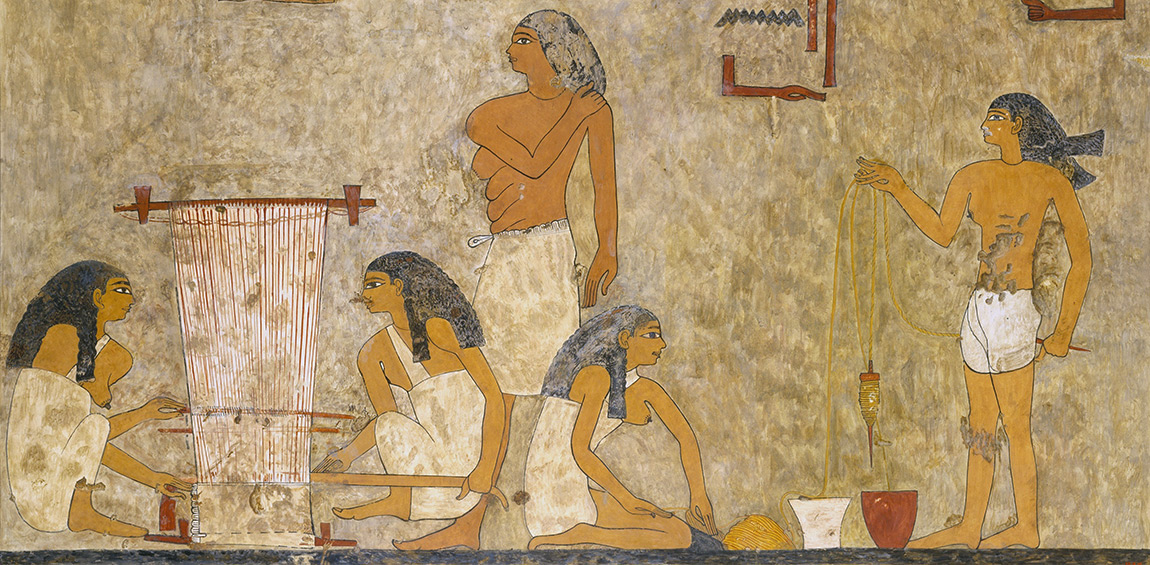
The available iconography provides many clues to the different steps and processes in linen production in Ancient Egypt. However, regarding practically performing splicing, few details are given apart from the splicing being performed on the thigh, as in the tomb of Khnumhotep (Newberry and Griffith, 1893, fig. XIX) (See Figure 2).
What is shown in the available iconographic sources, mainly dated to the Middle Kingdom, is described here in a very condensed form. Fibres are stripped from the stem, but it is not completely clear in what way. Subsequently, the fibres are positioned on what looks like a half dome and spliced on the thigh. Finally, spliced singles are twisted together with the help of a spindle and often passed through a spinning bowl. But the movement of the hands is unfortunately not revealed to us.
The Struggle of Joining Two Fibre Ribbons Together – Previous Research
Splicing has been investigated from a practical point of view previously. In the 1990s, Cooke et al. conducted experiments with decorticated retted flax, soaking the ribbons for 24 hours before splicing. The splicing points had to be glued to hold together, but the yarn produced could then be woven into a small sample and matched the originals when comparing them using SEM (Cooke et al., 1991, p.21).
In 2009, Urs Leuzinger and Antoinette Rast-Eicher (2011) focused on replicating Neolithic and Bronze Age thread from eastern Switzerland. They successfully made linen yarn using partially retted material and conducted splicing with wet fibre ribbons that had been soaked in water. The yarn was wound tightly onto a bottle cork and left to dry under tension so the splicing points held together (Leuzinger and Rast-Eicher, 2011).
In experiments reconstructing evidence of textile production in Tell el-Amarna, decorticated and soaked bundles were also successfully twisted together, but without rolling the thread up and keeping the thread under a bit of tension, the splicing points barely held (Kemp and Vogelsang-Eastwood, 2001, p.73). Vogelsang-Eastwood points out that no spools or other tools that the spliced singles could be wound around are represented in the available iconography (Kemp and Vogelsang-Eastwood, 2001). Vogelsang-Eastwood later highlights that caution is advised when using these artistic representations in trying to reconstruct crafts, practices and techniques from the past.
Although threads have successfully been spliced together previously, we sought and aimed for a simpler way of doing it. Describing end-to-end splicing is relatively easy. Two fibre ribbons are placed overlapping by a few centimetres and twisted together only at this point. But how was splicing done?
Practical Work
The material was first explored freely to develop a sense of its behaviour. From there, a systematic investigation followed, varying the length of overlaps, the degree of retting, and the method of creating the splicing point, while also testing combinations of wet, moist, and dry fibre ribbons, as well as s and z splicing directions. Throughout, care was taken to always splice root to tip or tip to root to produce as even singles as possible; where needed, the root end — typically the thicker of the two — was tapered to ensure a smooth splicing point. The process was then repeated with retted, half-retted, and un-retted flax.
The subsequent experiments and testing were based on working with un-retted strips of flax. The choices behind this are described in detail in our forthcoming article Reconstructing Flax Processing in Deir el-Medina: Decortication, Retting, and Experimental Approaches (Spinazzi-Lucchesi and Wallenberg in JARCE). In regard to the European material, the possibility that fibres for splicing may have been poorly retted or not retted at all has been provided recently by several authors (Rast-Eicher, 2005, p. 121; Leuzinger and Rast-Eicher, 2011; Rast-Eicher and Dietrich, 2015; Gleba and Harris, 2019; Karg, 2020, p.148; Harris and Gleba, 2024).
Much like the previous researchers attempting splicing, we faced initial difficulties in getting the splicing points strong enough to permit the subsequent twisting together of two spliced singles. Kemp and Vogelsang-Eastwood suggest an adhesive material could have been used (Kemp and Vogelsang-Eastwood, 2001, p.79-80). Another issue was the insufficient twist in the splicing point. The high twist that can be so clearly seen in the archaeological material (See Figure 3), was hard to achieve.
Inspired by the previous experiments carried out by Cooke et al. (1991), Leuzinger and Rast-Eicher (2011) and Kemp and Vogelsang-Eastwood (2001), we favoured working with wet fibre ribbons and at first found this method very easy. However, problems arose from the fact that flax fibres swell in water. If a splicing point is made with a fibre ribbon enlarged by absorption and left to dry, the splicing point becomes weaker once the ribbons shrink back to their normal size and gaps appear between the ribbons. When the depicted splicing scenes are described in literature, the spliced singles are referred to as balls, coils, or sometimes both (Kemp and Vogelsang-Eastwood, 2001; Vogelsang-Eastwood, 1992; Granger-Taylor, 1998). During some of the initial experiments, the spliced singles were wound into balls. When dry un-retted fibre ribbons, which are stiff and papery, were used for this, the balls tended to expand and turn into disorganised coils on their own over time, and therefore coils seemed better suited for the dry material. The making of loose coils can also be seen in the production of ramie thread in Korea, among other examples (Hamilton and Milgram, 2007, p.84)
With the lack of spools or other tools with a similar function as well, one could argue that winding the wet threads tightly into balls would do the same function as the spools and cork tested successfully by, for example, Leuzinger and Rast-Eicher (2011). Handling the spliced singles as one would when winding up yarn into a ball risk disturbing the splicing points, so keeping the spliced singles in coils seemed the better option for us (See Figure 4). With the statement “ one has to conclude that the ancient workers spliced vigorously and very effectively ” written by Vogelsang-Eastwood about the workers from Amarna (Kemp and Vogelsang-Eastwood 2001, p.73) kept in mind we wanted to find a method where the splicing point would hold without the use of adhesives, without lots of moisture, and without being kept under tension or handling the singles too much. At the same time, we wished to produce very tightly twisted splicing points.
Reflections and Results During Experimental Work
As experience with the different splicing methods and materials grew, greater control over the process gradually emerged — including over the direction of the splice, whether s or z. It became increasingly evident that one of the key factors in achieving a tightly twisted splicing point was the angle at which the two fibre ribbons meet. A narrow angle produced fewer rotations (See Figure 5a), while a wider angle generated the number of rotations necessary for a tight splice (See Figure 5b). A high number of rotations was desirable not only for visual consistency, but because the large number of rotations provides a better grip at the splicing point, resulting in a stronger join (See Figure 6).
To achieve a good splicing point, the ribbons were placed root to tip (See Figure 7) and overlapping by a few centimetres (See Figure 8). The splice was first initiated by rolling the start of the splicing point between the index finger and thumb (See Figure 9), before being placed on the knee and rolled with the palm of the hand. The key is to turn one fibre ribbon with one hand while keeping the tip and root ends apart with the other (See Figure 10). In this technique, the two ribbons are not so much twisted together as one is wound around the other (See Figure 11 and Figure 6b) — much like a core spun yarn — which yielded the highest degree of twist at the splicing point in our experiments for both z and s splicing. The craftsperson retains considerable control throughout both the amount of twist and the choice of which end is wound around the other can be adjusted according to preference and need. When splicing in this manner and with a wide angle between the two ribbons, a strong and durable splicing point could be made with completely dry and un-retted fibre ribbons, whether they were thin and soft ribbons or stiff and springy.
During our experiments, thinner, dry ribbons sometimes tended to slip between the fingers instead of starting to turn when splicing. Wetting the index finger with a tiny bit of saliva to initiate the rolling action proved helpful in countering this problem. In the iconography, sometimes one of the workers can be seen running the fibre ribbons through their mouth, and saliva has been suggested as a potential adhesive for making a strong splicing point (Cooke et al., 1991; Leuzinger and Rast-Eicher, 2011 and Kemp and Vogelsang-Eastwood, 2001). The experiments showed that quickly running one or both ends of the fibre ribbons in your mouth immediately before splicing did not cause the fibre ribbons to swell in the same way as if soaked in water for a longer time. The little bit of extra moisture can increase the adhesiveness and make a stronger splicing point, but this was found to be secondary compared to the need for the fibre ribbons to be joined at a wide angle when splicing. It is also worth noting that environmental conditions — such as ambient humidity—may influence the behaviour of the fibre ribbons during splicing and could be a relevant factor to consider in future investigations.
The combination of the high level of twist needed to make the splicing point, and the papery and stiff nature of the un-retted fibre ribbons created a perilous situation. This strong twist needed to be located only at the splicing point and not be allowed to travel down into the nicely coiled up spliced single, as this led to tangling. With this, it followed that the fibre ribbon being added must be allowed to rotate freely so that the twist being added during the splicing has somewhere to escape and isn’t allowed to accumulate in the coil, if coils are used to store the spliced singles.
Once the spliced singles were made, they were twisted together using a spindle and a spinning bowl with water in it (See Figure 4). Twisting the singles together with water created a much neater yarn and evened out the twist, as also described by Vogelsang-Eastwood (Kemp and Vogelsang-Eastwood, 2001, p.76). During this process, however, we occasionally encountered difficulties with the spliced singles unwinding from the coil. Rather than feeding smoothly, they became tangled and pulled large sections of the coil into a single mass. However, neither the available iconographic evidence nor the textual sources known to us provide any indication of how such problems may have been addressed in the past. In our experiments, we found that using sand to stabilize the coils was an effective solution (See Figure 12) This approach was inspired by the production of ramie cloth in Korea, where sand is used to hold yarn coils in place during warping (Hamilton and Milgram, 2007, p.84).
Linen Yarn Spliced End-to-end – Visual Appearance
In a spun 2-ply linen yarn, separated fibres have continuously been drawn out and spun into singles before being twisted together. Both the 2-ply yarn and singles can be very uneven depending on the amount of spin and thickness of the two singles and a high or low twist of the 2-ply yarn, but they are of the same character, and the yarn will have a similar appearance along its length. Linen threads made with end-to-end splicing, on the other hand, can, to the naked eye, appear homogenous but consist of different sections with different appearance and properties as described already by Cartwright et al. (1998). The simple end-to-end splicing creates two distinct sections of the single. The highly twisted splicing points and the longer sections of fibre ribbon between them with no or very little twist (See Figure 13). After two such end-to-end spliced singles have been twisted together, three combinations are produced (See Figure 14). One consisting of two fibre ribbons appearing almost as a 1-ply thread (a), one consisting of a fibre ribbon and one splicing point (b) and the last combination consisting of two splicing points being twisted together, producing a section with high twist (c). The latter combination can be referred to as having an enhanced plied appearance (Gleba and Harris, 2019, p. 2333). Figure 15 shows the three combinations as seen in an S2*z yarn produced during the experiments.
A varying thread thickness is caused by a difference in width between the root and tip of the fibre ribbons, as well as by fibre ribbons of different sizes and lengths being used in the same thread (Gleba and Harris, 2019, p. 2334). Depending on the length of the splicing points, the length of the fibre ribbons and how the splicing points end up aligning with each other, variations of the three combinations are also created, giving the yarn its distinct appearance.
The small ball of yarn (See Figure 16) was made with S2*z thread produced with the splicing method suggested in this article and used to weave the sample (See Figure 17), which clearly shows the enhanced plied appearance (marked by arrows) as well as threads with a very low twist. The threads for this sample were finished by boiling them in a solution of ash and water, followed by mechanical processing. This treatment was included as an investigative testing rather than an attempt to reconstruct a documented Ancient Egyptian practice. At present, it is unclear whether or how such a finishing treatment may have been carried out in Ancient Egypt, and further research is needed to investigate this question.
Conclusions
The production chain of linen in Ancient Egypt is well documented, and while the available iconography offers valuable evidence for the making of linen yarn, it does not provide detailed accounts of the splicing process itself. The experiments presented here offer new insights into the methods that may have been employed for end-to-end splicing in Ancient Egypt.
Our main observations were:
- The angle between the two fibre ribbons being spliced is the most critical factor in achieving a strong end-to-end splicing point with the required degree of twist.
- Beginning the splice by rolling the two ribbons between thumb and index finger, before transferring them to the thigh and rolling with the palm, produces a neat and controlled starting point.
- No adhesives or soaking of the fibre ribbons in water are necessary to achieve a strong splice.
- Spliced singles can be stored in coils, though care should be taken to avoid introducing additional twist during coiling.
- Some form of coil management would likely have been needed when twisting singles together.
- If un-retted fibre strips are used during splicing, some form of finishing treatment is needed for the threads and/or the woven fabric.
It is important to keep in mind that our observations are made by modern people and with modern flax. With the method described above, linen yarn could be produced in an efficient manner similar in visual appearance to the archaeological material. We cannot say for certain that the craftspeople of the past used the specific wide-angle method described above for their splicing. Achieving a strong splicing point has proved problematic in previous experiments, and we hope that our contribution here can be part of the way forward in the investigation of the fascinating production of textiles in Ancient Egypt and prehistoric Europe.
Comparing samples with archaeological materials can be challenging when working with splicing. This is partly due to our current knowledge and the many variations in all the possible factors: creating the splicing points with longer or shorter overlaps; combined with longer or shorter fibre ribbons; together with the twist of both the splicing points and the plying of the two singles will impact the appearance of the thread and later the fabric. The visual appearance will change further with potential finishing treatments of the yarn and fabric, as well as use wear and a whole host of conservation issues.
Further Research
Investigating one question always gives rise to many more, and regarding the textile production in Ancient Egypt, it is not certain at all that the craftspeople of the past used the same splicing methods for different situations. The chosen method can vary depending on material qualities, widths of fibre ribbons, and types of end products, as well as factoring in regional variations or different groups and products intended for different consumers. How would making linen thread for a sack differ compared to producing yarn for a see-through shawl in a royal workshop?
Splicing methods have the potential to be very different, although looking very similar in a finished fabric. When the overlaps between fibre ribbons are longer or shorter at different splicing points, or the tip or root end of the ribbons are wound around the other, do they differ only due to personal preference, adaptation to the available material or because of the subsequent twisting, warping or weaving methods used? Would it be possible to detect such elements in splicing points in different fabrics or products?
Acknowledgements
We wish to thank Iduna Pertoft Sundarp for the photos, Thom Kelly and Giacomo Piazzini for making the spindles, and Fransåkers Linodlarförening for providing the flax. Many thanks also to Anna Lindemark and Marie Ekstedt Bjersing for fun discussions and reading the text.
Funding statement
This research has received funding from the European Union’s Horizon 2020 research and innovation programme under the Marie Skłodowska Curie grant, agreement 890144 (WP 1) and the Agnes Geijer Foundation (AG2024-0013).
Keywords
Country
- Denmark
- Egypt
Bibliography
Baines, P., 1989. Linen: handspinning and weaving. London: Batsford Ltd.
Barber, E.W., 1991. Prehistoric textiles: the development of cloth in the Neolithic and Bronze Ages with special reference to the Aegean. Princeton Univ. Press.
Cartwright, C., Granger-Taylor, H., Quirke, S., 1998. Lahun textile evidence in London, In: S. Quirke, ed. Lahun Studies: pp. 92-111. Reigate: SIA.
Cooke, W.D., El-Gamal, M., Brennan, A., 1991. The hand spinning of ultra-fine yarns, Part 2: the spinning of flax. Bulletin du CIETA 69: pp.17-23.
Fox, T.W., 1910. Report on the textile fabrics In: M.A. Murray. ed. The tomb of two brothers. Manchester museum publication 68: Sherratt & Hughes.
Gleba, M., Harris, S., 2019. The first plant bast fibre technology: identifying splicing in archaeological textiles. Archaeol. Anthropol. Sci. 2329–2346. < https://doi.org/10.1007/s12520-018-0677-8 >
Hamilton, R. W. and Milgram, B. L. eds., 2007. Material choices: refashioning bast and leaf fibers in Asia and the Pacific. Los Angeles: Fowler Museum at UCLA
Harris, S and Gleba, M., 2024. Fibres and fabrics. In: R. Ballantyne, A. Cooper, D. Gibson, M. Knight, I. Robinson Zeki. eds., Must farm pile-dwelling settlement Volume 2. Specialists reports. McDonald Institute for Archaeological Research. pp. 449-534
Karg, S., 2020. Neolithic flax production in the pre-Alpine region: Knowledge increase since the 19th century. In: W. Schier and S. Pollock. Eds., Competition of fibres. Oxbow books. pp. 141-152.
Kemp, B.J., Vogelsang-Eastwood, G., 2001. The ancient textile industry at Amarna. London: Egypt Exploration Society.
Leuzinger, U., Rast-Eicher, A., 2011. Flax processing in the Neolithic and Bronze Age pile-dwelling settlements of eastern Switzerland. Veg. Hist. Archaeobotany 20, pp.535–542. < https://doi.org/10.1007/S00334-011-0286-2 >
Newberry, P.E., Griffith, F.L., 1893. Beni Hasan. London: Egypt Exploration Fund.
Nagano, G., Hiroi, N. eds., 1999. Base to tip: bast-fiber weaving in Japan and its neighbouring countries. Kyoto.
Rast-Eicher, A., 2005. Bast before wool: the first textiles. In: P. Bichler, K. Grömer, R. Hofmann-de Keijzer, A. Kern, H. eds. Hallstatt textiles: technical analysis, scientific investigation and experiment on Iron Age textiles. Oxford: Archaeopress. pp.117–32.
Rast-Eicher, A., Dietrich, A., 2015. Neolithische und bronzezeitliche Gewebe und Geflechte: Die Funde aus den Seeufersiedlungen im Kanton Zürich. Baudirektion Kanton Zürich, Amt für Raumentwicklung, Kantonsarchäologie,Salmon-Minotte, J., 2005. Flax. In: R R. Franck. Ed. Bast and other plant fibres. Cambridge: Woodhead Publishing. pp. 94-175.
Shamir, O., 2015. Textiles from the Chalcolithic Period, Early and Middle Bronze Age in the Southern Levant. Archaeological Textiles Review 57: pp.12–25.
Spinazzi-Lucchesi, C., Wallenberg M., forth. Reconstructing Flax Processing in Deir el-Medina: Decortication, Retting, and Experimental Approaches. Journal of American Research Center in Egypt (accepted).
Vogelsang-Eastwood, G., 2002. The production of linen in Pharaonic Egypt. Leiden: Stitching Textile Research Center.