

The content is published under Creative Commons Attribution 4.0 International license (CC BY 4.0).
Unreviewed Mixed Matters Article:
Conference Review: RAC/TRAC 2026, Aarhus, Denmark, 21-23 May
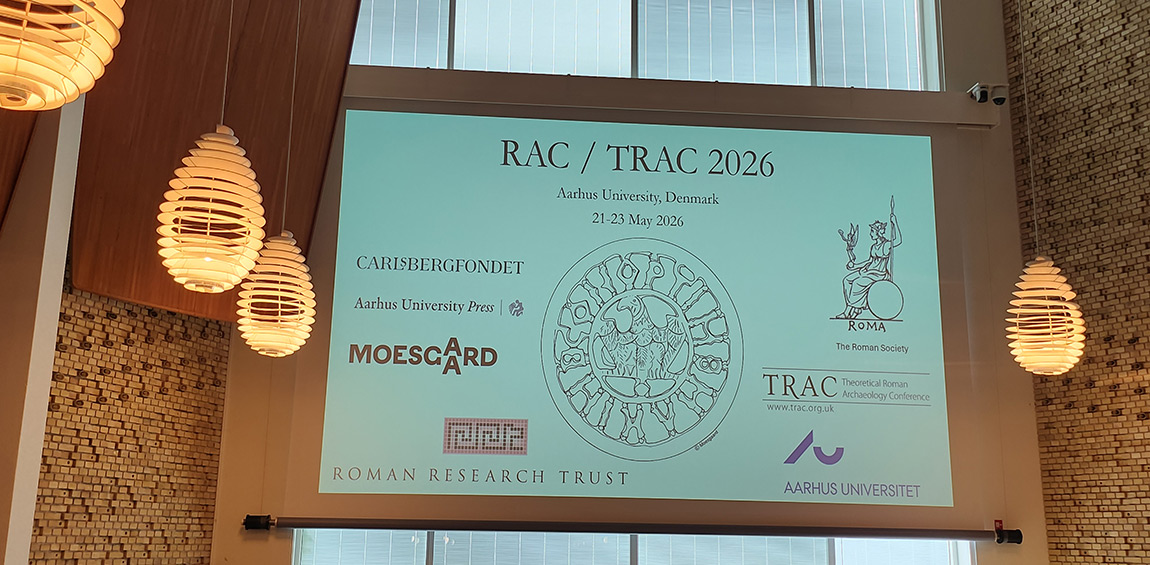
The Roman Society (Society for the Promotion of Roman Studies) and the Theoretical Roman Archaeology Conference (TRAC) jointly hosted this conference. The Roman Society has been organising biennial conferences since 1995. TRAC was planned in 1991 as a one-off event but due to interest it became an annual fixture until joining the RAC in 1995, organised by the Roman Society.
Since 2009 the conference is held once in the UK (the homebase of the Roman Society and of TRAC) and the next year outside the UK. Since in 2024 the conference was held in London, it was abroad this year, at the Aarhus Universitet (Aarhus University) in beautiful Aarhus, Midtjylland, Denmark. The Aarhus University has existed for nearly 100 years and is situated in the second largest town in the country (See Figure 1). Aarhus Universitet was a wonderful co-host providing us with coffee, cold soft drinks and Danish pastries during coffee breaks, and pre-ordered lunch in form of vegan wraps or rolls. The volunteers were recruited from among the students, and they did a great job in answering questions and helping with technical issues.
Day 1: Thursday, 21 May
Registration was open well in advance of the start of the conference so there was enough time to familiarise yourself with the premises and to browse through the conference program and abstracts. The opening ceremony was shorter than indicated in the program (See Figure 2). It consisted of words of greeting from the organisers of the Roman Society and TRAC as well as from the Aarhus University. Before going to the poster presentations and publisher stalls there was time to enjoy the first coffee break with Danish pastries. There were stalls for six publishers, among which were BAR Publishers and De Gruyter Brill, who all offered a conference discount on their publications. Like the conference itself the titles of the books covered a wide array of topics related to ancient Rome. The 36 posters, which were presented during this noon session with the creators standing next to them, covered not only a huge diversity of topics but also of regions, for example the latest information concerning the legionary camp at Neuss (D), or scissors and water supply in Roman Spain, or finds from Roman Scotland. The posters remained hanging throughout the whole conference (See Figure 3). The period after lunch was packed with nine parallel sessions which were each dedicated to a specific topic, for example Queer Roman archaeology, Roman Britain, water cultures beyond Roman Italy and Roman villas, with one paper presenting archaeological research close to my area, to name but a few. In each session between six to seven papers were presented with a coffee break in between. The evening was closed with a keynote lecture by Annalisa Marzano on Roman Archaeology in the Mediterranean Core and Frontier Zones.
Day 2: Friday, 22 May
The second day was fully packed with 9 parallel sessions, each between eight to ten lectures, introduced in the morning by the session organiser. I took part in the TRAC 2 session focusing on Experimental Archaeology and Living History organised by Alexander Iles (See Figures 4 and 5). I presented a paper on the portrayal of gladiators in reenactment. Other lectures in our session covered such interesting subject areas as how to strike bronze coins, reconstructing a naalbound sock, Roman reenactment in Ireland and how many Roman finds are there actually in Ireland, Roman era knitting and how to reconstruct the impression of a Late Roman emperor (See Figures 6 and 7). Before each break there was time to discuss the papers just presented. Other sessions on this day covered topics such as Roman harbour cities, burials, crafts, epigraphy, life at the edge of the empire to name but a few. In the late afternoon was a RAC Roundtable on the topic “Wither Roman Studies? New Agendas and the Current World in 2026” which took place in the aula. Four people presented a lecture on this topic, followed by a debating round with a panel of seven other people.
Day 3: Saturday, 23 May
The third day proceeded the same way as the second one with 9 parallel sessions covering, among other things, the curation of the Roman era in museums, water management and regional dynamics. This time the roundtable at the end of the day was organised by TRAC on the topic of “Decolonising the Roman Past. A Subaltern and Posthumanist Feminist Path in the Face of the Contemporary Human Crisis” with six people presenting their papers followed by a debating round with a panel of seven other people (See Figure 8). After that it was time to say goodbye but not before the organising committee said some words of thanks, especially to the volunteer students who received a big applause from the audience because everyone had appreciated their good work and assistance throughout the conference. Awards were presented. In one of the final speeches the number of delegates was given as 470. To end the next venue was announced as Cardiff, Wales. The people from Cardiff announced this first in Welsh before they translated it into English.
Excursions
There was a pre-conference excursion on Wednesday, 20 May to Moesgaard Museum which is only 15 min. by car from Aarhus. Three guided tours were offered: Two through the temporary exhibition about the Celtic World led by Camilla Bjarnø, a curator at the Moesgaard Museum. The other tour was through the exhibition of the finds from Illerup Ådal led by Xenia Pauli Jensen who is a senior researcher at Moesgaard Museum (See Figures 9, 10, and 11). She also gave a lecture on News from Barbaricum: Current Research in Roman Iron Age in Scandinavia . After the guided tours there was, of course, the opportunity to see all other exhibitions at the Museum.
On Sunday, 24 May, there was a post-conference excursion which was an organized bus trip to the museum of Vejle and to the Jelling rune stone. Vejle is a town located 75 km south of Aarhus with Jelling being another 10 km from Vejle. This trip lasted the entire day.
Conclusion
The conference was packed with loads of information including the two excursions and each conference day which had nine sessions running parallel. There were over four hundred delegates, some EXARC members, attending the conference either as visitors, session organisers, or speakers. It was not, therefore, possible to see everything or to meet everybody. As mentioned above the topics of the sessions were wide ranging, covering a vast array of themes. For this reason, you were able to learn a lot and had the chance to connect with old friends and new people. Though it was sometimes very tiring it was a wonderful experience thanks to the organising committee and the local organisation, which made everything run smoothly and found quick solutions to any problems such as locked lecture rooms on Saturday morning. Everyone who attended this conference, no matter if student, academic, or non-academic, shared a common interest in Ancient Rome. I would encourage everyone with an interest in Ancient Rome to attend this kind of conference.
Some people complained that the lecture rooms were spread over various buildings. Those buildings were connected by an underground passageway, so it was easy to get from one part of the buildings to the other without crossing the busy four lane road. This was just a minor venue issue and despite this I loved it.
Acknowledgment
My thanks go to EXARC member Alexander Iles who was the session organiser for the TRAC 2 session on ‘What it is to be Roman: Experimental archaeology’ who had convinced me to speak about the portrayal of gladiators and gladiatrices as Living History at various types of events. I assume that my presentation was of interest to some people in the audience at our lecture room at the Antikmuseet (Museum of Ancient Art).
Keywords
Country
- Denmark