

The content is published under Creative Commons Attribution 4.0 International license (CC BY 4.0).
Unreviewed Mixed Matters Article:
Conference Review: OpenArch/IMTAL Sweden 2012
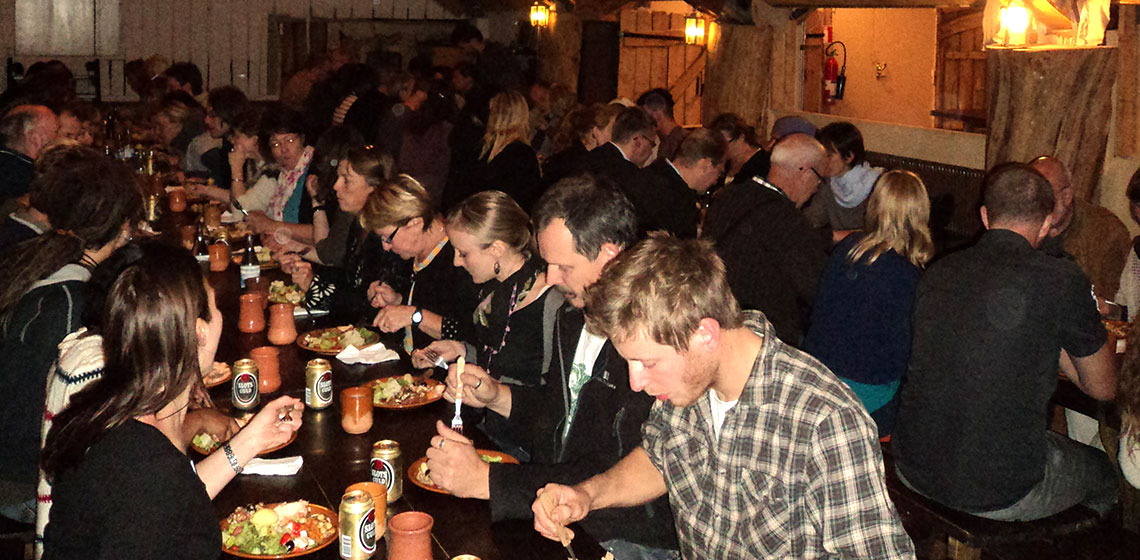
As a long-standing member of IMTAL (International Museums Theatre Alliance – www.imtal-europe.org) I have always enjoyed their conferences. The workshops and participatory events are held in fantastic venues with theatrics to entertain and inform. However, this conference was being held in partnership with an archaeology group with delegates from around the world. Would they find our way of interpreting heritage too much to take?
In the event I need not have worried. Although each organisation had a different approach it was immediately obvious that we shared the same values, aims and objectives. Everyone was committed and enthusiastic about their heritage and keen to disseminate their understanding and knowledge to a wide audience in the most effective way possible.
From the first coffee break to the final, elegantly served and delicious meal, the conference was an extraordinary experience.
The first thing that struck me was the willingness of delegates to engage with each other. Fortunately for me, English was the common language. People from different countries and disciplines debated and delighted in each other’s experiences and interests. There was no age barrier, no sense of being unimportant. Everyone was here to learn and to enjoy the cross-cultural diversity.
"I had no idea you were all so professional!" commented an archaeologist.
"I had no idea you were all such fun!" I responded.
What did the Conference do for me?
I founded the Guernsey ‘History in Action’ Company (GHIAC) during my time as Access & Learning Manager at Guernsey Museum. I knew that our local history was under-appreciated and poorly understood, and I felt ‘Museum Theatre’ offered a fresh approach.
Although I am now retired, GHIAC continues to work closely with Guernsey Museum and has a portfolio of over 50 presentations that include ‘first person’ accounts, short plays, costumed storytelling and appropriately dressed characters from the past. Performances take place in historic sites such as Castle Cornet and Fort Grey, in schools, and at events.
The focus of the OpenArch/IMTAL Conference was ArchaeologicalOpen-Air Museums: future perspectives and how theatre with historical contents can engage the audience. A wide brief!
I learnt that there is a multitude of ways to use heritage sites, academic research and artefacts to inform, enthuse, value and entertain. These are just a few:
- Traditional games are a brilliant way to connect to the peoples of the past. For example, the Foteviken Viking Fest was a triumph!
- You can develop a connection to a site, historical information or artefacts by encouraging people to develop their own stories. The session led by Emily Capstick invited delegates to develop site specific presentations. The themes that emerged included elements which touched on Odin to MI5, Revenge and ‘Jumping’: the Viking site was never so explored!
- You can address complex cultural divides by reflecting on differing views and beliefs sensitively and with compassion.
- The devil is in the details. Even the way you greet a neighbour can help to direct the audience to the place and time you are trying to convey.
- A theme park is not an Open-Air Museum and does not represent ‘Open Archaeology'. Archaeology stems from the site and it is its emergence through interpretation and reconstruction that enables the visitor to experience a sense of times past. This cannot be done through what is essentially a stage set.
- Few organisations work with the local Education Department although everything we do is ‘educational’.
- Science can be ‘lived’. This is best educational practice, but much more effective when led by a consummate performer!
- Our audiences should be at the centre of what we do. Without an audience, be it holidaymakers or academics, we have no reason to explore and conserve our heritage.
- That ‘intangible’ heritage must be considered as much as ‘tangible’ heritage.
- The Germans have a great sense of humour, and the Swedes do great food!
There were questions too….
- Is there such a thing as an ‘authentic replica‘? As one delegate remarked: "Isn’t a replica authentic?"
- How should we describe what we do?
Many of the Scandinavian colleagues used the term ‘Museum Mediation’ whereas we are more likely to use the term ‘Museum Interpretation’.
- Is what we strive for Living History, Live Interpretation, Historical Role Play, re-enactment or….?
- When are we interpreters, storytellers, re-enactors, actors, a teacher in appropriate costume or entertainers with knowledge?
- Can we present the past in an objective way or is it only accessible if it matches cultural expectations?
I have returned to Guernsey with a head full of ideas. Fortunately, my lovely successor at Guernsey Museum, Josephine Dowding also attended and was inspired by the conference. GHIAC will never be the same again!
Over the four days Sven, Bjorn and their extraordinary team provided wonderful venues, the highest quality food, drink, entertainment, transport and guided tours. We were totally indulged!
Without the distractions of everyday life we shared our experiences, laughed a lot, had endless discussions, learnt and were amazed, were inspired – and humbled - by the experiences and achievements of those around us.
Thank you!
Keywords
Country
- Sweden