

The content is published under Creative Commons Attribution 4.0 International license (CC BY 4.0).
Reviewed Article:
Reconstructing Textile Cleaning in the Ancient Roman Fullonicae
This project experimentally reconstructs textile cleaning in the ancient Roman fullonicae. White wool fabric was stained with olive oil, soil, wine, and tomato-based sauce to approximate the everyday soiling of Roman garments. After allowing the stains to set for seventy-two hours, the cloth underwent a washing, rinsing, and drying procedure modelled on descriptions and archaeological evidence of fulling workshops. A 1:1 mixture of stale urine and water was tested against a modern castile soap solution and a no-treatment control. The stale urine performed comparably to, and in some cases slightly better than, the castile soap at removing dirt and oil, while both treatments left the wool soft in texture. Notably, the urine-treated cloth retained no detectable odor after drying. These findings support the evidence for urine-based cleaning techniques in the ancient Roman fullonicae.
Introduction
The fullonicae , or Roman fullers’ workshops, functioned as the ancient equivalent of a modern laundromat, where the Romans would have brought their large white woolen togas and other garments to be cleaned and treated. As most Romans lacked access to running water, many relied on professional fullers to return their garments to them in a cleaned state, thus creating an important industry in the Roman Empire (Bradley 2002, 24). Though urine may strike modern expectations of cleanliness as shocking or absurd, even paradoxical, it can be seen as a logical and practical cleaning agent when situated in the context of the Roman Empire. A cheap and naturally produced liquid, urine served a wide range of purposes in the ancient world. In his Natural History, Pliny the Elder records the use of urine in the preparation of dyes and metals, removal of hair from cattle hides, production of fruit, and in an array of medicinal treatments including snakebites, burns, ear infections, sunburns, rashes, and sores (Pliny Natural History 33, 93; 33, 127; 23, 140; 17, 262; 28, 173; 28, 65-67; 28, 91; Bradley 2002, 31).
Although the ancient Romans likely did not understand the specific chemical mechanism behind the use of alkaline liquid as a cleaning agent, they appeared to have recognized these principles empirically. Pliny notes that more concentrated urine, particularly the urine coming from camels, was most useful to fullers (Pliny Natural History 28, 91 Bradley 2002, 30). Moreover, the urine that was used in the fullonicae was generally many days old, a stale mixture that would have been collected on the streets throughout the week before being relocated to the fullonicae for use. Evidence of this comes from the remains of large ceramic vessels set into the ground near the streets of Pompeii, some with openings that would have allowed liquid to drain directly into pipes leading into the fullers workshops (Bradley 2002, 30). This aligns with what we now understand about ammonia formation: as urine decomposes over time, bacterial enzymes break down urea, increasing both the ammonia content and the basicity of the solution (Barbosa et al. 2019, 937). In turn, the resulting alkaline mixture would presumably function much like a modern detergent or soap, in which a strong base reacts with fatty acids and breaks down oils, grease, and dirt embedded in the fabric through the process of saponification.
Miko Flohr, who has done extensive research on the fullonicae of Roman Italy, suggests that the role of ammonia in urine has been exaggerated by modern scholars (Flohr 2017, 39). Perhaps the surprising absurdity of urine itself as a cleaning agent has drawn contemporary attention to urine, downplaying the role of other materials that may have contributed to the washing process. There is indeed a gap in our understanding of the practical aspects of the fullonicae that ancient literary references and the archaeological evidence may never adequately address. For example, to what extent was stale urine effective as a cleaning agent? Were certain types of stains more responsive to this treatment than others? And after washing and drying, how would the cloth have smelled, felt, and looked relative to before?
These questions guide the following experimental reconstruction of textile cleaning in the ancient Roman fullonicae. Through this process of reconstruction - replicating the manner in which wool would become soiled through ‘everyday use,’ the process by which urine of varying concentrations would have fermented in vessels throughout the week, and the washing, rinsing, and drying procedures in the fullonicae - I aim to assess not only the practical efficacy of stale urine as a cleaning agent but also the sensory and embodied dimensions of the work performed by the Roman workers.
Method
The first step in this project involved the collection and fermentation of urine. Samples were collected on Saturday and left to ferment in protected containers that permitted air exposure while preventing the entry of debris, approximating the open collection vessels used in Roman fulling contexts. The samples varied in ammonia concentration corresponding to varying degrees of bodily hydration throughout the day. To prepare the textile samples, 100% white wool sheets were cut into twelve smaller patches measuring approximately nine by five inches. The wool swatches were then stained with a few tablespoons of wine, olive oil, tomato-based sauce, or natural brown soil to approximate common forms of soiling in daily Roman life, including sweat and dirt from labor in urban conditions, and spills from indulging in wine and food. Each stain type was applied to three separate wool swatches, with one swatch assigned to each of the three treatment conditions: urine-based treatment, castile-soap treatment, and no treatment. The wool was left to soak in the stains for seventy-two hours as a practical approximation of the delay that may have occurred before garments were brought to a fullonica for cleaning.
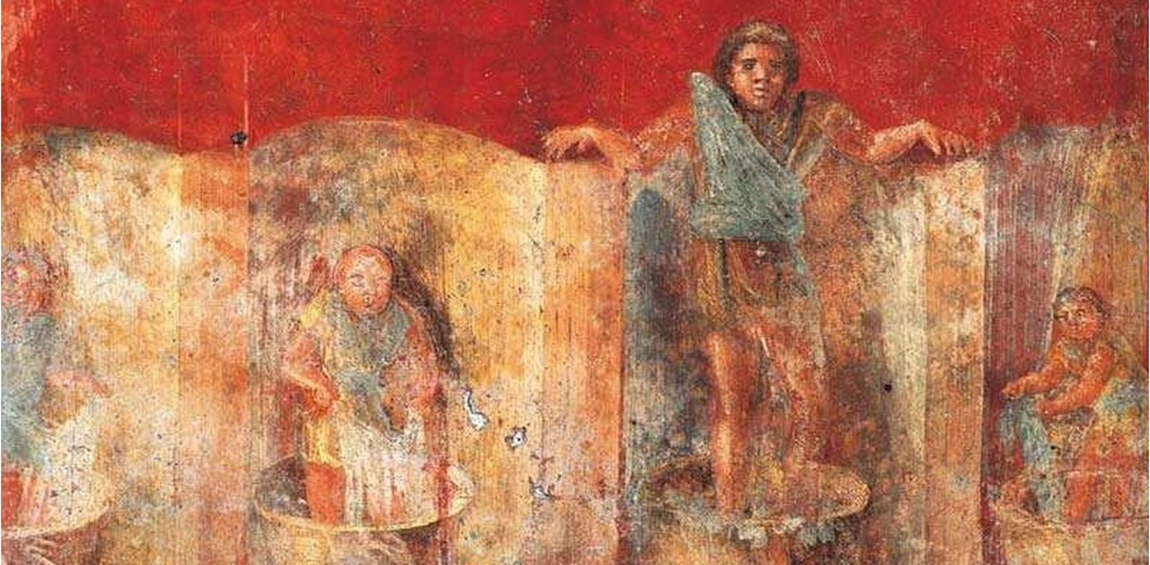
While most of what we know about the process in the fullonicae comes from imaginative reconstructions based on archaeological evidence and ancient literary sources, there appears to have been a standard procedure of washing, rinsing, drying, and treating the wool clothing (Flohr 2009, 175). During the washing phase, Roman workers, often slaves, stomped on the garments in large basins in a process called treading (See Figure 1) (Flohr 2020, 90). These basins would likely have been filled with water, urine, and other additional agents such as nitrum, potash, and fuller’s earth of various kinds to absorb the grease (Bradley 2002, 24). Because the available evidence does not specify the ratio of urine to water or the amount of cleaning agent used by Roman fullers, I employed a 1:1 ratio of water to stale urine, mixing 800 mL of each to obtain a reasonable volume of liquid in the basin relative to the size of the wool swatches. I replicated the treading process in a small basin – quite a bit smaller than the ancient tubs that would have accommodated a person standing and treading inside – using my hands to press, toss, and turn the wool items in the liquid mixture for approximately fifteen minutes.
After washing, the Roman garments would have been rinsed thoroughly. At the Fullonica of Stephanus in Pompeii, clothing was rinsed in an organized fashion via a system of three rinsing basins (Flohr 2020, 90). As fresh water flowed from an inlet pipe into an initial basin and then onward to a second and third basin, the garments would have followed the opposite sequence, moving from the dirtiest water in the final basin to the freshest water in the first basin (De Feo and De Gisi 2013, 601). This interconnected system of rinsing enabled fullers to conserve water by reusing the fresh water in the initial basin twice as it moved into the subsequent basins. Smaller fullonicae in Pompeii would have simply used water from the public street fountains and rinsed clothing in one step (Flohr 2020, 90).
Following the rinsing process, the clothes would have been checked to ensure that all stains were adequately removed; if cleaned to satisfaction, the garments were hung to dry out in the street (De Feo and De Gisi 2013, 600). If unclean, they would have undergone a second round of washing (De Feo and De Gisi 2013, 600). Once dry, the garment was likely brushed and whitened using burning sulfur or a fine white clay called Cimolian earth (Pliny Natural History 35, 197; Bradley 2002, 29). In my reconstruction, I rinsed the wool pieces under running water rather than in an interconnected system of rinsing basins, replicating the methods of the small-scale fullonicae. After rinsing, I repeated the treading process with the wool swatches stained with wine and tomato sauce. The same procedure was repeated in the castile soap condition, using an equivalent total volume of liquid. Colorimetric pH strips were used to compare the relative alkalinity of the stale urine and castile soap solutions. Given the constraints of cold rain and wind that weekend, I was unable to feasibly dry the wool outside as the Romans did. Instead, I dried the cloth on a clothesline facing the window in hopes that a degree of solar energy might assist the drying process.
Results
The stale urine was effective at removing both the oil and the dirt from the wool (See Figures 2-3). The wine stain faded but remained visible after washing and drying (See Figure 4). The tomato stain faded but was not completely removed, while the oil on the wool completely disappeared (See Figure 4). In general, the urine condition performed equally, if not slightly better than the castile soap condition (See Figure 5). This comparable performance may reflect the similar pH levels of the two liquids, both of which were weakly alkaline with a pH of approximately eight (See Figure 6).
Beyond the appearance, the texture of the wool after both washing conditions felt softer and less tightly wound than it had before washing. This was to be expected given the rigorous nature of treading, soaking, and rinsing; however, I was surprised that the urine did not alter the texture relative to the castile soap condition. The smell of the cloth after the urine condition was also surprisingly faint, despite the extensive soaking and the absence of any additional scents to mask the odor. This observation is important because, although we cannot directly access ancient sensory experiences, experimental reconstruction may be the best approximation of what the washed togas would have smelled like upon emerging from the fullonica . While urban Romans may have become accustomed to the ubiquitous scent of urine (as scholars like Miko Flohr argue), it is also plausible that the multi-step rinsing process heavily diluted the stench of urine from the clothing (Flohr 2017, 39).1
Discussion/Limitations
Taken together, the efficacy of stale urine at removing oil and dirt from 100% wool fabric supports the idea that urine would have served a practical cleaning function in the fullonicae of ancient Rome. However, this claim must be considered along with certain methodological constraints such as the inherent impossibility of accurately replicating the process using modern-day materials and an experimental location inside an apartment.
There are several limitations with respect to the materials used in this reconstruction. First, the use of tomato sauce as a stain was shortsighted given that tomato was a New World item and therefore did not exist during the Roman Empire. Alternative stains such as fish sauce or honey, which were commonly consumed in ancient Rome, would have constituted more historically grounded choices. Honey, as a primarily sugar-based and water-soluble food item, and fish sauce, as a salty, protein-rich liquid, may have responded differently to a mildly alkaline cleaner relative to the acidic, oily, and pigmented tomato sauce. Future investigations might compare additional stain types to examine how the chemical composition of different forms of soiling affects the efficacy of urine-based cleaning.
Wine and olive oil, by contrast, were both ubiquitous in the Roman world. Ancient Roman wine was chemically complex and often modified with various additives, including herbs and spices, that affected its aroma, taste, and color; yet it shares many of the basic chemical properties of modern wine, including ethanol, tartaric acid, and anthocyanin pigments that contribute to red wine’s color (Drieu et al. 2020). Because ancient Roman wine was often diluted with water, the modern wine used in this experiment may have produced a more concentrated stain, contributing to its persistence after washing (Feier et al. 2019, 336). Finally, while olive oil does not replicate the mixture of bodily oils that would have accumulated on Roman garments, its successful removal suggests that stale urine may have loosened similarly hydrophobic bodily residues associated with perspiration and daily wear.
Beyond the material constraints, this reconstruction is also limited by procedural unknowns: the proportion of urine to water, the duration of the treading process, and the specific type, amount, and application of fuller’s earth. Michael Witty (2016) argues that simple decayed urine may have been too chemically diluted to generate substantial concentrations of ammonium. He proposes instead that ancient Romans could have added wood ash to decomposed urine, raising the pH and causing ammonium to crystallize as struvite, thereby producing a more concentrated and transportable “urine powder.” If such processing occurred in fulling contexts, the diluted stale urine used in this experiment may underestimate the potency of the urine used by Roman fullers. In addition, sources suggest that fuller’s earth functioned as a degreasing agent during the washing stage and as a finishing agent during the drying stages (De Feo and De Gisi 2013, 601; Bradley 2002, 24). However, given my limited supply of urine and the absence of clear instructions regarding the application, quantity, or type of fuller’s earth used, I omitted it during the washing stage so as not to confound the role of stale urine as the primary cleaning agent. Instead, I attempted to rub fuller’s earth on the garments after the drying process as a finisher, but immediately noticed that the white wool began to turn a greyish tone. This was likely a misapplication of the fuller’s earth technique, suggesting that only white or very pale fuller’s earth would have been applied after the drying stage.2 Future experimental reconstructions might systematically compare urine-only washing with multi-agent washing conditions and finishing treatments to examine how alternative materials may have affected stain removal, texture, odor, and the final appearance of cleaned wool garments.
Finally, I captured some sense of the sensory and embodied experience of interacting with stale urine. I experienced a level of fatigue from the washing and rinsing stages, and some slight nausea throughout. However, relative to the ancient Roman slaves who would have treaded barefoot in large stalls with no protection from the fumes, likely for hours on end, my experience was glamorous. I sat on the floor rather than stood, used my hands coated in gloves rather than my bare feet, and protected my face with a mask and goggles. There was only so much I was willing to subject myself to in order to replicate the experience of ancient Roman fullers.
Conclusion
With these limitations in mind, this reconstruction does not claim to replicate the processes in the ancient Roman fullonicae with complete accuracy. Rather, this experiment offers a window into the practical aspects of the Roman fullonicae and the efficacy of stale urine at removing dirt and oil stains soaked into wool fabric. These results, in addition to sensory observations such as the soft texture of the wool, the lack of residual odor after drying, and the general experience of mixing fabric in urine for cleaning purposes, could only have been accomplished through direct experimentation and the willingness to engage in something new, unique, and rather uncomfortable.
Acknowledgements
This research is based on work I completed for the Ancient Roman and Greek Technology course at Dartmouth College in Fall 2025 with Professor Margaretha Kramer.
Keywords
Country
- USA
Bibliography
Barbosa, S. G., Rodrigues, T., Peixoto, L., Kuntke, P., Alves, M. M., Pereira, M. A. and Ter Heijne, A., 2019. Anaerobic biological fermentation of urine as a strategy to enhance the performance of a microbial electrolysis cell (MEC). Renewable Energy , 139, pp. 936-943.
Bradley, M., 2002. ‘It all comes out in the wash’: Looking harder at the Roman fullonica. Journal of Roman Archaeology,15, pp. 20-44.
De Feo, G. and De Gisi, S., 2013. Water and wastewater management in the treatment process of a Roman fullonica. Water Science & Technology: Water Supply , 13(3), pp. 599-605.
Drieu, L., Rageot, M., Wales, N., Stern, B., Lundy, J., Zerrer, M., Gaffney, I., Bondetti, M., Spiteri, C., Thomas-Oates, J. and Craig, O.E., 2020. Is it possible to identify ancient wine production using biomolecular approaches? STAR: Science & Technology of Archaeological Research , 6(1), pp. 16-29.
Feier, I., Migała, A., Pietruszka, M. and Jackowski, M., 2019. Roman wine in Barbaricum: Preliminary studies on ancient wine recreation. Heritage , 2(1), pp. 331-338.
Flohr, M., 2009. The social world of Roman fullonicae. Theoretical Roman Archaeology Journal (TRAC 2008) , pp. 173-185.
Flohr, M., 2017. Beyond smell: The sensory landscape of the Roman fullonica. In E. Betts, ed. Senses of the Empire . London: Routledge, pp. 39-53.
Flohr, M., 2020. Exploring the limits of skilled craftsmanship: The fullonicae of Roman Italy. In N. Monteix and N. Tran, eds. Les savoirs professionnels des gens de métier: Études sur le monde du travail dans les sociétés urbaines de l’empire romain . Naples: Centre Jean Bérard, pp. 87-100.
Meisterdrucke, n.d. Pillar fresco depicting wool manufacturing, from Pompei, Fullonica of Veranio Ipseo . Image ID: 1470317. Museo Archeologico Nazionale, Naples, Campania, Italy / Bridgeman Images.
Pliny the Elder, 1950. Natural History, Volume V: Books 17-19 . Translated by H. Rackham. Loeb Classical Library 371. Cambridge, MA: Harvard University Press.
Pliny the Elder, 1951. Natural History, Volume VI: Books 20-23 . Translated by W. H. S. Jones. Loeb Classical Library 392. Cambridge, MA: Harvard University Press.
Pliny the Elder, 1952. Natural History, Volume IX: Books 33-35 . Translated by H. Rackham. Loeb Classical Library 394. Cambridge, MA: Harvard University Press.
Pliny the Elder, 1963. Natural History, Volume VIII: Books 28-32 . Translated by W. H. S. Jones. Loeb Classical Library 418. Cambridge, MA: Harvard University Press.
Witty, M., 2016. Ancient Roman urine chemistry. Acta Archaeologica , 87(1), pp. 179-191.