

The content is published under Creative Commons Attribution 4.0 International license (CC BY 4.0).
Unreviewed Mixed Matters Article:
Conference Review: The 7th CONEXP held October 22-25 2025 in Liège (Belgium)
The 7th International Congress of Experimental Archaeology was held by the members of the TracéoLab (Liège, Belgium), between 22 and 25 October 2025. The organising committee was composed of Veerle Rots, Dries Cnuts, Justin Coppe and Sonja Tomasso (See Figure 1). This meeting, which takes place every three years, was eagerly awaited by the experimental archaeology community. It fulfilled all expectations and was a great success.
The schedule of this meeting was full, combining an inaugural talk open to the general public, 6 keynotes, 42 presentations and 10 posters, plus a day of live experiments with 14 experimental workshops.
The inaugural public conference, entitled: "Seul au monde: comment Sapiens est devenu le dernier humain?" was given by Nicolas Teyssandier (CNRS, UMR 5608 -TRACES) at the Salle Académique of Liège University (See Figure 2). It gave an actualised overview of this captivating topic, bringing together data from different approaches; from cognition to paleoanthropology and lithic technology.
The first day of the conference (October 22nd - See Figure 1) opened with the keynote presentation by Miguel Biard and colleagues, who presented the results of an experimental research programme focused on the production of large Magdalenian blades of the W11 habitation unit from Étiolles (France). Drawing on renewed lithic studies and experimental replication, this keynote provided a solid introduction to Axis 1 (Tool Production and Use), which structured the morning sessions. The subsequent oral presentations covered a broad range of experimental archaeology topics, including functional analyses, cultural transmission of knapping techniques, the application of multiscale microscopy for identifying technological gestures, and the role of raw material properties in shaping technological strategies.
Following the lunch, the second keynote was delivered by Jordi Rosell, who presented the results of his ERC-funded research on interactions between Neanderthals and carnivores. His talk introduced a “neotaphonomic” framework based on experimental exposure of faunal assemblages to wild carnivores, offering new perspectives on the duration and nature of Middle Palaeolithic occupations in Catalonia (Spain). This keynote was followed by presentations grouped under Axis 2 (Material Properties and Transformation). These focused primarily on post-depositional processes affecting archaeological materials under controlled experimental conditions, including sedimentary dynamics, freeze–thaw processes, and material degradation.
The day concluded with a final session returning to Axis 1, which focused on bone tools and their technological variability. These presentations addressed the diachronic use of bone implements as knapping and mining tools and emphasized the relevance of applying the chaîne opératoire concept to bone industries in order to better understand technical gestures, tool life histories, and behavioural implications.
The second day (October 23rd) began with the keynote lecture by Florent Tereygeol, who reviewed more than thirty years of experimental and archaeological research in archaeometallurgy, centred on the silver mines of Melle (France). His presentation addressed not only issues of raw material acquisition and metallurgical production, but also the long-term development of an experimental platform that has become a major reference for archaeometallurgical research and heritage valorisation well beyond the chronological limits of the medieval site itself. This keynote introduced the sessions of Axis 3 (Public Outreach), in which speakers presented a wide variety of case studies illustrating how experimental archaeology contributes to scientific communication, heritage mediation, and public engagement across different European contexts.
Before lunch, another session under Axis 1 focused on experimental studies of butchering and cooking processes. These contributions examined both use-wear traces on lithic tools and modifications observed on faunal remains, providing new reference data for interpreting subsistence practices. The lunch break was accompanied by the poster session (See Figure 3), which showcased a wide range of experimental archaeology research, from the development of digital databases and management systems for experimental protocols to methodological innovations and results from targeted experimental programmes.
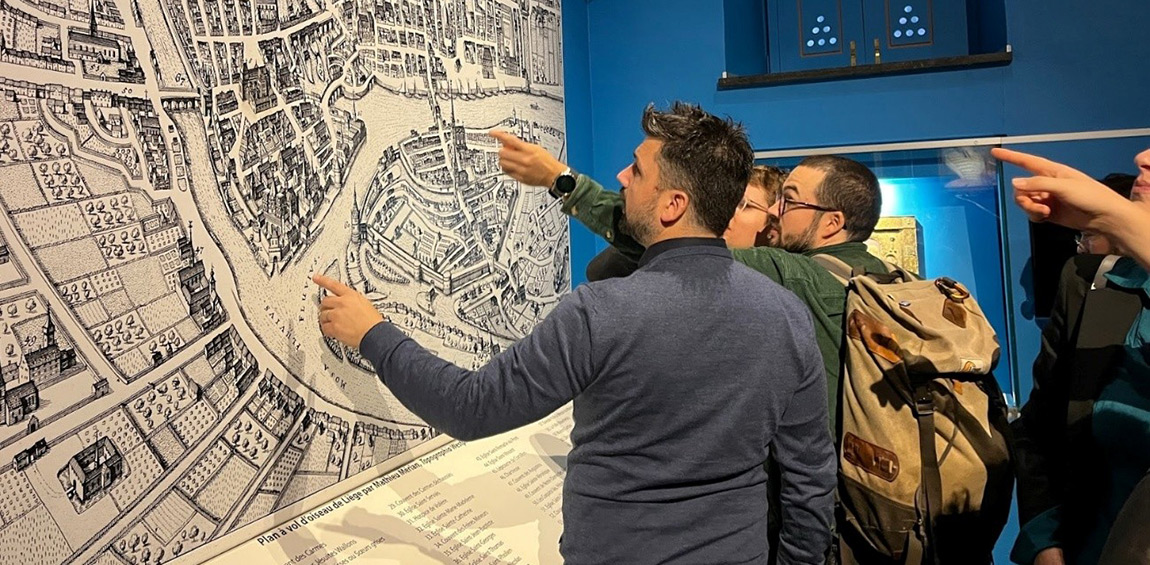
In the afternoon, the fourth keynote was delivered by Susanna Harris, who emphasized the importance of experimental research on perishable materials, particularly textiles. Her presentation highlighted how experimental archaeology can address the inherent bias of the archaeological record by moving beyond functional analyses towards sensory and experiential approaches, thereby offering deeper insights into past human practices and social worlds. The final oral presentations of the day focused on organic materials, including experimental research on plant fibers, cordage production, leather processing and personal ornaments. The day was concluded by a social activity and a visit to the Liège cathedral treasury with a cocktail (See Figure 4).
The third day (October 24th) opened with the keynote by Aimée Little, who explored the potential of experimental archaeology to investigate sensory dimensions of prehistoric technologies. Drawing on case studies from the Upper Palaeolithic and Mesolithic, she argued for moving beyond strictly techno-economic frameworks towards embodied and experiential interpretations of past practices. The subsequent sessions under Axis 1 presented a diverse set of experimental studies, including research on throwing sticks, hammerstones, and retouchers made from flint and other raw materials, functional analyses of tools made from industrial glass used by recent hunter-gatherer groups, and use-wear studies of stone mining tools.
After lunch, the final keynote was delivered by Maud Mulliez, who reviewed over a decade of experimental research on Roman wall painting. Her presentation demonstrated how experimental approaches can be applied to the study of ancient painting techniques, gestures and materials, an area that remains comparatively underexplored within experimental archaeology. The following presentations focused on rock art, both parietal and portable, before returning to Axis 1 with discussions on the behavioural and cognitive implications of tool production and raw material selection.
The conference concluded with sessions under Axis 2, addressing a wide range of experimental studies, including the thermal alteration of materials such as antler and flint, experimental archaeometallurgy of arsenic alloys, archeoastronomy experiments related to religious architecture, and the development of electronic replicas of prehistoric torches designed to reproduce lighting conditions comparable to those experienced in ancient contexts. The final talk was given by V. Rots, who presented the TraceoLab (See Figure 5).
The final day was dedicated to live experiments, demonstrations, and visits to the Prehistomuseum of Ramioul (See Figures 6 - 9). Fourteen highly diverse experimental workshops were held throughout the day inside and around the Museum, such as birch-tar production, flint knapping, and pyro-archaeological experiments. The participants and public could participate in some workshops, such as fiber processing, throwing sticks, or even the building of a Neolithic palisade. It was also possible to visit the famous Ramioul cave in the dark, using the modern replication of prehistoric torches presented during the congress. Demonstrations of gladiators and historical martial arts were also performed.
The Liège conference continues in the tradition of previous editions, bringing together a community of experimental archaeologists that has never been so diverse. All the community is looking forward the 8th CONEXP meeting, which will be held in Barcelona (Spain) in 2028, hosted by the Laboratory of Experimental Prehistoric Technology (LATPE - Universitat Autónoma de Barcelona) and the Laboratory of Experimental Archaeology (LAEX - Universidad Autónoma de Madrid).
Keywords
Country
- Belgium