
The content is published under Creative Commons Attribution 4.0 International license (CC BY 4.0).
Reviewed Article:
How Does the Labour Involved in Tablet Weaving Differ Depending on the Technique and Dyes Used?
This study is a summary of a project undertaken as part of the author’s undergraduate dissertation in Archaeological Science at the University of Reading. The experiment reproduced four Early Medieval tablet woven bands from Northern Europe, including every step of the chaîne opératoire from the scouring of the raw wool through to the weaving of the textiles. It aimed to compare both weaving techniques and the colours used in bands to determine which historical examples would have been the most time-consuming to produce, from start to finish. As far as possible, historically accurate methods and materials were used, including medieval-style wool combs and natural dyes, namely madder, weld and indigo extract. The labour that went into each step of the textile production process was recorded and compared between different dyes, weaving patterns, and techniques. The study revealed that the yarn production itself took the majority of the production time, especially spinning, whilst the indigo vat was the most time consuming of the three dyes used due to the fermentation process. Of the five weaving techniques compared, it was found that brocading and 3/1 twill were the most labour-intensive. The wider, more complex bands were more time-consuming to produce, due to the larger amount of yarn used and the more difficult weaving sequences, which were harder to memorise. When comparing the status of the graves from which the bands were recovered, a correlation between complexity of the band and wealth was observed, indicating that these more complicated bands were of greater value.
What is Tablet Weaving?
The tablet weaving technique of weaving narrow bands was used for a variety of decorative and functional purposes including belts, headbands, straps and woven borders on fabric. The technique has been known since at least the Bronze Age, with some of the earliest finds hailing from the salt mines of Hallstatt, Austria (Grömer, 2021).
The technical definition of tablet weaving is a form of warp-twined weaving, wherein the warp threads are passed through holes in the corners of tablets or cards, usually square-shaped and made of wood or bone. To advance the weaving, the tablets are turned either towards the weaver or away from them, passing the weft through the new gap between the top and bottom threads as shown in Figure 1. Each turn of the tablets and throw of the weft is one pick, and hundreds of picks form a densely-woven narrow tape.
The earliest surviving tablet woven bands take the form of starting borders for fabrics woven on the warp-weighted loom (Collingwood, 2015, p.13). The technique is ideally suited for producing a dense warp and its earliest evidence comes from a burial tumulus of the Middle Bronze Age, in Germany (Grömer, 2021). Complex weaves were already in use by the Iron Age, with the Hallstatt and Dürrnberg mines producing weaves of 3/1 twill (Grömer, 2021). By the late Iron Age, tablet weaving existed in two traditions: that of an ‘auxiliary technique’ for the warp-weighted loom and that of a decorative standalone technique (Ræder Knudsen, 2015, p.120). By the sixth century BC, very wide, complex bands can be found, such as that from the Hochdorf princely burial, which required 115 tablets to weave and was made using an intricate missed-hole technique (Ræder Knudsen, 1999, p.81). Tablet weaving likely reached Scandinavia by the first century BC (Raeder Knudsen, 2015, p.120) and was known in Egypt by the Byzantine era (e.g. Louvre Collections, 2019).
Tablet weaving reached its heyday in Medieval Europe. Hundreds of bands have been found, including both narrow tapes and borders over 100 cards wide, woven in materials ranging from simple undyed linen to silk with gold and silver metal brocades. A range of techniques were known, such as 3/1 twills with metal brocading from Birka, Sweden and pebble weaves and warp float designs from Snartemo, Norway. In Anglo-Saxon England, simpler metal brocades were common as well as double-faced repp-effect weaves and bands decorated with horsehair soumak, a form of weft-wrapping (Walton Rogers, 2007, p.10). These techniques tend to be regionalised and often have a continental origin, likely explained by the migration of women who dispersed their local weaving techniques (Walton Rogers, 2007, p.234). Later medieval tablet weaving became gradually more specialised and confined to ecclesiastical and royal contexts before eventually becoming obsolete in England during the Renaissance (see the examples in Coatsworth and Owen-Crocker, 2018). However, the technique remained a part of traditional costume in many parts of Asia and Eastern Europe, with tablet weaving still being practiced in indigenous communities through the present day. For example, Piggott and Henshall (1950) documented ethnographic examples of tablet weaving in Cairo, Jerusalem, and northern India.
Aims and Objectives
It is generally known that pre-industrial textile production was extremely time-consuming and formed a large part of the daily lives of people in the past. Many labour calculations have been made for handspinning, and some have been made for weaving on reproductions of historical looms (e.g. Mårtenssen, et al., 2006). However, labour calculations for tablet weaving specifically are practically unknown. This study will represent the first labour calculation for the complete chaîne opératoire - the steps and processes by which an object is produced (Delage, 2017) - for tablet weaving.
The aims of this experiment were to learn more about the labour involved in reproducing archaeological textiles, to discern the proportion of time dedicated to each step in the chaîne opératoire of producing tablet woven textiles, and to find out which weaving techniques were the most time-consuming. The project’s objectives were to carry out as many steps of the chaîne opératoire as possible, including: fibre preparation, spinning, dyeing and weaving. The final aim was to produce four tablet woven bands dating from Early Medieval Northern Europe in four different weaving techniques using three colours (red, blue and yellow), and comparing the time taken to weave one metre of each pattern.
The research questions were:
- Which element of the chaîne opératoire of tablet weaving is the most time-consuming?
- Is there a significant difference in the time taken to produce bands using different weaving techniques?
- Do the colours of yarn used to weave a band significantly impact the labour that goes into producing it?
- Can a meaningful comparison be made between the status of a burial and the complexity of a band found within?
The hypothesis is that the bands that consume more yarn, i.e. those that are made with more tablets and that use more threads per tablet, will be more labour intensive as more time is needed to produce a larger quantity of yarn. Bands using more complex techniques will take longer to weave and those with shorter, more easily memorable motifs will be faster to produce. Textiles coloured with vat dyes such as woad rather than the less complex mordant or tannin dyes will, overall, require more labour as the dyeing process is lengthier.
Previous Textile Experiments
This project will contribute to a wider understanding of how much time was dedicated to textile production, specifically tablet weaving. The comparison between grave status and tablet weaving can also shed light on which motifs and techniques were more highly regarded to people in past societies.
Previous experiments have been undertaken to calculate the labour involved in textile production; for example, Pepper (2019) compared the ease of weaving and time taken to weave cloth on both a horizontal treadle loom and a reproduction warp-weighted loom. These experiments are key to understanding how textiles were produced in pre-industrial eras and to understanding the proportion of time spent making textiles.
Furthermore, there have been several key studies reproducing tablet weaving specifically: Stoltz (2023) documented her process of learning how to weave twill motifs freehand, culminating in recreating motifs from the Snartemo V band from Agder, Norway, circa 550 AD; Skogsaas (2022) analysed and reproduced a brocaded band (13B2) from the Oseberg ship burial from 834 AD. Karina Grömer has published several reproductions of tablet woven bands from the Hallstatt salt mines dating between circa 800-450 BC. In 2005 she recreated three of the bands from the collection and recorded the time taken to weave ten centimetres of each, finding that the twilled motifs of Halltex 123 and 186 took much longer to weave than the simpler pebble motif of Halltex 152. In 2021, this experiment was repeated in part, with Grömer reproducing one metre of Halltex 123 and recording the time taken to achieve all the steps of the chaîne opératoire except for dyeing.
The Bands Recreated in this Experiment
Four historical tablet woven bands dating from Early Medieval Northern Europe were chosen to be recreated in this experiment. Each band was produced using a different weaving technique to compare the time taken between different methods. The bands chosen were each made only using red, yellow or blue yarn, all commonly used in bandweaving (Walton Rogers, 2007, p.63). These are simpler to produce than secondary colours such as green, which required the yarn to be dyed first with yellow and then again with blue. The dates of the bands recreated range from 500 to 1200 AD and hail from all over Northern Europe: one from Iceland, one from Norway, and two from Russia as shown in Figure 2.
Snartemo II
This band is from a grave in Agder, Norway, and dates to circa 500 AD (Stoltz, 2023). The band was woven with two threads per tablet, except for five border tablets (Regevik, Karisto and Pasanen, 2020). Today the band appears uniformly reddish, however the original colours are unknown. The band is often recreated in red and yellow, as was chosen here (Regevik, Karisto and Pasanen, 2020). The authors also argue that the band was woven with a tubular selvedge on one side, meaning the threads of the outermost border tablet are tucked under the band by the weft, producing a thicker, sturdier edge that reinforced the border of the band where it would get the most wear, for example a hem or sleeve cuff. The three Snartemo graves are sumptuous, containing grave goods such as gold swords, rings, and pottery (Stylegar, 2007, p.115). The graves consisted of stone cist burials, and the individuals buried inside were male, leading archaeologists to believe these were warriors. The surrounding area of Agder was known for its wealth; several gold hoards have been found in the region (Stylegar, 2007, p.102). Another, wider band was found within the Snartemo II grave (Could, 2025, p.151), and the Snartemo V grave also contained an intricate tablet woven band discussed later.
Ladoga Tabby Weave
This example, shown in Figure 4, is from Staraya Ladoga in Northwestern Russia. The Gaigovo Kurgan burials of Ladoga date to the 12th-13th centuries AD (Kochkurkina and Orfinskaya, 2016). The Ladoga cemetery consisted of 14 barrows, many of which contained other grave goods such as bells, rings, and combs. The demographic of the cemetery included both sexes, however, most of the tablet weaves were found in female graves (Kochkurkina and Orfinskaya, 2016, p.31). This band was recovered from the first mound of three found to contain textiles (Kochkurkina and Orfinskaya, 2016, p.22). It is made in a tabby weave technique, wherein each pattern tablet is threaded identically with one dark and one light thread. The pattern is produced by turning the cards one quarter turn forwards, then one turn backwards to make the striped background and forming the pattern using warp floats by changing the turning direction of the relevant cards. The original red and blue colours still clearly show in the extant band. The weft was found to be a bast fibre, likely oak bark (Kochkurkina and Orfinskaya, 2014, p.89), however, for simplicity, wool yarn was used in the reproduction. In the third barrow located at this site, an almost identical band was also found bearing the same motif but using black rather than blue as the contrast colour. This sister band was found sewn to a woollen tabby fabric (Kochkurkina and Orfinskaya, 2016, pp.29-30).
Reykjasel Brocade
This band, shown in Figure 6, is a woollen brocade from Reykjasel, Iceland, dating to circa 800-100 AD (Sarpur, n.d.). The band likely formed the straps of an apron dress (Sarpur, n.d.). The ground weave was found to be 3/1 twill (Ungerechts, 2018), and the brocade was likely made using a supplementary weft which passed through the regular shed in a lancé technique, meaning the additional weft ran from selvedge to selvedge (Bravermanová and Březinová, 2015, p.106). The brocading thread now appears white, however, it could have originally been dyed yellow, as these dyes often fade quickly, and this was the interpretation chosen for this project. The ground weave is clearly visible as being dyed red and blue in alternating stripes. Since the fragment is missing the left selvedge, the edge of the pattern had to be extrapolated from the rest of the band (Ungerechts, 2018). In my reproduction, the twill was woven using the two-pack method described by Collingwood (2015, pp.216-217). This band was found in one of two pagan graves discovered in Reykjasel in the early 20th century, with no nearby settlement or further burials. The grave in which this band was found also contained grave goods such as beads and an oval brooch, suggesting a female burial of medium-high status (Zugaiar, 2012, pp.126-127).
Kekomäki, Kaukola SZ Motif
This band was found in a woman’s grave excavated in Kekomäki near Kaukola, Russia, in the late 1880s (Schvindt, 1892, p.39). The town was originally part of Finland but now belongs to Russia following the Second World War. The site has been dated to circa 1200 CE and consists of six graves on a small hill (Schvindt, 1892, p.39; Lewins, 2015). This fragment was found in Grave 3, a double burial containing a man and a woman (Schvindt, 1892, p.70). The band likely formed part of the border of an overdress (Schvindt, 1892, p.185). Many of the graves in the cemetery were richly furnished with grave goods, including tools, weapons, textiles and metal accessories such as belt buckles and rings (Schvindt, 1982, pp.15-50). Grave 3 contained multiple weapons, textiles, and assorted metal finds such as chains and rings, as well as a pair of shears (Schvindt, 1892, pp.34-39). The band itself is no longer extant, with only the drawing shown in Figure 7 surviving. The pattern consists of alternating S and Z motifs created by changing the turning sequence of the tablets, and from Schvindt’s drawing it appears it was made with two colours of yarn, although the hues themselves are now unknown. The choice was made to reproduce the band in blue and yellow yarn, following the dark and light threads suggested in the drawing. The width of the original band is unknown. A band with a similar motif was recovered from a burial in Ladoga, Russia, although this example was woven with two rather than four threads per tablet (Kochkurkina and Orfinskaya, 2014, p.91).
Materials and Methodology
The fleece used in this experiment was a Ryeland-Suffolk cross, sourced from a local farm. The staple length was roughly 95 mm and the fibres were mostly fine with no kemp or hairs, placing the fleece in the shortwool category (Ryder, 1984: Table 5). The wool was scoured to remove the lanolin and dirt following McElroy (2018), using a modern scouring agent.
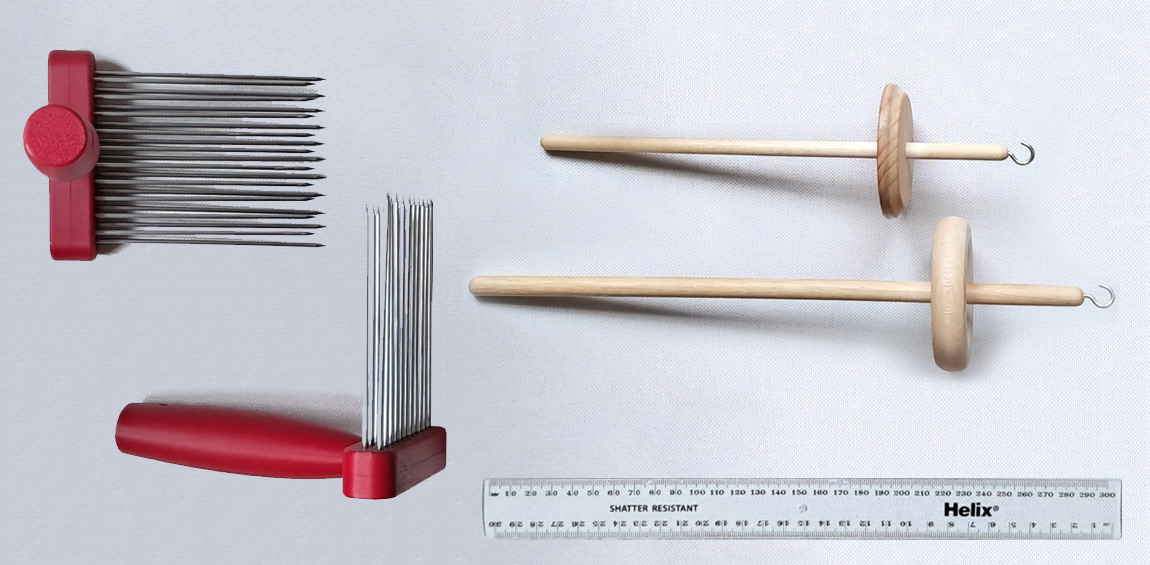
To prepare the fibre for spinning, the locks were combed using wool combs to remove any vegetable matter (VM) and shorter fibres, and to align the fibres. Locks of wool were passed from one comb to the other several times, removing waste fibre and VM in the process. The wool combs used in this experiment had two rows of straight tines, which were set into plastic three dimensional (3D) printed handles. Medieval combs were set into wooden handles and typically had curved tines, which helped with transferring the wool from one comb to the other such as those in Figure 4.2 (Hunt, 2024) The time taken to accomplish this step may be higher than is historically accurate due to the author’s lack of experience in combing.
To produce five skeins, a 25 g modern top-whorl spindle was used to spin the thread and a similar, heavier spindle (45 g) was used for plying. The sixth skein was spun using a reproduction medieval spindle and a distaff and was then plied using a modern spindle. The modern spindle setup was chosen for this experiment because it is the most familiar method known to me, and therefore I was able to produce a quicker and better quality yarn using this method than by using a medieval spindle and distaff. Using the fastest available method that allowed the production of the finest yarn was desirable for the project. This is because using the modern method allowed the production of a similar quality yarn to that produced by those with years of experience using a distaff in the Early Medieval period. Therefore, the choice to use less historically-accurate equipment resulted in a more accurate measurement of time taken.
The yarn was spun Z-twist and plied S-twist. Thread was spun and plied in batches of roughly 25 g, to make sure that each skein was about the same weight when dyeing. In the end, each skein weighed between 21g and 18 g, meaning 150 g of wool was spun overall.
For the mordanting process prior to dyeing, alum (aluminium sulphate crystals) was used. Before the late 15th century, alum was a precious commodity, and therefore, alternative mordant including plants rich in aluminium such as clubmoss were used (Hall, 1996, pp.636-638; Wright, 2010, p.181). The yarn was first scoured again to remove the last of the lanolin, then mordanted using 10% weight of fibre (WOF), as suggested by Dean (2018).
The dyestuffs used were indigo, madder, and weld. The original plan for the experiment was to use woad for the blue dye rather than indigo and a dried woad ball was used to prepare a dye vat. However, it was ultimately unsuccessful and failed to produce a blue colour, therefore, an alternative was sourced in indigo extract. The woad ball was first couched to increase the dye content, following Cardon, Koren and Sumi (2023). The woad vat was then prepared following Dean (2018) and Cardon, Koren and Sumi (2023) and left to ferment for nine days. The vat was discarded after testing samples failed to turn blue and instead were dyed a brownish yellow. Although woad (Isatis tinctoria) is the more historically accurate blue dye for the Early Medieval period (Balfour-Paul, 1998, p.27), indigo allowed a similar hue to be produced. The indigo vat was prepared according to Tomkies (2017). The timings of both the woad and indigo vats were combined to produce a reasonably accurate calculation for a hypothetical successful woad vat.
To produce the red dye, 50 g of dried madder root (Rubia tinctoria) was used. This dye was in common use in Northern Europe at this period, as evidenced by its presence in Anglo-Scandinavian York (Hall and Kenward, 2004, p.404). The madder dye bath was prepared following Dean (2018).
For the yellow dye, 50 g of dried weld (Reseda luteola) was used following Dean (2018). All three dyes were found in the textile remains from the Snartemo V grave from sixth century Norway (Wright, et al., 2022).
The weaving patterns were sourced from either published analyses of the bands, e.g. Regevik, Karisto and Pasanen (2020) or from the websites of experienced weavers such as Silvia Ungerechts. Each pattern was recreated using the Twisted Threads tablet weaving pattern web app, created by Shelagh Lewins, in order to standardise the formatting of each written pattern, except for the Ladoga tabby band, as this technique does not translate well into the website’s format. Wooden tablets with four holes were used, each hole being numbered with small dots. The weft thread was stored on a bone shuttle during weaving. A 1.5 m warp was measured out for each band and one metre of each band was woven using the backstrap method. The time taken was recorded, as well as the time taken to fix any mistakes made. This was done to compare the number of mistakes made between different techniques.
The time taken for each step was recorded using the stopwatch on a mobile phone. Each active session lasted about 30 minutes, and the timings were recorded on a Microsoft Excel spreadsheet. A set of kitchen scales, accurate to the gramme, were used to weigh the yarn and measure out dyestuffs and chemicals.
Results
Three main sets of results were obtained: the time taken for each step of the chaîne opératoire; the time taken to weave one metre in each technique; and the difference in time taken.
The chaîne opératoire
The total amount of time taken to produce 150 g of dyed yarn and to weave five bands was approximately 85 active hours and 720 passive hours over three months. ‘Active’ time refers to activities where something was being done, such as preparing the dye bath and spinning the yarn. ‘Passive’ time refers to time spent waiting, such as fermenting the woad vat and allowing the dye baths to simmer. Of the 150 g of yarn produced, only 58 g was used in the production of the bands, and the rest was surplus. It was calculated using the percentage of yarn used that it took 22.5 hours to spin the yarn for the five bands and just over four hours to comb the fibre used. The further calculations use these figures rather than the time taken to produce the whole amount of yarn made for the project. The most time-consuming step of the chaîne opératoire was the spinning, taking 53% of the total active time spent on the experiment as shown in Graph 1. The production of the yarn from raw fleece to dyeing was much lengthier than the weaving of the bands themselves: weaving only took a third of the total time.
Yarn production
The 150 g of yarn took just over 58 hours to make, meaning each gramme of yarn took about 23 minutes to produce from start to finish. Of the individual processes required to produce the yarn, spinning the singles was by far the most time-consuming element, as shown in Graph 2. The average metres per gramme of the yarn was 7.32m/g, meaning each metre of yarn took roughly three minutes to spin. The total amount of time taken to spin the yarn required for each band was calculated and varied from just under 200 minutes to 428 minutes, as seen in Graph 3.
The yarn produced was compared with an archaeological example of tablet weaving from Hallstatt, Austria following Hartl, et al. (2015: Table 1). Although the Hallstatt bands date to the Iron Age, this archaeological example was chosen due to a lack of in-depth exploration of the yarn quality of Early and Later Medieval tablet weaving. The yarn made for this experiment has the same number of plies and a similar diameter to the Hallstatt yarn, with a twist angle ranging between 40° and 47°.
Dyeing
The total ‘active’ and ‘passive’ time for each dyeing activity was measured. The woad vat was by far the most time-consuming element of the dyeing process, taking the longest active time (72 minutes) and passive time (approximately 720 hours). This was due to the lengthy couching and fermenting processes, as well as the fact that the yarn had to be oxidised and soaked in vinegar after being dyed, steps which were not necessary for the madder and weld vats. The madder dyeing took a total of 13.6 hours, slightly less than the weld, which took 14 hours in total, as demonstrated in Graph 4.
Weaving
One metre of each band was woven, shown in Figure 12. After initially weaving the Ladoga band in a double-face technique, I was informed that it was in fact originally made using a tabby weave (Andalova, 2025) The band was remade in the correct technique, but the data produced from the incorrect band was retained as it was still of value. Of the five weaving techniques reproduced overall, the fastest was the simple double-faced band and the slowest was the 3/1 twill Reykjasel brocade, as shown in Graph 5. There was a moderate positive correlation (R = 0.57) between the length of a motif in picks and the time taken to weave one motif, as can be seen in Graph 6. However, the Reykjasel brocade was an outlier, as the number of picks per motif was low compared with the time taken to weave each motif, owing to the complexity of the two weaving techniques used.
Discussion
The breakdown of steps of the chaîne opératoire
The results have shown that spinning was the most time-consuming element of the textile production process. The majority of the time spent was on producing the yarn before weaving; the final step was relatively short and took just 33% of the total reproduction time. This corroborates the idea that weaving is much less time-consuming than spinning; for example Ingvild Øye has suggested that spinning the yarn for a length of cloth took three to five times as long as weaving the cloth on a warp-weighted loom (2022, p.53). One question this raises is, if yarn was produced specifically for tablet weaving, or if waste yarn from weaving larger pieces of cloth was used for tablet weaving, would it have been seen as worth expending such large amounts of labour just to produce the trims? However, much tablet weaving in the Early Medieval period was used alongside warp-weighted looms, functioning as cloth borders. This means the warp length would be the same as the piece of cloth produced – ruling out the use of offcuts for this, as loom waste tends to produce much shorter ends. It is possible then that these ends may have been used as weft, as the weft thread can be broken and rejoined fairly frequently without negatively affecting the structural integrity of the band. However, even here this could only apply for bands woven separately, as for woven borders the weft threads are left as long loops to form the warp threads of the cloth to be woven (Raeder Knudsen, 2011, p.181). Therefore, it is likely that the yarn for tablet weaving was purpose-made, at least for the warp threads.
While the breakdown of the time taken for each step of the chaîne opératoire has identified spinning as the most time-consuming process, this only considers the active time spent. If the passive time, i.e. time spent waiting for processes to occur naturally, were accounted for, then the dyeing process would take its place as the longest step. The amount of active time spent dyeing for this experiment was just over two hours, whereas the passive time totalled over 30 days. Almost all this time was taken by the preparation of the woad vat; the couching and fermentation processes required several days to several weeks each. Growing the dye plants themselves was beyond the scope of this experiment, however, had these steps been included, they would have increased the passive time taken from one month to three years. The plants must be sown, watered and harvested, and madder, in particular, requires at least three years before the dye compounds have sufficiently developed within the roots (Roberts, 2024). The dyestuffs for this experiment were purchased already processed and dried, but if they were harvested fresh then the madder and weld would need to be chopped up and the extraneous material removed, and the woad leaves would need to be mashed and shaped into the woad balls that were purchased for the experiment. If this time was accounted for, the dyeing process would account for a greater proportion of the total labour needed to produce the textiles.
Difference in time between different weaving techniques
The results show that several factors influence the time taken to weave a particular band: the complexity of the techniques used, the number of techniques, and the number of threads/cards required. It is clear there is a considerable difference between the different techniques tested in the experiment and the time taken to weave a metre of each. The simplest techniques, where the cards are all turned the same direction, are the fastest. By contrast, the most complex techniques, such as 3/1 broken twill, that require the packs to be changed each pick take the longest. Apart from the Reykjasel brocade, the motifs with the fewest picks are the fastest to weave, as it takes the least time to memorise the sequence. This corroborates the findings of Grömer (2005), who found that the twill motifs were also significantly more time-consuming than simpler bands.
The number of techniques used in a band also makes a difference; those that combine multiple weaving techniques take much longer to weave than simpler bands that only employ one technique. For example, the band from Reykjasel used both 3/1 twill and a brocading technique and took by far the longest to reproduce out of the five bands. Similarly, the Snartemo II band’s tubular selvedge increased the time taken to weave the band.
The number of tablets required for each band and the number of threads per tablet also affected the total amount of labour involved. The narrower bands require fewer threads; for example, the Ladoga tabby band was the narrowest motif reproduced in this experiment with 10 tablets, while the Snartemo II band was the widest, requiring 17 tablets. Fewer threads mean less yarn consumed and therefore less time taken to prepare the materials for weaving. The wider bands also typically have more complicated motifs, which take longer to weave, as each tablet often needs to be manipulated individually for every pick – the wider the band, the more exacerbated this factor becomes. Additionally, the number of threads per tablet will affect the overall time taken to produce a band. The bands that required only two threads per tablet used less yarn in total to weave, reducing the amount of labour that went into preparing the weaving materials. For the band requiring the most yarn, the Reykjasel brocade, the 60 threads the band used took 428 minutes to produce, whereas for the Ladoga tabby band, the 28 threads took just under 200 minutes. This wide discrepancy demonstrates that the techniques used and width of a band significantly impact its labour intensity.
Difference in time between different dyes used
The difference in time taken between mordant dyes (those which only require a mordant to affix to the fibre) and vat dyes (those which require reduction and oxidation) is an important consideration. The results of the experiment demonstrate that the woad vat, which, if successful, would have taken 722 hours from start to finish, was the most time-consuming of the three dyes tested. Due to the extensive fermentation and couching times, the blue yarn took significantly longer to dye than the red or yellow yarn. However, if the time taken to grow the plant is considered then yarn dyed with madder would also be time consuming, as it requires three years of preparation - even if much of this time is passively spent waiting for the plant to grow. By contrast, weld and woad can both be harvested the year they are planted (Dean, 2018, p.76; Royal Horticultural Society, n.d.). The lack of success regarding the woad vat is not uncommon, as other dye experimenters have also experienced initial difficulties in achieving a blue colour (e.g. Becker and Banta, 2025; Hartl, et al., 2015).
Relationship between the complexity of the bands and the status of the burial
The archaeological contexts of each band were fairly similar consisting of graves in small cemeteries of just a few burials. Each grave contained additional grave goods, an indication that the individuals were of a higher status (McGuire, 1982, p.164). The most richly furnished burial was the Snartemo II grave, which is thought to have been that of a warrior (Stylegar, 2007). These graves were stone cist burials. The Kekomäki band was also found in a burial containing many grave goods, however, these were not as sumptuous as the Snartemo II site. The Ladoga and Reykjasel graves both contained smaller amounts of grave goods; while the Reykjasel grave was a simple coffin burial, the Ladoga graves consisted of large earthen mounds. If the amount of labour involved in producing a tablet woven band is high, meaning it is wide, uses expensive materials and complex techniques, it would follow that the band is more likely to be found in a high-status burial context. However, this has not been observed within the four bands studied here; the most time-consuming band is the Reykjasel brocade, which was recovered from one of the lower-status burials of the four contexts. The reverse is also true; the richest burial is the Snartemo II grave, but the band from the grave reproduced in this study is not the most complex. This can be explained, however, by the fact that the bands included in the experiment were limited by both width and materials, and therefore the spectacular bands found in the other Snartemo graves were not accounted for; their complexity does indeed correlate with the status of the burials. Contrastingly, while the Ladoga and Kekomäki burials yielded multiple tablet woven fragments, they were all relatively narrow and simple bands, similar to those recreated here. The Reykjasel brocade was a standalone find and therefore has no comparative material. The discovery of simpler tablet woven bands in graves of medium to high status, and complex bands in very high-status graves suggests that tablet weaving itself is an item that only the wealthier echelons of Early Medieval society could afford, with the most expensive bands being reserved for the elite. Therefore, the evidence does indeed suggest that the wealth of the deceased correlates with the labour involved in producing the textiles they were buried with them.
Strengths of the study
The study was successful in that the aims of hand spinning 150 g of yarn in three colours and reproducing four tablet woven bands were satisfied, and a meaningful comparison between weaving techniques and dye colours could be made. The production techniques used were of suitable authenticity to fairly represent the timings of weaving in the Early Medieval period, and the author had significant enough experience in spinning and weaving that lack of specialist knowledge did not negatively impact the results. The study also covered a wide range of techniques; the five covered in the experiment are representative of the basic types of tablet weaving found throughout a significant time span.
Limitations of the study
The experiment was limited by the restriction of the materials used for weaving. Only woollen textiles were chosen to be reproduced, as the chaîne opératoire for preparing wool yarn is the simplest; the other common materials being linen and silk. The author was not as familiar with the production processes of flax and silk, and therefore any archaeological examples of bands woven with these materials were omitted from the study. Bands that employed metal for brocading were also discounted, as it was not possible within this experiment to calculate the time taken to produce the metal threads.
Another restriction placed on the experiment was the width of the bands reproduced. This reduced the amount of yarn required for the project, which ensured that the experiment could be completed on time. As tablet woven bands could be over 100 cards in width, this greatly reduced the applicability of the study’s findings (Ræder Knudsen, 2011: Table 2.3).
Conclusions and Further Work
This project successfully demonstrated the difference in time taken to produce yarn in different colours and tablet woven bands of different techniques and widths. The yarn colours produced by vat dyes take significantly longer to achieve than simpler mordant dyes.
The most time-consuming step of the chaîne opératoire for producing tablet weaving is the spinning of the yarn. This highlights the sheer importance of spinning as a daily task for people living in pre-industrial societies, as even a small decorative band requires many hours of spinning to produce the yarn, let alone the dozens of yards of textile needed to clothe a household or to make a ship’s sail. It took over 70 hours to produce 150 g of dyed yarn and to weave five metres of simple tablet woven ribbon – nearly two working weeks. This figure would increase exponentially with the difficulty of the weaving patterns. In reality, the different tasks of spinning, dyeing and weaving may have been undertaken by different specialist craftspeople and so this amount of labour would not have fallen upon one individual.
The choice between different tablet weaving techniques will significantly affect the time taken to produce a length of trim, implying the simpler techniques will be easier and therefore cheaper to make. The narrower bands using fewer threads per tablet are the most yarn-efficient, making them the easiest bands to prepare the materials for, further reducing their labour cost. By contrast, the Reykjasel brocaded band was the most time-consuming to weave and required the most yarn to produce, suggesting that of the four bands recreated here it was the most expensive to manufacture and likely the most valuable. The relative value of tablet weaves seems to positively correlate with the richness of the burials from which they were recovered, an idea which could be used to inform archaeologists of the status of a burial from any tablet weaving remains found within it.
Tablet weaving was undoubtedly a luxury item in the Early Medieval period, as it mostly served only decorative purposes. The findings from this study once again show how the time and effort expended for the production of textiles is incredible. Analysis of these brightly coloured, decorative bands demonstrates the high standard of cloth that textile workers in the past were capable of creating. Although textile production is typically dismissed as ‘women’s work’ and has been disregarded from serious academic study time and time again (Barber, 1993: xxiii), this labour calculation demonstrates that, while it may well have been predominantly the work of women, the production of cloth in the Early Medieval period was no small feat.
This study would benefit from an expansion in terms of the number of bands reproduced and the materials used. The reproduction of similar motifs in multiple techniques would allow for a better and more direct comparison of the difference in time taken between different weaving methods. Additional colours such as green, brown and orange, as well as naturally pigmented wool, could be utilised to provide a frame of reference for the whole colour spectrum. Bands using silk, linen, and metal could be included, which would allow the total labour to be calculated for a larger corpus of archaeological textiles. Testing different lengths of weaving could also be compared, as the amount of loom waste and take-up naturally is affected by the total length of the warp. Finally, wider bands of more than 20 tablets would benefit from study, giving an estimate of the effort necessary to produce the more elaborate weaves from Northern Europe such as those from Birka, Sweden.
Building a more comprehensive database this way would allow a larger number of extant tablet woven bands to be analysed for their relative labour cost, increasing the potential insights that analysing textiles could provide. Going even further, bands could be scored according to several features affecting the production time, allowing an overall estimation of the labour expended on their creation to be calculated easily and compared against others.
Experimental archaeology in general would benefit from a greater number of studies of textile reproduction, especially looking at the time involved in the various textile crafts and the amount of labour that was required to produce certain garments and complete outfits such as those that can be inferred from archaeological textile remains. This knowledge would be extremely beneficial when discussing the value of clothing and the status of individuals.
Acknowledgments
This project was funded by the Friends of Butser Ancient Farm charity.
Keywords
Country
- Iceland
- Norway
- Russia
Bibliography
Andalova, L., 2025. Weaving mistake discussion, Instagram conversation (Personal communication, 11 September 2025).
Balfour-Paul, J., 1998. Indigo. London: British Museum Press.
Barber, E., 1993. Prehistoric Textiles: The Development of Cloth in the Neolithic and Bronze Ages with Special Reference to the Aegean. Princeton, NJ: Princeton University Press.
Becker, R. and Banta, H., 2025. Adventures in woad: Woad dyeing in the ancient, medieval, and modern worlds. EXARC Journal, 2025/3. Available at: < https://exarc.net/ark:/88735/10812 >
Bravermanová, M. and Březinová, H., 2015. Further textile artefacts from the Royal Crypt at Prague Castle (CZ): A tablet-woven silk band and fragments of a child’s funeral tunic. Archaeological Textiles Review, 57, pp.104-110.
Cardon, D., Koren, Z.C. and Sumi, H., 2023. Woaded blue: A colorful approach to the dialectic between written historical sources, experimental archaeology, chromatographic analyses, and biochemical research. Heritage , 6(1), pp.681-704. Available at: < https://doi.org/10.3390/heritage6010037 >
Coatsworth, E. and Owen-Crocker, G., 2018. Clothing the Past: Surviving Garments from Early Medieval to Early Modern Western Europe. Leiden: Brill.
Collingwood, P., 2015. The Techniques of Tablet Weaving. 2nd ed. Brattleboro, VT: Echo Point Books & Media.
Could, G., 2025. The development of motif and technique in early medieval north European tablet weaving. Archaeological Textiles Review, 67, pp.147-153.
Dean, J., 2018. Colours from Nature: A Natural Dyer’s Handbook. 2nd rev. ed. West Sussex: Book Printing UK.
Delage, C., 2017. Once upon a time...the (hi)story of the concept of the chaîne opératoire in French prehistory. World Archaeology, 49(2), pp.158-173.
Grömer, K., 2005. Tablet-woven ribbons from the prehistoric salt-mines at Hallstatt. In: P. Bichler, K. Grömer, R. Hofmann-de Keijzer, A. Kern and H. Reschreiter, eds. Hallstatt Textiles: Technical Analysis, Scientific Investigation and Experiment on Iron Age Textiles. Oxford: Archaeopress. pp. 81-90.
Grömer, K., 2021. ‘Tablet weaving is a small byway of textile production…’: Bronze and Iron Age tablet bands with stripes, meanders and triangles from the salt mines in Austria. In: F. Pritchard, ed. Crafting Textiles: Tablet Weaving, Sprang, Lace and Other Techniques from the Bronze Age to the Early 17 th Century. Oxford: Oxbow Books. pp. 3-22.
Hall, A.R. and Kenward, H., 2004. Setting people in their environment: Plant and animal remains from Anglo-Scandinavian York. In: R.A. Hall, ed. Aspects of Anglo-Scandinavian York. The Archaeology of York, Vol. 8, Fasc. 4. York: Council for British Archaeology. pp.372-426.
Hall, A.R., 1996. A survey of palaeobotanical evidence for dyeing and mordanting from British archaeological excavations. Quaternary Science Reviews , 15(5-6), pp.635-640.
Hartl, A., Néss Proaño Gaibor, A., van Bommel, M.R., Hofmann-de Keijzer, R., 2015. Searching for blue: Experiments with woad fermentation vats and an explanation of the colours through dye analysis. Journal of Archaeological Science: Reports , 2, pp. 9-39. Available at: < https://doi.org/10.1016/j.jasrep.2014.12.001 >
Hunt, J., 2024. Types of wool combs , In-person conversation (Personal communication, 6 February 2024).
Kochkurkina, S. and Orfinskaya, O., 2014. Приладожская Курганная Культура: Технологическое Исследование Текстиля. Petrozavodsk, Russia: Karelian Research Centre, Institute of Linguistics, Literature and History.
Kochkurkina, S. and Orfinskaya, O., 2016. Archaeological textiles of the 10th to the 12th century from the Gaigovo barrow group (Russia, Leningrad oblast). Archaeological Textiles Review, 58, pp.21-33.
Lewins, S., 2015. Finnish SZ Motif. [online] Available at: < shelaghlewins.com/tablet_weaving/Finnish_SZ/Finnish_SZ.pdf > [Accessed 12 August 2025].
Louvre Museum Collections, 2019. Online collections. Accession number: E 28288. Available at: < https://collections.louvre.fr/en/ark:/53355/cl010049695 > [Accessed 11 November 2026].
Mårtenssen, L., Andersson, E., Nosch, M.L. and Batzer, A., 2006. Technical Report: Experimental Archaeology Part 1, 2005-2006 . Copenhagen: Centre for Textiles Research.
McElroy, L., 2018. How to skirt and clean a fleece. Mother of Purl, [blog], 3 April. Available at: < https://www.motherofpurl.net/blog/2018/4/3/how-to-skirt-and-clean-a-fleece > [Accessed 21 June 2025].
McGuire, R.H., 1982. The study of ethnicity in historical archaeology. Journal of Anthropological Archaeology , 1(2), pp.159-178.
Øye, I., 2022. Tracing Textile Production from the Viking Age to the Middle Ages. Oxford: Oxbow Books.
Pepper, G., 2019. Time looms over us: Observations from an experimental comparison of medieval English loom-types. Archaeological Textiles Review, 61, pp.71-87.
Piggott, S. and Henshall, A.S., 1950. 194: Tablet weaving in the Near East. Man , 50(Aug), pp.115-116.
Ræder Knudsen, L., 1999. Technical description of the fragments of the broad tablet woven band found on the big cauldron from Eberdingen-Hochdorf. In: J. Banck-Burgess, ed. Hochdorf IV. Stuttgart: Konrad Theiss Verlag. pp.80-82.
Ræder Knudsen, L., 2011. Tablet-woven textiles from 3rd to 4th-century AD weapon deposits in Denmark and northern Germany. In: S. Moller Wiering, ed. War and Worship: Textiles from 3rd to 4th-Century AD Weapon Deposits in Denmark and Northern Germany. Oxford: Oxbow Books. pp.163-198.
Ræder Knudsen, L., 2015. Early Iron Age tablet weaving in Denmark. Archaeological Textiles Review, 57, pp.118-22.
Regevik, K., Karisto, M. and Pasanen, M., 2020. Finds from the Snartemo II grave: Rolled edge? Tubular selvedge? Vest-Agder Museet , [online] 4 September. (Last updated 30 October 2023). Available at: < https://www.vestagdermuseet.no/snartemo-ii-narrow-band/ > [Accessed 2 August 2025].
Roberts, M., 2024. Growing & harvesting madder (Rubia tinctoria). [online] Available at: < https://www.wildcolours.co.uk/html/madder.html > [Accessed 28 January 2026].
Royal Horticultural Society (RHS), n.d. Reseda Luteola | weld. [online] RHS. Available at: < https://www.rhs.org.uk/plants/14437/reseda-luteola/details > [Accessed 7 January 2026].
Ryder, M.L., 1984. Medieval Sheep and Wool Types. The Agricultural History Review, 32(1), pp.14-28.
Sarpur: Cultural and historical database, n.d. Hálsmál. [online] National Museum of Iceland. Collection numbers: 4873-b/1901-94. Available at: < https://sarpur.is/Adfang.aspx?AdfangID=320728 > [Accessed 3 August 2025].
Schvindt, T., 1892. Tietoja karjalan rautakaudesta käkislamen kihlakunnan alalta saatujen löytöjen mukaan. Helsinki: Suomalaisen kirjallisuuden seuran.
Skogsaas, B., 2022. A tablet woven band from the Oseberg Grave: Interpretation of motif and technique. EXARC Journal 2022/3. Available at: < https://exarc.net/ark:/88735/10649 >
Stoltz, R., 2023. How to become an Iron Age weaver: An experiment based on a new analysis of a tablet-woven band with animal motifs from Snartemo II (Agder, Norway AD 500). Primitive Tider , spesialutgave, pp.81-86.
Stylegar, F.-A., 2007. Farmers, Mariners, and Lords of Long-Ago: Archaeology and Prehistory in the Agder Region. Kristiansand, Norway: Vest-Agder County Council.
Tomkies, D., 2017. Indigo Natural Dye Instructions. [dye kit instruction booklet] DT Craft & Design.
Ungerechts, S., 2018. Ein Band aus Reykjasel i Jökuldal / Island. Aislings Welt, [blog] 24 April. Available at: < https://aislingde.blogspot.com/2018/04/das-band-aus-reykjasel-i-jokuldal-island.html > [Accessed: 3 August 2025].
Walton Rogers, P., 2007. Cloth and Clothing in Early Anglo-Saxon England. York: Council for British Archaeology.
Wright, C., 2010. Florentine alum mining in the Hospitaller Islands: the appalto of 1442. Journal of Medieval History, 36(2), pp.175-191.
Wright, K., van Bommel, M.R., Kirkinen, T., Suomela, J., Seitsonen, J. and Ruokolainen, J., 2022. A chieftain’s colourful garments: microinvasive analysis of Norwegian Snartemo V textiles. Archaeological Textiles Review, 64, pp.24-39.
Zugaiar, A., 2012. The orientation of pagan graves in Viking Age Iceland. MA. Reykjavik University. Available at: < https://skemman.is/bitstream/1946/11267/1/Final%20Dissertation.pdf > [Accessed 31 January 2026].