
The content is published under Creative Commons Attribution 4.0 International license (CC BY 4.0).
Unreviewed Mixed Matters Article:
Event Review: Archäotechnica 2026, Up Close with the Past
The ARCHÄOTECHNICA has been taking place at the Brandenburg State Archaeological Museum for the last 15 years. What began as a small show featuring demonstrations of traditional craft techniques has since developed into a major event that attracts participants from across Germany and beyond to the picturesque town of Brandenburg an der Havel, situated approximately 60 km from Berlin.
Alongside contributions from the fields of re-enactment and living history, the main highlights are the results from experimental archaeological projects that are presented to interested visitors and brought to life during this annual weekend event. Specialists from a wide range of academic disciplines, as well as from the worlds of craft and art, may also feature among the performers, provided it serves the theme. Each year, the focus is on a different, cross-period theme or an entire historical era – past events had for example focused on the Thirty Years’ War, the Bronze Age, diets through the ages and life in a medieval town.
In 2026, ARCHÄOTECHNICA explored the decorative aspects of humankind. Under the title ‘Fibers, Clothing, Ornaments’, the event was all about people and fashion across the millennia. In the outdoor areas and indoor spaces of the State Museum – which is housed in a former medieval monastery – invited participants demonstrated how people dressed, adorned themselves and styled their hair in times gone by.
Experimental archaeologist Markus Klek was on hand to explain how people might have dressed in the Ice Age climate of the Upper Palaeolithic. The first steps in leatherworking were demonstrated, and the carcass of a roe deer was cut open and processed using flint blades.
Students from the University of Tübingen also focused on the Ice Age period, explaining their experiments on Palaeolithic beads and thus sharing their seminar with a wider public. At their stand, children had the opportunity to make their own shell jewellery or decorate their faces with red ochre.
Jörg Nadler, a full-time fisherman by trade, had painstakingly attempted to reconstruct the decorative attire of the so-called ‘Shaman of Bad Dürrenberg’, and he accomplished this task splendidly.
The association Projekte zur Lebendigen Geschichte e.V., Frank Georgi and the group Hetairoi e.V ., on the other hand, gave us a glimpse into the wardrobe of antiquity. Clothing, headdresses, hairstyles and even fragrances from ancient Greece and Rome and the Iron Age Germanic peoples, such as the Lady of Huldremose, reconstructed on the basis of archaeological finds, historical illustrations or texts, were displayed and explained at their stands.
Attention was given to the jewellery traditions and regional costumes of the European Bronze Age. Aurea Aetas and Bikourgion brought with them an extensive collection of Bronze Age adornment replicas and hand-crafted woollen and linen garments from the period, modelled on archaeological finds. PhD student Anna Bahcivanoglu presented the very latest results from her research. She is investigating Bronze Age ring jewellery from the Berlin-Brandenburg area and brought along 3D models of original artefacts to illustrate her findings. Archaeotechnician Frank Trommer and his team demonstrated how metal jewellery is made. For example, iron components of traditional costumes were crafted at the blazing forge. He also had a selection of bronze jewellery pieces modelled on archaeological originals on display. At her craft stall, goldsmith Sayuri de Zilva let the young inquisitive visitors hammer, bend and shape metal jewellery.
As well as local cultures, attention also turned beyond Europe’s borders. The Seschat Fernschule für Ägyptologie and other participants brought millennia-old Egyptian fashion trends back to life. Alongside experiments in pleating linen dresses, the group demonstrated and explained the use of fragrances, replicas of wigs and the intricate craft of making beaded collars.
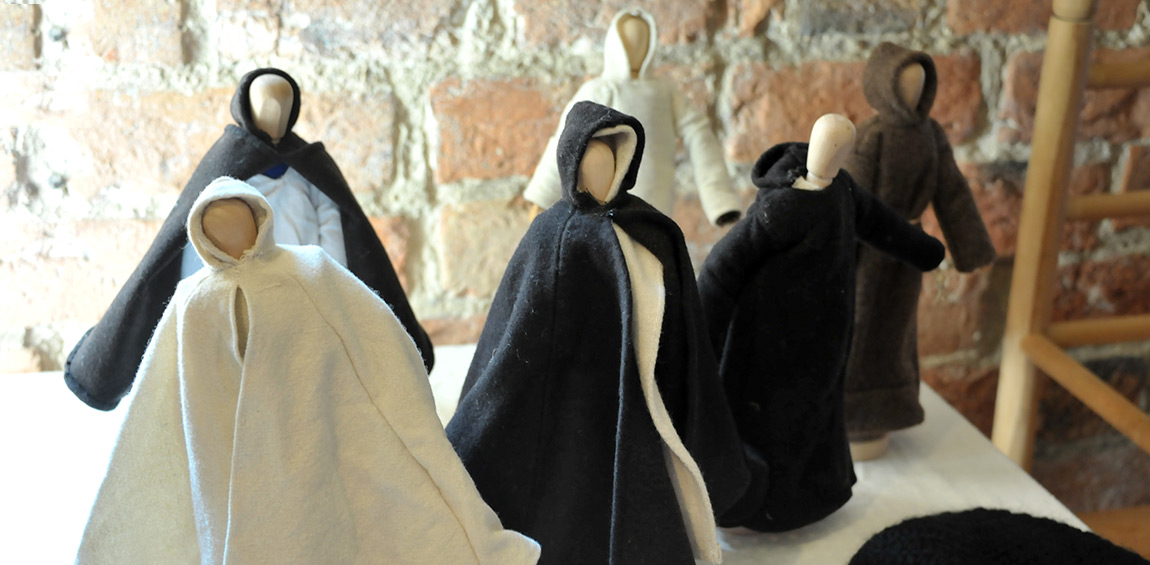
The group Bellum et Culina presented medieval fashion trends, from the elite right down to the humble shepherd, as well as fascinating insights into the cleaning of linen garments. Porta Temporum showed that medieval illuminated manuscripts also contain fascinating details about the clothing of people from that era. Tremonia 1300 and Veni Vide Vetera explained courtly fashion, intricate medieval hairstyles and the differences between the habits of various religious orders to an enthusiastic audience.
Ralf Hildebrandt-Dietz and Sylvia Hildebrandt displayed a range of shoe designs and glass beads from the early Middle Ages and other periods. Visitors were also invited to try their hand at the art of glass bead-making and took colourful souvenirs home with them.
Silvia Ungerechts is a well-known expert in the art of tablet weaving. She amazed visitors with her more than advanced skills.
Members of the Club Rocaille group, along with milliner Hildegund Bemman, introduced visitors to the elegant fashions of the 18th and 19th centuries. Visitors were able to admire and learn about corsets, embroidered silk dresses and opulent headwear based on historical designs.
With a theme such as this, the raw materials themselves naturally had to be covered as well. Consequently, there were also presentations on the processing of wool and linen. The Skuddenhof Weserarm, which specialises in breeding the Skudde sheep, had even brought along a few animals. Here, visitors learnt about the different coats of various sheep breeds and how the animals are shorn. Florian Saum from the Lauresham Open-Air Laboratory took over the next stage of wool processing. He demonstrated how the wool is washed and combed before being spun into yarn using a hand spindle. Visitors practised spinning diligently for themselves at his stand. Meanwhile, textile archaeologist Katrin Kania shared her knowledge about the so-called ‘large spinning wheel’ in the Middle Ages. An impressive replica of such a spinning wheel was, of course, part of her display. Staff from the Düppel Museum Village, namely Ilka Kühne and Christoph Arbeiter, demonstrated how flax is grown and processed to extract fibres for textile production.
Last but not least, the focus was also on genuine historical textiles. Textile archaeologist Ronja Lau informed about the working methods and technical equipment used in her profession. Visitors were invited to look through the microscope. Geertje Gerhold from the Brandenburg Cathedral Chapter patiently explained how old textiles, such as liturgical vestments, as preserved in the cathedral treasury, are restored and researched.
Short lectures spread throughout the day, and the traditional fashion show rounded off the more than extensive programme.
The pleasing visitor numbers, along with the positive feedback from participants, guests and the organisers themselves, make it clear that there is a genuine interest in history and archaeology amongst the public. It is therefore worthwhile to invest in academic research and to bring it out of offices, laboratories and universities so that people can experience it first-hand. When delivered to a high standard and designed to encourage questions, wonder and active participation, the past too has a future – even in times of cutbacks and austerity measures.
The Brandenburg State Archaeological Museum therefore hopes that the ARCHÄOTECHNICA event format will continue to provide opportunities for knowledge-sharing, exchange and entertainment in the years to come.
Keywords
Country
- Germany