

The content is published under Creative Commons Attribution 4.0 International license (CC BY 4.0).
Reviewed Article:
Cochineal in the Classroom: Engagement Success with an Ancient Colourant
Cochineal, small insects that feed on nopal (prickly pear) cactus leaves, produce a naturally vibrant red colourant and have been used from ancient times for purposes such as dyeing, painting, and cosmetic applications. The ease with which colour can be obtained from Cochineal insects, and its associations with ancient cultures of the Americas, positions it as an ideal candidate for engagement and this paper describes successful hands-on workshops of Cochineal dyeing. Experimental methods were encouraged and facilitated in these workshops, demonstrating the value this natural colourant has in providing accessible educational opportunities for learners of all ages.
Introduction
The small and unassuming Cochineal insect (Dactylopius coccus ) may not be a household name, but since Pre-Columbian times it has been an important source of natural red colourant and continues to be used today in food and cosmetic products. Cochineal became one of the most valuable exports from the Americas in colonial times, since the vibrancy of the red that can be produced from the insect surpassed the shades possible with other natural sources in Europe and Asia. The long and intriguing history of Cochineal makes it ideal for engaging people interested in archaeology and can be the subject of hands-on workshops for a variety of ages. Since remnants of the dye process generally do not survive in archaeological contexts, experimentation is a key method for understanding how it would have been processed and used.
Cochineal
As parasites of nopal cactus, also known as prickly pear, Cochineal insects (genus Dactylopius ) are native to the Americas where this type of cactus (genus Opuntia ) originated. There are several species of Cochineal, but it is the Dactylopius coccus that has been cultivated in the Americas since Pre-Columbian times for the richness and quantity of the natural red colourant that can be extracted from it (Chávez-Moreno, Tecante and Casas, 2009, p. 3338). As well as being a valuable source of colour, there are also recorded uses of Cochineal as a medicine for various aliments (Chávez-Moreno, Tecante and Casas. 2009, p. 3344). Once thought to have originated in South America (Rodríguez, Méndez and Niemeyer, 2001), it has more recently been determined that D. coccus likely originated in Mexico (Schowalter, 2025, p. 2).
Female Cochineal insects are wingless, larger in size (4-6 mm in length) than their winged male counterparts (3-3.5mm in length), and feed on the pads of cacti; males lack mouths and are unable to feed, thus they are not parasites of prickly pear (See Figure 1 and Schowalter, 2025, See Fig. 2). Due to female insects being wingless, they are sessile and spend most of their life attached to cactus pads to nourish on sap (Vakte, et al., 2024, p. 149). Due to their immobile nature, they produce carminic acid as a form of protection against predators, and it is this acid (constituting between 17 – 24% of their dry body weight) which is naturally reddish in colour (Vakte, et al., 2024, pp. 149-150). Though the bodies of the insects are red, they appear as clusters of white on cactus pads because of a substance that they secrete to protect against sun exposure and halt water loss (See Figure 2).
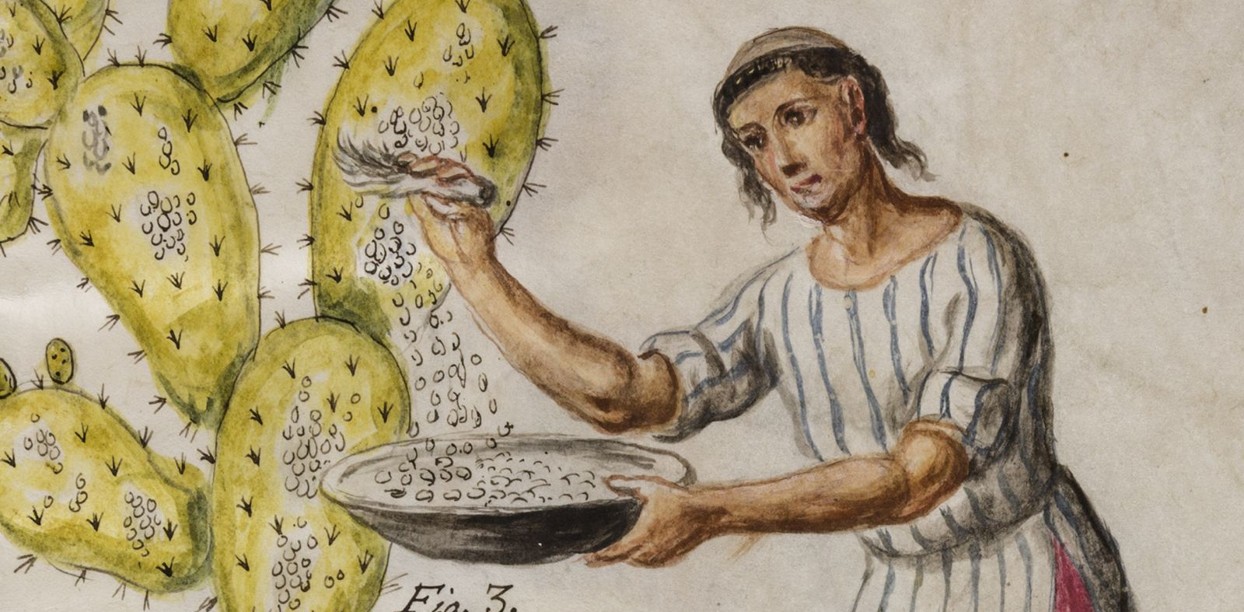
Rather than extracting acid from insects when alive, and using it as a colourant immediately, the insects are usually heated and then dried for later use. In Pre-Columbian times, the insects were collected from cactus leaves (See Figure 3) and then either dried in the sun or heated by boiling them in water or cooking them in an oven (Donkin, 1977, pp. 17-18). They can then be processed by crushing into a fine powder, and adding water as needed (See Figures 4a and 4b). To become colourfast, Cochineal requires a mordant to bind itself to a material. Colour results depend on several factors, including temperature range the dye is heated to, length of time the dye is heated, type of mordant, material the Cochineal is applied to, and addition of substances such as salt and lime (Arroyo-Figueroa, et al., 2011). The concentration of carminic acid in Cochineal, which varies based on the insect’s diet and the environmental conditions it lives in, also impacts colour (Vakte, et al., 2024, p. 150). Thus, as well as the natural red colour of Cochineal it can also be used to create colours such as orange, purple, and pink.
Due to the colour-extraction process, which destroys the insects, direct archaeological traces of Cochineal insects are challenging to observe. Nadel (2024) has focused her research on recognising evidence for Cochineal production, and recently with her colleagues identified the “first known chemically identified cochineal production artifact” from early Colonial period Mexico (Nadel, et al., 2026). Due to its soluble nature, Cochineal use in the ancient Americas is often thought to have been restricted to a dye and evidence for its use with textiles is abundant (Orna, 2011, p. 92; Wouters and Rosario-Chirinos, 1992). However, Cochineal could also be used as a lake pigment if the colour was extracted and made insoluble through precipitation onto an inert base such as clay, chalk, or gypsum (Houston, et al., 2009, p. 62). While it has been suggested that the Spanish introduced Cochineal lake pigments into the Americas, and there is evidence of its use on Colonial period Andean drinking vessels to support this (Pearlstein, et al., 2015), there may be evidence for its use in a Pre-Columbian bark-paper book from Mexico known as the Codex Fejérváry-Mayer (Domenici, et al., 2018, p. 133) as well as Zapotec mural painting (Magaloni-Kerpel, 2010, p. 61).
In Aztec Mexico, where Cochineal was known as nocheztli meaning “blood of the prickly-pear cactus” (Brittenham, 2015, p. 26; Cabellos, 2024, p. 8), it became an important tribute item. Cactus farms developed to harvest the insect, producing larger cultivated forms, which generated greater quantities of colour (Dutton, 1992, p. 21-22). The Codex Mendoza, commissioned for the Spanish King circa AD 1540, reports that the Aztec Emperor Montezuma II collected Cochineal insects and cloth dyed with Cochineal from various towns on an annual basis (Lee, 1948, p. 452).1 After Spanish colonizers arrived in the Americas and discovered Cochineal, they soon began to export it (the word ‘Cochineal’ comes from the Latin ‘coccinus’, meaning ‘scarlet-coloured’). Later in time, Spanish colonialists required that the province of Oaxaca – where cultivation of the insect was concentrated by the sixteenth century – pay tribute to the crown in the form of Cochineal (Salinas, 2018, p. 260-261).
Although other insects had long been used in the Old World to produce colours such as crimson and vermillion, including the Kermes and Porphyrophora genus (native to areas of Europe) and Kerricalacca (native to Asia and previously known as Laccifer ), they produced a much less concentrated dyestuff – and required more processing to extract colourant –compared to Dactylopius Cochineal from the New World (Chávez-Moreno, Tecante and Casas, 2009, p. 3346; Geddes de Filicaia, et al., 2026). Thus, having access to a direct source of vibrant red was incredibly valuable for the Spanish. In the 16th century they exported between 50-160 tons of Cochineal every year (since it took as many as 70,000 insects to make one pound of dye), leading it to become one of the more valuable imports (Finlay, 2014, p. 50). It was largely used for dyeing fabrics of the wealthy and elite, including cardinals in Rome (Cabellos, 2024, p. 8), and even found its way into the palettes of famous artists such as Rembrandt and Gainsborough (Greenfield, 2019). The Spanish later began cultivating Cochineal domestically, and by the nineteenth century the Canary Islands became the largest producer in the world (Cabellos, 2024, p.8). However, with the introduction of synthetic dyes not long after, the value and use of Cochineal declined.
Revival of Cochineal use in more recent years is linked to the growth of the natural colourant industry, and it can be found as an ingredient listed as ‘carmine, crimson lake, carminic acid, or red no. 4’ in food and cosmetics products (Vakte, et al., 2024). The largest worldwide producer of Cochineal today is Peru, accounting for roughly 80% of the world's supply, but it is also produced in Mexico (primarily in and around Oaxaca) and the Canary Islands (Santiago and Lozano, 2010; Vakte, et al., 2024, p. 150). The geographic range of Prickly Pear cactus limits the areas in which it can be produced, and the “very labour intensive” process involved (Associated Press, 2023) also limits the number of farmers who are willing to invest in Cochineal production.
My Journey to Cochineal
My journey into the world of Cochineal began when I was a Ph.D. student at the University of Calgary in Alberta, Canada. My dissertation research focused on the study of ancient Maya dress and textiles, including the use of dyes and pigments (Tremain, 2017). My interest in experimental archaeology stems further back from when I was an undergraduate student at the Institute of Archaeology, University College London. The Institute has a strong reputation of engaging students through hands-on experiential learning opportunities, including the multi-day experimental archaeology course that has been an annual tradition for more than 40 years.2 That trip is the first introduction that new undergraduate students have to the Institute, and I remember spending my first few days of the degree program making pottery and flintknapping in a field with my new classmates.
Later in my degree program, one of the most memorable assignments I completed involved experimental techniques to re-create an ancient artifact. I decided to create a shell necklace using stone tools and fondly remember my Honours supervisor, the late Dr. Norah Maloney – a lithic specialist and a genuinely wonderful person – allowing me to borrow some of the stone tools in her office to conduct my experiments. Even after twenty years since that assignment, I recall the process clearly. The somatic (and difficult) experience of perforating and shaping shell, using only stone tools, created a lasting impression on me because I was required to be actively hands-on with the materials I was researching. I later learned theories about the value of actively ‘doing’ rather than passively remembering in my journey into pedagogy for post-secondary Archaeology classes (Bonwell and Eison, 1991). I have since endeavoured to incorporate hands-on experiential activities and assignments for my students whenever possible.
Cochineal and an Archaeology Workshop
The first opportunity I had to create a hands-on workshop about Cochineal materialised in 2015, during my Ph.D., when I was invited to share my research at a small conference in North Carolina known as ‘Maya at the Lago’ (since it was focused on the ancient Maya and took place near Lake Norman in Davidson).3 The conference combined academic sessions with hands-on workshops, and the audience was an interesting mix of lifelong learners and budding archaeologists (from the high school where the conference was held). The workshops were separated for the high-school students and the registered conference attendees (the latter were an older demographic on average), so each workshop ran for two separate sessions. I proposed a workshop about Cochineal dye because I predicted it would be a captivating way to introduce people to the topic of ancient colourants, especially because of the near-immediate results that could be obtained with the crushed insects. Additionally, through my research I had been learning of the versatility of Cochineal for obtaining a variety of colours and anticipated that the experimental opportunities of the workshop would increase successful public engagement.
Ahead of the workshops, I experimented with dyeing fabric at home in several ways. This included modifying the length of time that the dye was heated for (a richer and more vibrant red was achieved with longer heat exposure) and adding different ingredients including salt and lime juice. I also created tie-dyed examples, with the use of string, and explored different methods of applying colours to fabric including immersion and painting with a brush. I requested that the participants have access to a range of materials like these, so that they could undertake experimental approaches to using Cochineal. The conference coordinators were excited about the prospect of participants having freedom to experiment during the workshop, rather than adhering to strict instructions, and happily sourced the materials I suggested. I prepared plain, uncoloured, fabric for the workshop by scouring it and treating it with alum and tannin (to ensure the dye adhered to the fabric).
To preface the hands-on portion of each workshop, I provided a relatively short presentation about Cochineal and its association to the ancient Americas. I then demonstrated the process of turning Cochineal into a dye, and suggested materials that participants could use for their own experiments. Both workshops, one for the students and the other for the older demographic conference attendees, were an overwhelming success in terms of active engagement and sparking curiosity (See Figure 5). Even the conference organizer himself, a high school teacher with a B.A. in archaeology, enthusiastically joined in the process of what he referred to as “crushing bugs”. Due to the low barrier to engagement, all participants were successful at dyeing fabric with Cochineal. The flexibility they were provided with, and the range of materials they had access to, undoubtedly contributed to this success. Had participants been asked to follow a formal set of instructions, and all create the same outcome for their fabric in terms of colour or design, their creativity would have been stifled, and this would have hampered their natural curiosity. By designing and facilitating a workshop that promoted exploration, in an active way, the participants enjoyed learning about Cochineal and were able to engage with it in a way that they were personally interested in. Overall, the workshops demonstrated the value of providing a (colourful) hands-on opportunity for learners of all ages to connect with a practice dating back thousands of years.
After the workshop, I published a teaching resource about Cochineal dyeing as an activity for the UK-based website Mexicolore (whom I had worked with previously to publish materials about ancient Maya dress).4 The website is dedicated to educational resources about ancient Mexico, and the Cochineal resource supplements the many informative pages available for teachers and young learners. Intended as a means of replicating the dyeing activity in a classroom, I structured the resource with some brief context about Cochineal and provided step-by-step instructions. This extended the benefits of the workshop beyond the conference, and allowed others interested in Cochineal to try their hand at the activity.
Cochineal and Experimental Archaeology
Fast forward a decade later, I had the opportunity once again to run a workshop about Cochineal. Not long after I began my position as Assistant Professor in the Department of Archaeology at Simon Fraser University (SFU), the undergraduate representatives of the experimental archaeology club invited me to provide an activity for their members. Previous hands-on exercises at the club, established in 2024, have included flintknapping and atlatl making. The latter is a staple at the department’s annual ‘Palaeo-Olympics’, a competitive event first organised by the undergraduate Archaeology Society in 2017.5 Participants in the event try their hand at Paleolithic-themed activities such as making fire, knapping stone tools, painting cave art, and of course throwing atlatls. Paleolithic research is a strength of faculty in the department, as is biological and forensic research, archaeological science, heritage management, and archaeology of the Pacific Northwest Coast.
The department course offerings reflect the faculty's diverse interests and expertise, and though a course about the 'Archaeology of the New World' is regularly offered to students there is no course dedicated to the cultures of Mesoamerica. Knowing that several students were very interested in learning more about ancient Mesoamerica, I took the opportunity to offer a Cochineal workshop to the experimental archaeology club as a means of providing an activity related to this cultural area. I advised the club representatives where to purchase Cochineal insects and provided them with a list of supplies they would need to bring (as well as directing them to review the aforementioned teaching resource about Cochineal). I encouraged them to advertise the workshop to their members not only as an opportunity to learn about ancient colourants, but also an opportunity to bring a personal item that they would like to dye.
A few weeks later, in early 2025, a small cohort of undergraduate students, of mixed backgrounds and archaeological interests, participated in the 60-minute workshop. It was held in one of the archaeology department’s teaching classrooms, which provided sizeable workspaces and access to a sink for easy cleanup. As with previous iterations of the workshop, I first provided a brief contextual framework for participants by discussing the history of Cochineal in Mesoamerica. I also brought additional reading materials, and examples of Mesoamerican-inspired textiles, to further support students who were interested in learning more (See Figure 6). Prior to beginning the hands-on portion, I outlined workshop goals and provided suggestions for ways they could experiment with applying the dye to different surfaces and altering its colour.
As with the previous workshop, the participants enjoyed the freedom of using different application methods for the dye including complete submersion and application via paintbrushes. Different to the previous workshop however was the choice to dye any personal items they brought with them. One student opted to dye yarn, so they could subsequently use it in a knitting project, another brought an item of clothing and experimented with brushing and dipping the fabric into the dye (See Figure 7). The latter student was fascinated by the immediate impregnation of the fabric, as well as the richness of colour, and after the workshop asked to borrow reading material related to anthropological research in the Maya region. While their participation in the workshop may not be the only causal factor for their interest in this topic, it clearly helped to stimulate enquiry and encourage curiosity.
Overall, the SFU workshop helped to verify that hands-on experiments with Cochineal can be successful with different audiences. The first iterations of the workshop took place with attendees of a specialized conference focused on the ancient Maya, who had at least some prior contextual knowledge of Mesoamerican archaeology. The SFU students largely had no such prior knowledge, though they were very familiar with archaeology in general. The difference in knowledge had no bearing on the outcome of the workshop, since all participants were able to successfully use Cochineal to dye fabrics and expressed their enjoyment of doing so. The workshop is therefore suitable for audiences who have an interest in archaeology, but they do not necessarily require any pre-existing knowledge of the archaeology of Mesoamerica.
Conclusion
Cochineal is a suitable topic for audiences interested in archaeology and ancient colourants, and the experiences described here demonstrate that it can be the topic of hands-on experimental workshops. The success of a Cochineal workshop is not dependant on the audience’s familiarity with the subject matter, nor does not require a specialised setting to be successful; space for participants to work with the materials is the most important, and this could be realized in a variety of locations outside of formal classrooms. The enchantment of working with Cochineal is the instant result that is realised upon adding water to the dried insects, and this low barrier to success allows workshop participants more time to experiment with application techniques and changing the colour of the dye. Such experiments become the concentration, and not the surroundings they are taking place in; being far removed from the geographical and cultural associations of ancient Cochineal dyeing practices does not deter participants from engaging.
- 1
See Figure 1.1 and its description in Brittenham 2015
- 2
https://www.ucl.ac.uk/social-historical-sciences/news/2020/oct/introducing-archaeo-tech-renaming-ucl-institute-archaeology-experimental-archaeology-course, accessed 23 February 2026.
- 3
The Maya at the Lago Annual Conference last took place in 2021. For more information, see: https://www.goafar.org/conferences
- 4
https://www.mexicolore.co.uk/maya/teachers/cochineal-dyeing-resource
- 5
Keywords
Country
- Canada
Bibliography
Antonio de Alzate y Ramírez, J., 1777. Memoria sobre la naturaleza, cultivo, y beneficio de la grana… , (Essay on the Nature, Cultivation, and Benefits of the Cochineal Insect). Edward E. Ayer Manuscript Collection, VAULT Ayer MS 1031). Available at: < https://collections.newberry.org/asset-management/2KXJ8ZWZLI5J > [Accessed 25 March 2026]
Arroyo-Figueroa, G., Ruiz-Aguilar, G.M. L. Cuevas-Rodriguez G.and Gonzalez-Sanchez. G., 2011. Cotton Fabric Dyeing with Cochineal Extract: Influence of Mordant Concentration. Coloration Technology 127(1), pp. 39-46. Available at: < https://doi.org/10.1111/j.1478-4408.2010.00276.x >
Associated Press, 2023. In Mexico, Family Makes Red Dye of Nobility the Traditional Way. VOA News , September 2. Available at: < https://www.voanews.com/a/in-mexico-family-makes-red-dye-of-nobility-the-traditional-way/7252053.html >, [Accessed 27 April 2026].
Bonwell, C.C. and Eison, J.A., 1991. Active learning : creating excitement in the classroom. California: Jossey-Bass.
Brittenham, C., 2015. Three Reds: Cochineal, Hematite, and Cinnabar in the Pre-Hispanic Mesoamerican World. In C. Padilla and B. Anderson, eds. A Red Like No Other: How Cochineal Colored the World, pp. 26-35. New York: Skira Rizzoli.
Cabellos, T., 2024. Cochineal: The Insect that Dyes our World Red. Journal for Weavers, Spinners, and Dyers 291, Autumn 2024, pp. 8-10. Available at: < https://www.wsd.org.uk/wp-content/uploads/2024/08/J291-Cochineal.pdf > [Accessed 25 Maech 2026]
Chávez-Moreno, C. K., Tecante, A. and Casas, A., 2009. The Opuntia (Cactaceae) and Dactylopius (Hemiptera: Dactylopiidae) in Mexico: A Historical Perspective of Use, Interaction, and Distribution. Biodiversity and Conservation 18(13), pp. 3337-3355. Available at: < https://doi.org/10.1007/s10531-009-9647-x >
Domenici, D., Miliani, C., Buti, D., Brunetti, B.G. and Sgamellotti, A., 2018. Coloring Materials, Technological Practices, and Painting Traditions: Cultural and Historical Implications of Nondestructive Chemical Analyses of Pre-Hispanic Mesoamerican Codices. In É.D. García and M.L. Vázquez de Ágredos Pascual, eds. Painting the Skin Pigments on Bodies and Codices in Pre-Columbian Mesoamerica. Tucson: The University of Arizona Press, pp. 129-143.
Donkin, R. A., 1977. Spanish Red: An Ethnogeographical Study of Cochineal and the Opuntia Cactus. Transactions of the American Philosophical Society 67(5), pp. 1-84.
Dutton, L.M., 1992. Cochineal: A Bright Red Animal Dye. MsC thesis, Baylor University, Texas. Available at: < https://baylor-ir.tdl.org/items/4a97af67-4ffc-4824-9140-b243bd07ca67> [Accessed 23 February 2026]
Finlay, V., 2014. The Brilliant History of Color in Art . Los Angeles: The J. Paul Getty Museum.
Geddes de Filicaia, E., Evershed, R.P., Bull, I.D. and Peggie, D.A., 2026. Stable Carbon Isotope and Accurate Mass Studies for Source Determination and Identification of Cochineal Insects andLake Pigments. Microchemical Journal 223, 117349. Available at: < https://doi.org/10.1016/j.microc.2026.117349 >
Greenfield, A.B., 2019. The bug that had the world seeing red. Smarthistory ,September 15, 2019 [online]. Available at: < https://smarthistory.org/cochineal/ >, [Accessed 27 April 2026].
Hartshorne, H., 1881. The Household Cyclopedia of General Information. New York: Thomas Kelly. Available at: https://onlinebooks.library.upenn.edu/webbin/book/lookupid?key=olbp36678 [Accessed 24 April 2026]
Houston, S., Brittenham, C., Mesick, C., Tokovinine, A. and Warinner, C., 2009. Veiled Brightness: A History of Ancient Maya Color . Austin: The University of Texas Press.
Lee, R.L. 1948. Cochineal Production and Trade in New Spain to 1600. The Americas 4(4), pp. 449-473. Available at: < https://doi.org/10.2307/977830 >
Magaloni-Kerpel, D. 2010. The Hidden Aesthetic of Red in the Painted Tombs of Oaxaca. RES: Anthropology and Aesthetics 57/58, pp. 55-74. Available at: < https://doi-org.proxy.lib.sfu.ca/10.1086/RESvn1ms25769972 >
Nadel, S.R., 2024. A Reconstructed Chaîne Opératoire for Mesoamerican Cochineal: Implications for the Archaeological Analysis of Insect Dye Production. Archaeological Review from Cambridge, Future, Human Insect Entanglement: Past, Present, and Future, 39(1), pp. 134 156. Available at: < https://doi.org/10.17863/CAM.118231 >
Nadel, S.R., Butrón, A.O., Pingarrón, L.B. and Mendoza, E.T., 2026. The chemical identification of cochineal production tools in archaeological environments: Preservation, degradation, and contamination.” Journal of Archaeological Science: Reports 72(June 2026), pp. 105736. Available at: < https://doi.org/10.1016/j.jasrep.2026.105736 >
Orna, M.V., 2011. Chemistry and Art: Ancient textiles and medieval manuscripts examined through chemistry. Educación Química 22(3), pp. 191-197. Available at: < https://doi.org/10.1016/S0187893X(18)30133-2 >
Pearlstein, E., Mackenzie, M., Kaplan, E., Howe, E. and Levinson, J., 2015. Tradition and Innovation: Cochineal and Andean Keros. In C. Padilla and B. Anderson, ed. A Red Like No Other: How Cochineal Colored the World, pp. 44-51. New York: Skira Rizzoli.
Rodríguez, L.C., Méndez, M.A. and Niemeyer, H.M., 2001. Direction of dispersion of cochineal ( Dactylopius coccus Costa ) within the Americas. Antiquity 75(287), pp.73-7. Available at: < https://doi.org/10.1017/S0003598X00052741 >
Salinas, C.M., 2018. Mexican Cochineal, Local Technologies and the Rise of Global Trade from the Sixteenth to the Nineenth Centuries. In M.P. Garcia and L. de Sousa, ed. Global History and New Polycentric Approaches : Europe, Asia and the Americas in a World Network System , pp. 255-273. Palgrave Studies in Comparative Global History. Available at:< https://doi.org/10.1007/978-981-10-4053-5 >
Santiago, E.C. and Meneses Lozano, H.M., 2010. Red Gold- Raising Cochineal in Oaxaca.Textiles Society of America Symposium Proceedings 39. Available at: < https://digitalcommons.unl.edu/tsaconf/39/ > [Accessed 24 April 2026]
Schowalter, T.D., 2025. Ecology, use, and management of cochineal insects (Hemiptera: Dactylopiidae). Journal of Integrated Pest Management 16(1), pmaf033. Available at: < https://doi.org/10.1093/jipm/pmaf033 >
Tremain, C.G., 2017. A Study of Dress and Identity in the Late Classic Maya Court. Ph.D. Dissertation, Graduate Program in Archaeology, University of Calgary. Available at: < https://ucalgary.scholaris.ca/items/7611e3b9-c263-44a4-810d-1710b8e02e50 > [Accessed 23 February 2026]
Vakte, S.R., Sonawane, C.P., Saraf, K.V., Kashmire, S.M. and Nehete, J.Y., 2024. Cochineal Insects ( Dactylopius coccus ) in Cosmetics: An Overview of Taxonomy, Composition, Extraction Methods, Applications, and Regulatory Perspectives. International Journal of Entomology Research 9(10), pp. 148-153. Available at: < https://www.entomologyjournals.com/assets/...> [Accessed 25 March 2026]
Wouters, J. and Rosario-Chirinos, N., 1992. Dye Analysis of Pre-Columbian Peruvian Textiles with High-Performance Liquid Chromatography and Diode-Array Detection. Journal of the American Institute for Conservation 31(2), pp. 237-255. Available at: < https://doi-org.proxy.lib.sfu.ca/10.2307/3179495 >
Image Sources
Figure 2: https://commons.wikimedia.org/wiki/File:014_cochineal.jpg
