

The content is published under Creative Commons Attribution 4.0 International license (CC BY 4.0).
Unreviewed Mixed Matters Article:
Book Review: Experimentelle Archäologie in Europa, Jahrbuch 2025
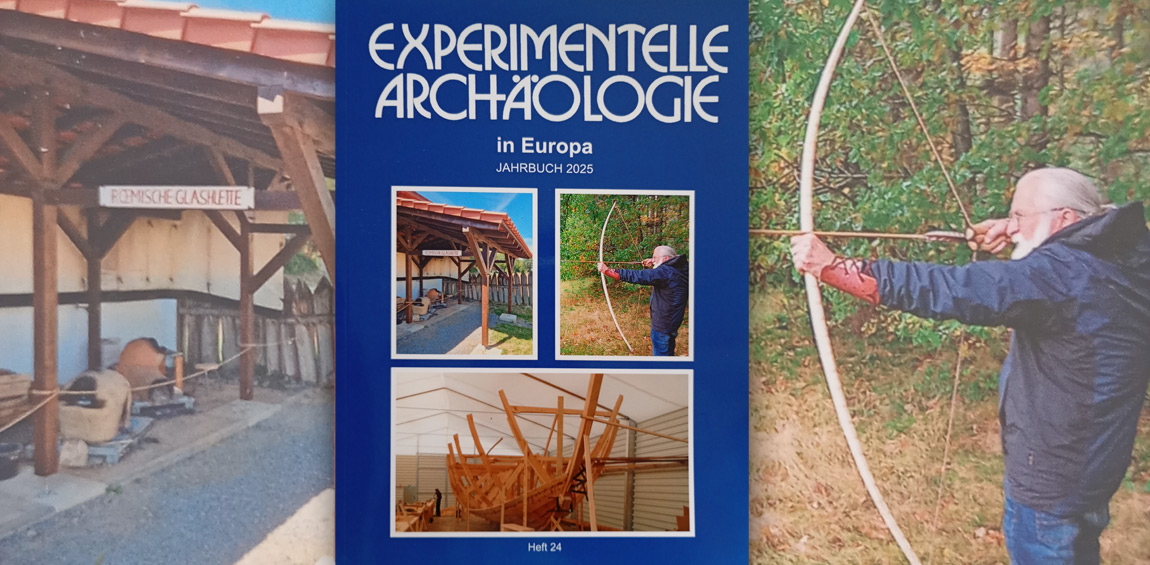
The periodical is published by Gunter Schöbel and the European Association for the Advancement of Archaeology by Experiment e. V. (Europäische Vereinigung zur Förderung der Experimentellen Archäologie) EXAR in collaboration with the Pfahlbaummuseum Unteruhldingen.
In 2024 EXAR hosted their annual conference from 19th until 22nd September 2024 at the Urgeschichtlichen Museum (URMU) in Blaubeuren (Germany) which was attended, due to available space, by 80 participants. The Jahrbuch 2025 contains as before essays from lectures held at this conference and was presented at the 2025 conference. As usual, the annual report (pp. 247-250) and the author guidelines (pp. 251-253) are at the back of the volume.
The 2025 periodical is much longer than the past issues and contains 17 essays, divided among the usual sections: Experiment und Versuch (Experiment and Testing, pp. 11-73), Rekonstruierende Archäologie (Reconstructive Archaeology, pp. 73-158), and Vermittlung und Theorie (Education and Theory, pp. 161-253).
It is noteworthy that this time several articles are linked to each other. The first are two articles by Bettina Birkenhagen, who is an archaeologist and project leader at the Roman Villa Borg, and provides with co-author Michael Dillenberger an article about beer brewing according to Roman model (Bierbrauen nach römischem Vorbild – erste Experimente und Ergebnisse, pp. 11-20) based on archaeological finds and historical texts. The second article by Birkenhagen deals with a completely different topic which is about the production of Roman cameo vessels co-authored by the Roman glassmakers Mark Taylor and David Hill (Neue Anregungen zur Herstellung römischer Cameogefäße, pp. 39-48). They examined three Roman cameo vessels and experimented with how to add the white glass with the pattern on the blue glass of the vessel. Both articles are part of the experiment and testing section. Another expert on Roman glass, Frank Wiesenberg, also presented two articles. One of his papers, falling under the experiment and testing section, discusses the size of a glass furnace if you want to produce not just glass beads but larger pieces like a mosaic glass bowl or windowpanes (Reduce to the Max – oder: Wie klein darf ein römischer Glasofen sein?, pp. 21-38). In the section on education and theory Wiesenberg writes about setting up a small reconstructed Roman glass workshop at the museum RömerWelt am caput limitis of which he has acted as director since 2019 (Die Römische Glashütte in der RömerWelt am caput limitis zwischen Experiment, Versuch und Vermittlung, pp. 173-187). The RömerWelt works together with the public professional school of glass as well as with universities to offer them the premises and ovens for experiments. Following this, there are two articles about the reconstruction of a fortepiano dating to the 18th century. The first one can be found in the section of Reconstructive Archaeology and looks more on the craftmanship which is necessary to reconstruct it (H. Balk, M. Madelung, Vom Handwerk zur Musik und zurück – Forschungsnachbauten eines Hammerflügels aus der Schule von J.A. Stein (um 1780) und ihre klangliche Wiederbelebung, pp. 139-158). By measuring the old instrument carefully and looking at its construction sequence the authors recreated it, and luckily you can play on the reconstructed instrument which is no longer possible on the original. The second one which can be found in the section of Education and Theory explains the usefulness of 3D digitization giving an example how this was used for the reconstruction of this fortepiano and to compare the original instrument with the reconstructed version (S. Bosche, Handwerk und Digitalisierung Hand in Hand – Das Potenzial von 3D-Digitalisierungsverfahren für die Experimentelle Archäologie, pp. 201-216).
The section Experiment and Testing contains two more essays. One is written by Andreas Klumpp who had previously written about cooking equipment for the yearbook 2017. Since his initial paper, he gathered more sources which were the topic of his PhD thesis “Culina Historia”. For this volume he focuses on “normal” kitchen equipment with unusual preparation methods such as insulation cooking, and on “exotic” cooking equipment such as hot stones or earth ovens (Von hölzernen Rosten, Kieselsteinen, “Schnellkochtopfdeckeln” und dem Huhn in der Flasche, pp. 49-59). The last essay in this section deals with iron soles worn in the 15th and 16th century against caltrops (A. Franzkowiak, issin sol behebet dir din füß gesunt – Eisensohlen gegen Fußangeln, pp. 61-73). Franzkowiak tested the two sole types and identified that you could walk and even run over different grounds with them without any problems.
The Reconstructive Archaeology section consists of five more essays. The first one looks at the experimental production of Palaeolithic flutes (H. Wiedmann, Experimentelle Herstellung paläolithischer Flöten, pp. 77-88). In the Swabian Alb, the oldest musical instruments have been found consisting of flutes made from mammoth ivory and swan bones. Wiedmann reconstructed the flutes and tested them out. The second essay is about the reconstruction of a Paleolithic bow and arrow, an experiment carried out by the well-known experimental archaeologist Harm Paulsen (S. Furken, S. Hartz, Pfeil sucht Bogen – das Ahrensburger Steinzeitexperiment, pp. 89-102). The third essay of this section jumps from the Paleolithic to the Bronze Age, dealing with the reconstruction of handles of sickles which appear ergonomic with a ‘thumb’ groove (J. Engelman, Bemerkungen zur Herstellung spätbronzezeitlicher Sichelgriffe, pp. 103-111). The following article looks at different ways of how to wear hollow bronze rings dating from the Hallstatt C period (K. Saunderson, K. Grömer, Lady of the Rings – eine besondere hallstattzeitliche Kleidungsform, pp. 113-123). Looking at finds of these rings, which have an approximate diameter of 13 cm, led the authors of this article to the conclusion that they were worn around the hip/belly with a belt of grosgrain ribbon. They attempted to wear replicas of those rings in different ways. The next article is about the reconstruction of a Roman ship, but this time a merchant vessel whereas in the yearbook 2024 it was about patrol boats (P. Johann, Die Bissula – ein seegängiges römisches Handelsschiffi m Experiment, pp. 125-137). This 1:1 scale reconstruction was tested on its sailing performance on the river Moselle as well as on the open sea off the coast of Cannes.
The last section, Education and Theory, along with the aforementioned articles by Frank Wiesenberg and Susanne Bosche contains four more essays. The first one, written by Thomas Lessig-Weller, a museum education officer at the Keltenwelt am Glauberg and treasurer of EXAR, tackles an important topic which is how to connect experimental archaeology with school education (Experimentelle Archäologie und Schule – eine Beziehung mit Zukunft, pp. 161-172). At the Keltenwelt they have two programs for schools involving experimental archaeology: one is making sling shots and how to throw them, the second is shooting with different bows at different distances on a reconstructed linothorax. The problem of ‘reenacterism’, i.e. ideas created by one reenactment/living history group taken over by other group without critically looking at the sources themselves, is highlighted in the essay of Fabian Brenker using the example of 13th century citizens and foot soldiers (‘Fiktive’Konstrukte im kollektiven ‘Wissen’ der Darstellenden Interpretation am Beispiel bürgerlicher Kleidung und Fußsoldaten im Hochmittelalter, pp. 189-200). Julia Heeb, director of Museumsdorf Düppel in Berlin and chair of the EXARC board, had previously presented a paper at the EXAR conference in 2017. At the 2024 conference she presented the RETOLD project which is coordinated by EXARC and was funded from 2020-2024 by the EU (Das EU-Projekt “RETOLD”- Einheitliche Dokumentationsstrategien für archäologische Hausmodelle und altes Handwerk, pp. 217-227). The paper highlights how this web-based tool can be used to document the steps taken to reconstruct a medieval house, but also the importance of the project which can be of potential interest to other stakeholders. The last article in this section is by Gunter Schöbel comparing three archaeology associations in Germany of which two have a long history already, being founded in the early 20th century but are still thriving today (Drei Vereine – und ihre Möglichkeiten zur Unterstützung der Experimentellen Archäologie in Europa, pp. 229-243). In his essay the author requests for closer cooperation of those three associations because they all strive for the same goals.
As in previous years, the articles of the 2025 yearbook cover a wide span of historic periods; from the Neolithic to the 18th century, and reflect in their variety the vast field of experimental archaeology, such as architecture, shipbuilding and various crafts, and show the diversity in knowledge of the members of EXAR. The majority of the articles are written in a way that you can follow the matter easily even if you are not familiar with the topic. Unfortunately, specialized terminology without an explanation was noted in two articles: the first article on Roman glass mentioning a ‘Glashafen’ without explaining this very specific term, and the article on Roman boats used nautical terms that not all readers will be familiar. For a book aimed at readers from different fields those specialized terms should be explained (terminology list appended to the article).
In previous reviews of the EXAR yearbooks, this reviewer pointed out that articles are nearly always written in German, with only a short abstract in English. Gunter Schöbel’s essay provided a reason to this, although the members of EXAR are spread over Europe the majority are based in Germany, followed by Austria and Switzerland, the so-called D-A-CH region thus.
For those interested in experimental archaeology, this book is worth reading. Furthermore, this edition includes articles that should engage further debate within EXARC including:
- combining experimental archaeology with school education, thus disseminate this field out of our own bubble to the broader audience and maybe future researchers;
- helping to continue the RETOLD project; and,
- working together among the various associations dedicated to experimental archaeology, not just between those three clubs mentioned by G. Schöbel, but also including EXARC and other associations which are out there.
Book information:
Schöbel, Gunter (ed.), 2025. Experimentelle Archäologie in Europa, Jahrbuch 2025, Heft 24, Unteruhldingen: Gunter Schöbel & Europäische Vereinigung zur Förderung der Experimentellen Archäologie e.V. European Association for the advancement of archaeology by experiment, ISBN: 978-3-944255-24-8
Keywords
Country
- Germany