

The content is published under Creative Commons Attribution 4.0 International license (CC BY 4.0).
Unreviewed Mixed Matters Article:
Book Review: Nalbinding: It’s not Knitting: Heritage techniques for the contemporary textile crafter by Sally Pointer
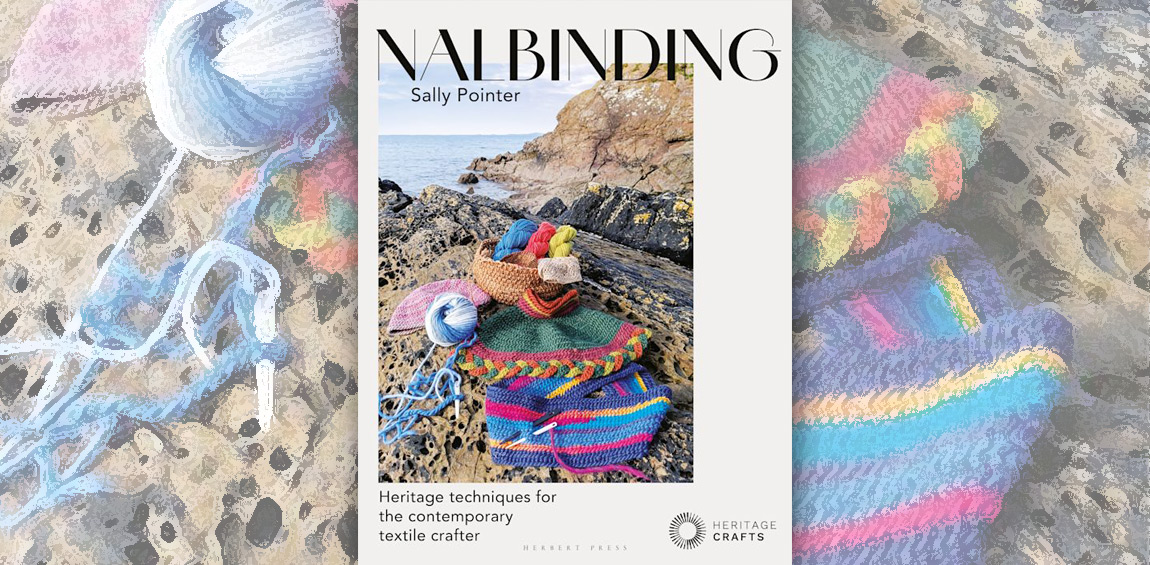
Sally Pointer, an EXARC member, is an experimental archaeologist and heritage educator, and has authored the first nalbinding book in English, which is published by major publishing house (Herbert Press, Bloomsbury Publishing). This crafting book is aimed for textile crafters, as expressed on the sub-tittle, and it has gathered quite a lot of enthusiasm and anticipation during the months leading up to its publication, much due the lack of available printed materials around nalbinding. Does it meet expectations?
The book begins with a short introduction into the theory and history of nalbinding, which both could easily be worth of book series on their own. This includes a discussion on the use of the word “knitting” as part of the byline, which is important to point out as part of separating the two techniques, even though, they occasionally may look the same. The theory section is repeating common beliefs, and some of the modern practises are extended into being part of the historical practises, such as using “one rather large needle” (page 13), which is not correct, as evidenced by the archaeological examples discussed in the book: Jorvik sock has 36 rows/10cm, which calls for a needle roughly the size of a medium size tapestry needle. There are some minor mistakes in the theory section. For example, Margrethe Hald’s main work with nalbinding was carried out in late 1940’s, with publication in 1950, and translated with revisions into English in 1980, but in general it has the focal points of nalbinding theory explained. The history section is limited, however, this is expect for the length of the publication. Nevertheless, it introduces examples outside of the commonly known traditions, such as the Ancient Pueblo, the living tradition of making camel muzzles and sand socks in Middle East, and the various nalbinding traditions of sub-Saharan Africa and Oceania, as well as the more well known North Atlantic traditions, and Ptolemaic-Roman era Egyptian pieces.
The author guides the reader through the basics around nalbinding: how to choose a needle, what types of yarns to use, how to join the working lengths of yarn to the next one, how to stack the needle, and how it is perfectly normal to unpick the non-neat first few stitches of a nalbound chain. There are a couple of short explanations on how to do few typical connection stitches, how to increase and decrease stitches, what type of tensioning options there are, how to work flat and how to full the finished piece. The only left-handed instructions (Oslo stitch) provided in the book are separate from the other instructions, and are placed with the basics, rather than with other stitches.
The main body of the book is divided into three sections: the needle-tensioned stitches, the thumb-tensioned stitches, and the socks and technical information. The needle-tensioned stitches include simple looping, cross-knit looping and York, the thumb-tensioned Oslo, Mammen and Dalby. All in all, there are 20 projects to work on, including making a needle, sock-toppers for living history kit, a couple of hats and mittens, and two sock patterns, with a couple of different heel types, different shapes of pouches and bags, a scarf and a capelet. Some of projects are interesting; there has not been a pattern for the Ptolemaic-Roman era socks in cross-knit looping, nor has there really been accessible patterns for the simple looping bags or pouches. The Moebius scarf is a welcome addition, as is the capelet, although the technically challenging braid is braided with chains rather than nalbinding the braid. The hats, socks and mitten patterns slightly challenge the sub-title of “contemporary”; they are rather common and similar patterns can be found in several self-published manuals and social media posts. The technical information includes a short introduction to different notation systems, which are used to describe nalbinding, mainly focusing on Hansen and Kaukonen. The list of references includes 21 entries, out of which several are rather inaccessible even with inter-library loans and research facility/university database accesses, so the possibilities to follow the references are somewhat limited.
The simple looping part is where the author excels. The author provides step-by-step instructions on how to twist cord with raffia and hemp and discusses usage of other bast-like fibres in nalbinding. The author shows a handy trick: how to benefit of the hand twisted cord as a stable foundation for simple looping projects. This type of information has been missing from most publications around nalbinding, especially, as it is not bound to an indigenous culture or their living heritage, but simply to the technique itself. Knowing Pointer’s work, the simple looping and its variations are the part of nalbinding the author is most familiar with, and it would have been amazing to have a comprehensive book showcasing simple looping projects in various bast fibres and how to handle them.
The book has few issues, which the knowledgeable nalbinder might spot. These include the above-mentioned common beliefs, which have, some at best, limited evidence and even less so extendibility to historical or archaeological nalbinding practises. Reference to older research in theory and history sections overlooks much of the research done around nalbinding, in both archaeological and historical spheres. For example, when introducing the Mammen find reference is made to Hald 1980 (in fact 1950), instead of referencing for example the 2018-2023 research by Mannering et al. ( Fashioning the Viking Age ). The theory section, as well as naming the stitches (Tarim, Oslo) enforces some of the misnomers and long-standing misunderstandings around them. Although Pointer does discuss many of these, they gets lost amongst the other text and thus continue to be a controversy. Pointer includes the instructions for fulling in nalbinding, and most of the projects done with the thumb-tensioned stitches are fulled, which in the greater corpus is pretty much a single source practice from mid-20th century Sweden, and rather conveniently misses the point of having to give instructions for well fitted nalbound items, as most thumb-tensioned projects are fulled to size. There also seems to be the misconception that only children’s socks in Ptolemaic-Roman era Egypt were done in multiple colours and in cross-knit looping, this is not the case. As a general note, throughout the book it is made clear that nalbinding is not the main focus of Pointer’s research or crafting.
The book itself is beautifully printed. The paper quality is nice and thick, the photographs are crisp, the colours and yarns used in the examples are well chosen, there is nice contrast between the yarn, the needle, the hands shown in photographs and the background. The technical photographs are well planned and informative. The instructions are clear and easy to follow. The historical and archaeological examples shown with the corresponding stitches are good examples of their limited corpuses, and the quality of the photographs is better in some cases, than what the source providing them have online. The “Tips” and the “Troubleshooting” sections are both very helpful, and point to common issues and to their solutions, which a new nalbinder, or even experienced one, might run into. The layout works relatively well as an e-book too, although on smaller screen some back and forth scrolling is needed.
Nalbinding: It’s not Knitting is a crafting book, aimed for knitters/crocheters to expand their skills, the re-enactors and living history people to hone up their kits with fraudulent nalbound socks (one of the most ingenious nalbinding projects I have ever seen!) or Ptolemaic-Roman era socks from Egypt, and to the heritage enthusiasts to keep the craft alive. It is best for those new to nalbinding (or a nalbinder with only knowledge of simple or compound stitches) as it does not provide significant new information for an intermediate nalbinder. Although some of the stitches and materials used in the book have been used for 8500+ years, it is definitely a modern interpretation, not a guide to historical or archaeological re-productions. Did it meet my expectations? I have to say, I’m not sure. It is informative, it is written by a talented individual (never thought that would be a key criteria on a book review, but with the heap of AI-slob nalbinding books published during last six months, this is a welcome change of pace), it gets the job done, so to speak, but it seems to miss the expected amazingness by a notch or two. In the end of the day, it is a beautiful, well written book, with lovely, colourful pictures which makes you smile.
Book information:
Nalbinding, It’s not Knitting, Heritage Techniques for the Contemporary Textile Crafter, 2026. Pointer, Sally. Herbert Press, Bloomsbury Publishing, 2026, 160 pages, illustrated in full colour throughout, £30.00 (Paperback),
ISBN: 9781789943061.