

The content is published under Creative Commons Attribution 4.0 International license (CC BY 4.0).
Unreviewed Mixed Matters Article:
Book Review: The Bloomsbury Handbook of Experimental Approaches to Roman Archaeology by Lee Graña Nicolaou, Tatiana Ivleva and Bill Griffiths
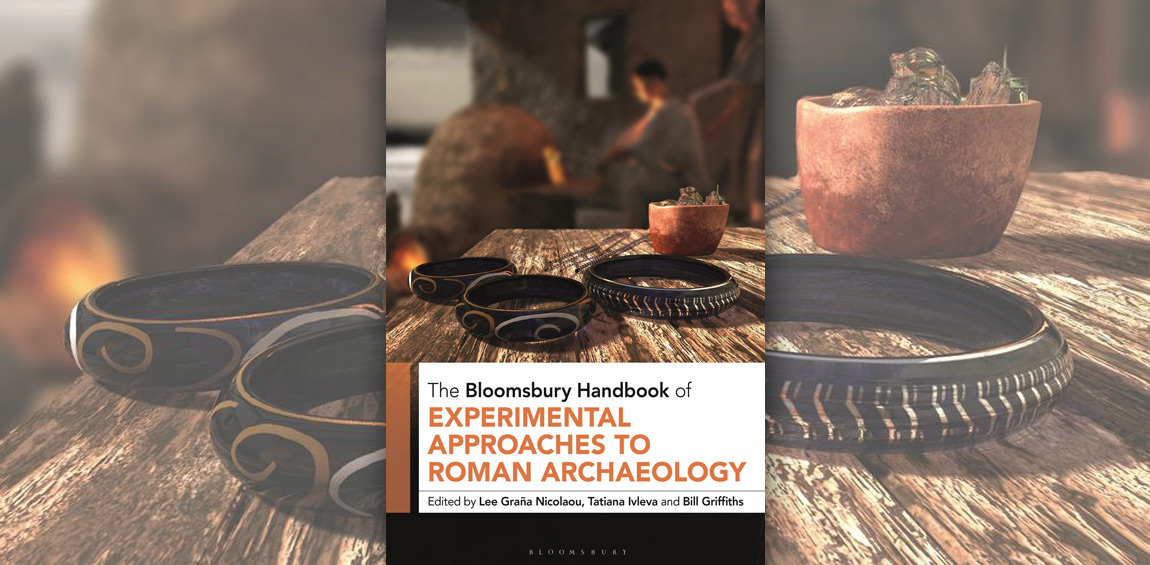
This handbook provides a gateway into Roman Experimental Archaeology. Echoing the foreword, Experimental Archaeology is often viewed by those outside the field as the realm of prehistory, where experimentation can be conducted to, and theorise about what is not known. At the same time, due to their historical sources and physical remains, Rome and later periods are perceived as not requiring experimentation. This handbook quells this idea, instead collating the work of skilled and inventive individuals and providing both a framework and inspiration for future work.
The Handbook is divided into five thematic parts: 1) Experimentation as a Tool for Academic and Public Education, 2) Rebuilding the Past: Architectural Reconstructions and Archaeological Open-air Museums, 3) Actualistic Experiments: Activities, Processes and Chains of Production, 4) Experiencing the Past: Sensory Experiences and Interpretations and 5) Digital Technologies: 3D Reconstructions and Gaming. Each showcases detailed work and aspects of interacting with Roman Archaeology and is introduced with methodologies that ground the experiments within theoretical and practical knowledge. This means the reader can engage confidently with the presented material. The book is well illustrated and easy to understand for anyone from experienced archaeologist to enthusiastic layperson. The format of stand-alone chapters allows for readers to either read sections that are relevant to them as required or read the entire book cover to book over a week - as this reviewer did!
Part One summarises projects of the past, and the sometimes complicated relationship between stakeholders, academics and reenactors. Anique Hamelink’s fantastic chapter 2 brings fresh air to the discourse and outlines a method for incorporating the reenactor’s and artisan’s research and presentation of the past. The chapter is thought-provoking and suggests methods of bridging the gap between the academic and the passionate layperson.
Part Two focuses on architectural reconstruction and open-air museums with physical reconstructions of archaeological remains and presentation of these spaces for modern audiences. Chapter 7 by Peter Kienzle considers the presentation of ephemeral or lost structures, such as rammed-earth structures at Xanten. Experimentation with building traditions which have survived is an exciting opportunity, and the consideration of methods in an age of climate change and resource management holds hope for modern populations. The consideration of the representation of reconstructed spaces in Part Two, and how this shapes the public's interaction with these buildings, juxtaposed with the challenges of authenticity, is thought-provoking.
The theme of Part Three is the detective work of experimental archaeology, with each experiment seeking to answer the ‘How’ through their proposed experimentation. Readers who also enjoy logistics, as this reviewer does, and the interconnected nature of human life, will also enjoy this section for the detailed methods, especially in chapter 14 by Heather Hopkins. Utilising interdisciplinary engineering research, she sought to understand the Roman dyeing industry, from the resources utilised to the spaces required, and the chapter is a constant reminder that experimental archaeology requires interdisciplinary techniques and becomes interdisciplinary as soon as the experiment begins.
Part Four emphasises the senses: food, exercise, accessories and clothing are evaluated in this chapter with phenomenological experience at the heart of these experiments. Chapter 19 is an inspiring example where Janet Stephens' non-archaeological knowledge, in this case in hairdressing and hairstyles, results, through the study of depictions and numismatics, in the theory that the Empress Julia Domina suffered a specific hair loss disorder.
Part Five demonstrates how digital technologies can bring the Roman world to life and how the experience of Romans can be understood today. Such as in chapter 23, which models lighting in Roman insular housing. Digital reconstruction also enables the use of objects to be tested, as in the reconstruction of chapter 24’s belt-like object , without facsimiles, which can be expensive and time-consuming. The section ends with two chapters focused on video gaming and experimental archaeology - a phenomenological approach to storytelling and visitor experience for the user and creator.
The Handbook collates a diverse variety of experimental work on the Roman world, and in itself is a useful tool to understand the methodological and scientific processes conducted by those who contributed. The experiments within offer any reader a strong starting point to consider their own experiments, as well as a network of passionate researchers who can provide collegial support for new ideas. The variety of areas of research is encouraging, as it shows the variety of experimental archaeology, and new and growing areas such as digital reconstruction mean both specialists from other fields and laypeople are valid research partners as this area of experimental archaeology grows.
In conclusion: the Handbook provides a practical reference guide to Roman Experimental Archaeology. For those looking to understand previous work, engage participants or design their own project, the Handbook provides. This reviewer hopes future readers will enjoy and be inspired by it as much as I have been, and that it will lead to a greater understanding of the Roman past.
Book information:
The Bloomsbury Handbook of Experimental Approaches to Roman Archaeology. 2024. Lee Graña Nicolaou, Tatiana Ivleva, Bill Griffiths. Bloomsbury Academic. 544 pages
eBook ISBN 9781350217850; ISBN 978-1350217836