
The content is published under Creative Commons Attribution 4.0 International license (CC BY 4.0).
Reviewed Article:
The Borgund curly pile Textile: Reconstruction of an early medieval textile fragment from the deserted town Borgund, at Sunnmøre in Western Norway
Pile-woven textiles are rare archaeological finds. During the excavation of the deserted medieval town Borgund at Sunnmøre, Norway, an unusually well-preserved early medieval textile fragment with a knotted pile was found. One side is twill woven, while on the other, long curly tufts of wool thread have been woven and knotted in. The Borgund curly pile textile stands out: the pile is curled in a way that has not been previously documented, and the knot is unlike other known pile knots, although the weave of the textile does resemble other known pile woven finds woven by the research team’s craftspeople. The article presents analyses of the textile and the subsequent experimental work. The reconstruction process is documented from data collection and analysis through raw material selection, including the production processes of spinning and weaving and time spent on these processes. Furthermore, the time-use, that is, the time needed for the production of a ‘varafell size’ (circa 1 x 2 metre) example of the fabric, the original use of the textile and final disposal of the worn-out piece of cloth are addressed. The results of the case study are the reconstruction and the knowledge that emerged through the process.
Introduction
Ancient textiles have great potential as a source of knowledge about the past, and in Norway, full advantage has not yet been taken of this fact. Few textile fragments from the significant material available from archaeological excavations have been reconstructed, and little has been published on reconstruction and the entire process which underlies it. However, the knowledge in one's hands is a tacit knowledge that develops over time: many years of weaving experience and learning that enables one to see and better understand ancient textiles and the people who made them. This knowledge cannot be attained through books alone, it must be felt in the body. Thus, a reconstruction process will provide us with a greater understanding of our textile cultural heritage. With excellent preservation conditions for organic materials, more than 230 late Viking Age and medieval wool-textile fragments have been found during excavations of the deserted town Borgund, near Ålesund in western Norway (See Figure 1). The current article presents the study and subsequent reconstruction of a 10 x 10 cm fabric of one of these fragments, an early medieval pile textile with a unique curly pile and type of pile knot (University Museum of Bergen’s inventory no. BRM 1/2055/1) (See Figure 2). It is the accumulated knowledge of the research team’s textile craftspeople that has made it possible to embark on the present reconstruction process. With the Borgund curly pile textile as a case, we will explore how a detailed study of fibres, weave, pile, knots, and a subsequent experimental and practical reconstruction process can provide more information about textiles, the technological choices made, and time spent by ancient craftspeople. The curly effect in the pile is especially interesting: we address which technique may have been used to create this kind of springy quality in the pile, and why.
Through a survey of published details of Viking Age/medieval pile textiles from the North Atlantic area, we explore whether the choice of fibres, weave, pile, and knots can tell us something about where the Borgund curly pile was made, and by whom. We also ask, in which context and by whom might the textile have been used?
Background
The deserted town Borgund was one of 16 Norwegian places that written records describe as urban during the Middle Ages (Helle, 2006, p.42) (the Middle Ages in Norway are dated to between circa 1030 and circa 1537). By Norwegian standards, Borgund was a medium-sized town (Hansen, 2017, pp.59–94). After abandonment sometime after the late 16th century, the location of Borgund was lost from memory and not rediscovered until the mid-1950’s, and subsequently large-scale archaeological investigations were carried out. Today, after more than 30 archaeological field seasons, most extensively from 1954 and into the 1970’s, 5300 sq. m have been investigated and some 52,000 objects collected and included in the University Museum of Bergen’s collections (University of Bergen, n.d.). From 1954, the Borgund excavations were mainly led by the archaeologist Asbjørn E. Herteig, perhaps better known for his work on the Bryggen site in Bergen. Herteig’s excavations in Borgund and Bergen were the first of their kind in Norway, in which the settlement of ordinary medieval people was investigated. The excavation methods applied were pioneering for medieval archaeology at their time, and the archaeological sources have great potential for new insights. However, little research has been done on the material from Borgund in recent times. The current study is part of The Borgund Kaupang Project (BKP), which addresses the legacy data from the site through several sub-studies. Through a multidisciplinary approach, the project aims to shed light on the economic and cultural prerequisites of Borgund from emergence to abandonment (University of Bergen, n.d.). This study is one of two sub-studies which address textiles from Borgund (see also Hayeur Smith, 2024; Hayeur Smith and Hansen, in prep.). The Borgund curly pile textile was used and disposed of by someone in Borgund. The study and the subsequent reconstruction of the fabric of the textile which was found in this place may add detail, depth, and colour to the understanding of the social and cultural networks of ordinary people of the Middle Ages in the periphery of Europe.
Pile weaving
The pile-weave technique takes us several thousand years back in time. A pile textile has two different sides: on one side, the structure of the weave is visible, while on the other, the pile is woven and tied in with knots. The pile, also known as floss, rag, or napp in Norwegian (Engelstad, 1942), is either made from wool, thread, or textile scraps. In the Nordic countries, traces of this technique have been found in Danish Bronze Age textiles (Guðjónsson, 1962, p.70; Geijer, 2006). It is believed that the technique may have originated around 3,000 BC and can be traced back to ancient Mesopotamia and the Sumerian civilisation (Guðjónsson, 1962, p.70 with references; Wright, 2013, pp.395–397). It is not certain whether the pile textiles in the world have been influenced by each other or created independently in separate locations. People migrated early on and brought textiles and knowledge with them. In the North Atlantic region, the pile weave may have arisen independently, based on a need for protection from the harsh climate, or it may have been inspired by influences from outside. A woven textile may resemble a fleece, but can be made much larger, softer, lighter and more flexible than sheepskin. When worn against the body, the warm air in the pile will keep you warm. Facing outwards, the pile will protect you from the rain. Pile textiles have most likely been used on both sides, as protection against the rain and cold.
Other pile textiles and previous research on pile textiles from the North
The pile coverlet called napparye in Norwegian has been used in all the Nordic countries and has been given many different names: rye, rya, sengerye, båtrye, lofotrye, grårye, slitrye, and prydrye . A rya ( rye ) was a utilitarian textile used to cover the body for warmth, and was usually made of yarn in pure wool, but could also be made from scraps of other textiles and other types of yarn. They were common both inland and along the coast, and they were mostly used as bedspreads. The båtrye (“boat rug”) is the best documented and preserved type of napparye in Norway. It was used by fishermen and on boat trips along the coast in large parts of the country until the end of the 19th century. They were an important part of the boat’s equipment, as fishermen could be out at sea for extended periods of time. Along the way, they might sleep in the boat, under the boat on land, or in simple lodgings, called rorbuer. A båtrye could be two metres wide and was used both to sleep on or under (Kjellmo, 1996). The oldest recorded napparye from the Nordic countries is from 17th -century Sweden, but pile textiles have existed in the Nordic countries and the North Atlantic region for longer than that (Geijer, 2006). Archaeological pile-woven textiles from sites dating to the Viking Age or medieval period have been found in for instance, Kildonan, Isle of Eig in Scotland, Hedeby/Haithabu in today’s Northen Germany, Birka and Lund in today’s Sweden, Dublin in Ireland, Heynes in Iceland, Veien, Ringerike in Norway, and Landnamsgården, Narsarsuaq and GUS (Gården under Sandet/The farm under the sand in Greenland (Guðjónsson, 1962; Priest-Dorman, 2001; Østergård, 2003, p.73; Abarria, 2003; Geijer, 2006).
Pile textiles are mentioned several times in Norse saga literature, either as an aside or as part of a larger context. The varafell is a type of pile textile, it is a large woven wool fabric with tufts of wool from the hairy outer coat ( dekkhår ) of sheep woven and tied into the weave with knots. It looks like and has the characteristics of a sheepskin pelt and was often used as a cloak. Because it is woven, a varafell can be made much larger than a sheep fleece (Guðjónsson 1962; Hàkonardòttir, Johnson and Kløve Juuhl, 2016, pp.24–32).
Håkon jarls saga recounts the story of how King Harald received the epithet Gråfell (Greycloak). It describes an Icelandic ship filled with varafell that sailed into the Hardanger region in western Norway. When no one wanted to buy the varafell , the Icelanders decided to give one to Harald, who was king at the time (between circa 960 and 970). It was not long until all the varafell were sold (Håkon jarls saga , 1899, p.104). Trade between Iceland and Norway goes back to the Viking Age. The varafell, as well as the woven wool textile, wadmal , are textile products known to have been exported from Iceland (Hayeur Smith, 2015, p.23). In the Icelandic law book, Grågås, there is a detailed description of how wadmal and varafell should be made (Guðjónsson, 1962, pp.68–69; Laws of early Iceland: Gragas II, 2000). And according to the Norwegian law, Gultaingslovi, both wadmal and varafell could be used to pay fines and taxes (Gulatingslovi, 1981, p.208). Based on this, it can be assumed that these types of textile were also produced in Norway during the early Middle Ages. Vadmal is a woven wool textile with specific measurements and weights. The term Vadmal comes from the Old Norse, vaðmål ,which means a certain measure of cloth (Hoffmann, 1975).
The Icelandic textile researcher, Elsa Guðjónsson (1962), has written an article on prehistoric pile textiles, with particular emphasis on the Icelandic export of varafell and a well-preserved varafell fragment from Heynes. The Heynes varafell, or röggvarfeldur , as it is also called, is the most frequently published of the archaeological pile fragments in the North Atlantic region. The Heynes fragment, found during excavation at the Heynes farm in Iceland in 1959, has been dated to sometime between 900 and 1100 AD and is now at the National Museum of Iceland in Reykjavik. Guðjónsson (1962) concluded that the fragment is of the finest quality, most likely a hàfnarfeldur . Her assessment was based on the description of these wares in Grågås , which specifies the weight and size of a varafell as two ells wide and four ells long, or 102.4×204.8 cm (Guðjónsson 1962, p.68). The hàfnarfeldur was a light and fine type of varafell that was treated separately and given a high value (Guðjónsson 1962; Hàkonardòttir. Johnston and Kløve Juuhl, 2016, p.31). Guðjónsson’s (1962) research on pile textiles has been, and continues to be, an inspiration and reference for further research into these textiles, including our reconstruction of the Borgund fragment.
The textile finds from Greenland, known as Nordbodraktene, are the largest and best-preserved assemblage of Norse textile garments from the Middle Ages. Three pile fragments from the Greenland assemblage are described by Else Østergård (Østergård, 2003, pp.72–75). Based on Østergård’s description, one of these pile fragments might resemble the Borgund fragment. So far in our research, however, it has not been possible to examine this Greenlandic textile further. No reconstructions have been made of the pile textiles from Greenland, whereas several of the other textiles and clothes from there have been reconstructed (Østergård, 2003).
When it comes to pile textiles, little experimental research and only a few reconstructions have been made and published. Still, two reconstruction experiments based on the pile textile from Haynes, Iceland, have been documented and published. One focuses on the use of materials as well as the weaving technology in pile weaving (Priest-Dorman, 2001), while the other experimental reconstruction focuses on how pile weave functioned and was used, with the point of outset in woven samples of pile weave (Hopkin, 2021).
The Haynes pile is a popular and decorative textile, and it has been re-created through several small and larger, albeit ‘non-scientific’ and ‘undocumented’, weave attempts. It has been created in both twill and tabby and it has been woven as ‘art’, costume, and as trial pieces in connection with teaching and learning weaving technology and the use of the warp weighted loom (Ravnanger and Kløve Juuhl, 2014–2024). While preparing for a publication about the warp-weighted loom, two large full-sized varafell were woven, one in Iceland and one in Norway (Hákonardóttir, Johnston and Kløve Juuhl, 2016). These weaving processes have not been scientifically documented but have resulted in a teaching program on the warp-weighted loom at The Osterøy Museum in Norway (Ravnanger and Kløve Juuhl, 2014–2024).
There are other types of experimental research and reconstructions in the field of textiles in general. Fashioning the Viking Age project, an extensive research project on fibres, tools, textiles and reconstruction was published recently. Based on archaeological finds from Hedeby/Haithabu in present day northern Germany, the project focuses on textile tools and the production of textiles, while complete outfits are reconstructed based on fragments from two Danish Viking graves (Andersson Strand and Demant, 2023; Mannering and Rimstad, 2023). This research project has been going on in parallel with our Borgund curly pile reconstruction project, and while it contributes valuable knowledge to the field of experimental textile research, we have not had the chance to take advantage of the knowledge accumulated in the Fashioning the Viking Age project.
In Norway, a very well-preserved tunic from Lendbreen was recently reconstructed. Due to global warming and melting ice, a group of archaeologists found the tunic at the edge of Lendbreen in Oppland (Norway) in 2011. Thorough analyses and reconstructions of this textile have been made, from its wool fibres to a finished woven and sewn garment. It was woven in diamond twill and is 14C dated to be some 1700 years old (AD 230–390) (Vedeler and Hammarlund, 2017). The original tunic was exhibited at Norsk Fjellmuseum in Lom (Norway) in the summer of 2013. For the exhibition, Osterøy Museum (Norway) was asked to lend the museum a warp-weighted loom with a diamond twill sample as similar to the original as possible on the loom. Kløve Juuhl and Elizabeth Johnston set up the loom and wove approximately 20 cm (7.9 in) before the loom with reconstructed twill was transported to Lom in time for the opening of the summer season at the museum (Kløve Juuhl 2016, pp.192–194). A research report was not made based on Kløve Juuhl and Johnston’s work, but the reconstruction and their work on the loom, as well as Vedeler and Hammarlund’s reconstruction (Vedeler and Hammerlund, 2017), are part of the knowledge and inspiration on which to base further research – and for the reconstruction of the Borgund curly pile textile.
Overall methods
Before embarking on an extensive reconstruction project, one must define the aim of the project, its size and expression. There are three possible ways of making a reconstruction. One may choose to reconstruct the textile as it looked when it was excavated, when it was placed in the ground, or when it was new, used for the first time (Nørgård, Fransen and Østergård, 2010, p.17). The experiments and subsequent reconstruction described in this article aim to make a reconstruction of the fabric of the Borgund curly pile textile in its present state of conservation. The ambition was to make a reconstruction – a fabric sample – large enough to allow an estimation of the amount of time used for producing a textile of comparable quality to the Borgund curly pile textile and of the standard size of a varafell according to measures given in Grågås: two ells wide and four ells long, or 102.4×204.8 cm (see Guðjónsson, 1962, p.68 with references), here: 1 x 2 metre. In the end, the reconstruction measures 10 x 10 cm.
In experimental archaeology, knowledge about textile production and tools are important parts of a reconstruction. Archaeological material such as remnants of fabric and tools in datable contexts can provide concrete information about textile production in the past (Øye, 2015). Data was collected based on observations of wool fibres, thread quality, weaving technique, pile knots, and the curl of the pile, and experiments were carried out to create the practical reconstruction of thread and fabric for the reconstruction presented here. The textile fragment was studied with the naked eye, and details were studied and documented using a digital photo microscope (Dino-lite digital microscope). The wool fibre was studied microscopically, and samples of the weave and pile were analysed for identification of colourants (see below). After initial collection of data on the properties of the textile, hypotheses based on the authors’ experiences as craftspeople were tried out through experiments. The experiments sparked new questions and the need for reassessment of the archaeological textile. Details of the textile were reassessed during several research visits to the Medieval Collections of the University Museum of Bergen. It was very fruitful, even essential, to be able to re-address the textile time and again. The experiments were aimed at identifying the fibres, thread properties for warp, weft and pile respectively and weaving technique, to reach a reconstruction which is as close to the original fabric as possible.
It is not only the quality of the wool or the spinner or weaver’s skills that influence the yarn and textiles created, but also the tools used in the process (Andersson Strand, 2015). Inspired by (Hoffman, 1974, pp.284–287; Øye, 2022), an ambition was to try out the various textile production processes using tools based on finds of such from Borgund, and on finds and knowledge from the same time period. The choice of tools used when making samples for the reconstructed Borgund textile was thus informed by research into textile tools based on finds from Scandinavia in the Viking Age and the early Middle Ages (Edland, 2022; Øye, 2022). This included a wool comb, a spindle and a warp-weighted loom. As far as possible, the tools used during the experiments and for the reconstruction are thus copies of tools which may have been available during the early Middle Ages in the North. Due to concerns for the time-use during the experiments, more recent tools and modern threads and materials have, however, been used through some phases of the research (specified below).
Time-use for the various steps towards the final reconstruction has been documented using a stopwatch for ‘efficient time’, that is, time without breaks, all along from spinning thread by hand and by spinning wheel, producing the pile thread, setting up the loom, and weaving the fabric. Time-use for shedding the sheep and preparation of the wool for spinning has not been documented.
The Borgund curly pile textile, data
Date and spatial context
The Borgund curly pile was found in 1961 in square Æ7 in Søndre felt (Southern site). The field method applied during the 1950–70s was spit-excavation; within grid squares of 7 x 7 meters, horizontal ‘spits’ of varying thickness were removed and finds were collected and documented with a reference to square and spit number. Based on analysis of the original site documentation, a new set of ‘mechanical layers’ (ML) has been established in connection with the Borgund Kaupang Project. The ML is given a broad post quem/ante quem date through datable objects in the ML. Altogether about 11500 objects have been dated directly by typology or by the carbon-14 method (14C). In order to obtain a date for an ML, the constrained date of directly datable objects in the ML is found, secondly the date may be constrained/narrowed down further by the dates of MLs below or above the ML in question (Hansen et al . in prep.). The Borgund curly pile has been dated directly by 14C, and the find context has been dated by association with an ML. Four 14C samples from the textile were analysed (See Table 1). Two samples comprised a mix of the weft and pile: TRa-14770 and TRa-15788, while two samples were from the weft (TRa-15789) and the pile (TRa-15790), respectively. The combined date of the four 14C dates is between 1042–1160 AD (2 sigma, 95.4% certainty). The textile was assigned to ML Æ7/9 and this association with the ML provides a contextual date of between 1120 and 1160, here also referred to as the ‘mid-12 th century’. The interval of the contextual date is slightly shorter and in ‘the younger end’ of the direct 14C date-interval of the textile, but both intervals are within the ‘early Middle Ages’. It is important to note that the relatively crude excavation methods used in Borgund may mean that the finds in a given ML/context may not be strictly contemporary. Still, there is no real discrepancy between the direct date and the contextual date of our textile, because the former relates to the date of the wool and thus the manufacture of the textile, while the latter dates the final deposition. Both dating frames are thus interesting and will be taken into consideration below.
Table 1.
During the mid-12th century, the area covered by square Æ7 lay in the tidal zone of the shore of the Klokkersundet strait/sound (See Figure 3). A walking bridge (K51) extending from dry land across the tidal zone was also located in Æ7 and may be relatively contemporary with our textile. Several other objects were found in the same ML as the Borgund curly pile; these include other textile fragments, a wooden spoon, miscellaneous wood fragments, fishbones, worn-out leather shoes and production debris from leatherworking.
The Borgund curly pile, data
The Borgund curly pile textile has not been cleaned or treated with conservation substances at the time of research. It seems to be well preserved and appears quite clean, though remains of the cultural deposits (sandy deposits) are still present between the fibres of the fragment. The presence of sandy deposits has not been an obstruction to the documentation of the textile. The textile piece is 8 x 10 cm (3.1 x 4 in) long and wide (See Table 2), so it is indeed a fragment. It has no original weave edges preserved, however stitching along one edge shows that the cloth was darned (See Figure 4 C). The textile is woven in twill, where on one side only the twill structure is showing, (hereafter the twill-side ) (See Figure 4 B), while on the other, long curly tufts of thread have been tied into the weave with knots visible only on the pile side (hereafter the pile-side ) (See Figure 4 A). Today it is of reddish-brown colour.
The wool fibre
The textile fragment was studied microscopically (Dino-lite Digital microscope). Based on the microscopic analysis and long experience with archaeological textiles and extensive knowledge of the wool qualities that were used in the North Atlantic region during the Viking Age and later periods, it was concluded that both warp, weft and pile were made from long staple length of sheep underwool, similar to wool types encountered during the work on textiles found in Viking Age and later periods in North Atlantic contexts.
The oldest Nordic sheep breed is small, short-tailed, with horns and two layers of wool: a fine, short and soft underwool and a long, coarser, protective outer hair. These short-tailed sheep were adaptable and hardy, managing well in the cold climate and challenging living conditions of the Nordic countries. This was the resilient breed that the Vikings brought with them as they raided and settled further west, and the breed that has developed into sheep that live on the North Atlantic islands today. In the Middle Ages, wool from the short-tailed sheep was the most common textile fibre in Norway and the North Atlantic region (Øye, 2022). The present Old Norwegian Sheep, called Gammelnorsk sau, nordeuropeisk korthale sau or stuttrover in Norwegian (Buer, 2017) (here: ONS), is the breed that has most in common with the ancient Nordic sheep breed (Buer, 2017, pp.32–43, Øye, 2022, pp.24–27). The ONS’ wool fibre is curly and has a scaly surface that gives it good insulating properties, even when wet. The underwool has a high fat content (lanolin), which makes the fleece windproof and protects against the cold. The long, shiny outer hair also makes the pelt waterproof. Wool from this breed has been used in the present experiments and the reconstruction.
Colour/colourants
As already mentioned, the textile fragment is of reddish-brown colour today. The thread of the warp, weft and pile displays no difference in shades. Colour analyses were carried out on two samples: One sample of the warp and weft and one sample of the pile. A High-Performance Liquid Chromatography and photo diode array detection system (HPLC-DAD) was applied. This method is useful for the identification of organic colourants (Vanden Berghe, Gleba and Mannering, 2009). Analysis was carried out at the Royal Institute for Cultural Heritage in Belgium. The laboratory reports that traces of ellagic acid, which refer to the presence of ellagitannins, were found in both samples. Ellagitannins can, however, come from a wide range of plant sources, and one cannot determine whether they were intentionally used on the wool fibres or if they came from cross-contamination of wood or plant material that was in close contact with the textile, for instance, while it was deposited in the ground. The laboratory concludes that due to the small amount of ellagic acid detected, it is most likely that the fibres were contaminated rather than deliberately dyed (Vanden Berghe and Coudray, 2021). Based on the analyses, there was no indication whether the original colours of the warp, weft and pile were dyed or whether they were in the natural colour of wool. So, it was decided to use wool in natural colours, grey and brown, in the reconstruction.
Thread, weave, and pile properties
The diagonal structure of the weave is clearly visible in the archaeological fragment and corresponds to a twill weave. The textile is thus woven in 2/2 twill, which creates small diagonal lines in the structure of the fabric (See Figure 4 B). Both the warp and weft have eight threads per centimetre, which gives an even weaving structure. The warp thread is single ply, hard-twisted and Z-spun. The weft is also a single-ply, hard-twisted, but S-spun thread. S-spun thread is spun to the left, and Z-spun is spun to the right. The thickness and texture of the original thread revealed a yarn which was soft and spongy. To be able to recreate the thread, it was important to feel it.
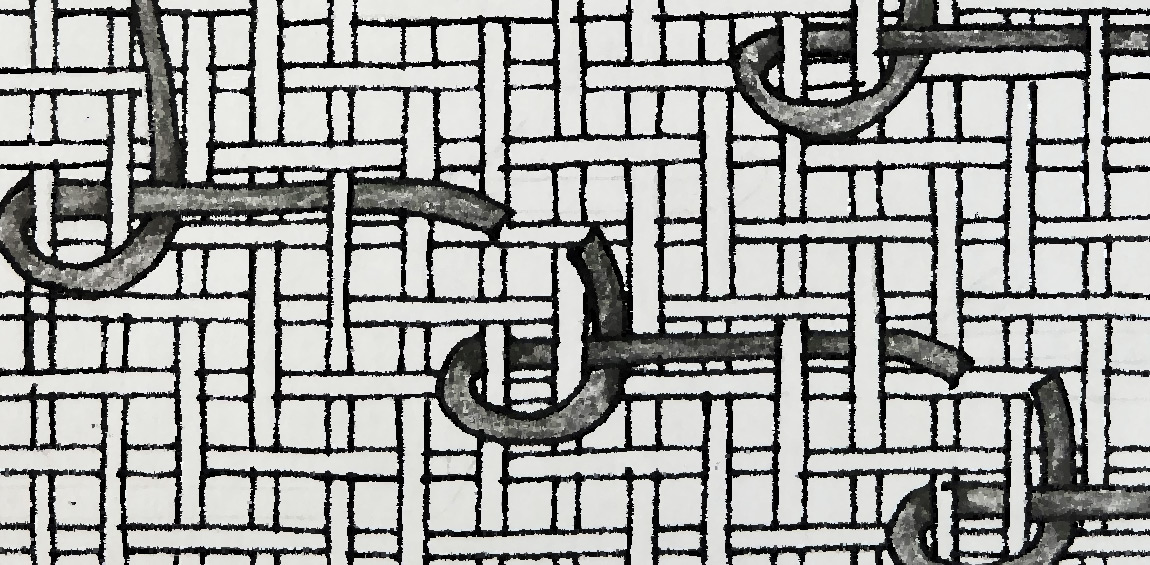
The pile is made of a thin, hard Z-spun single-ply thread, with a curled, springy texture. The length varies between 3–6 cm (1.2–2.4 in) when woven and tied with knots into the fabric. If extended to its full length, the pile would measure between 9–15 cm (3.6–6 in). The knots are placed close together and hidden in the weave on the twill-side (See Figure 5 A). The fragment has many well-preserved knots and a clear structure, which makes it possible to securely identify the knot type and the system of knots visible on the pile-side (See Figure 5 C). Every pile knot is tied around four warp threads, and wound around the outermost thread on each side, with one end turning downwards and the other facing up (See Figure 5 B). The pile is woven and tied between every fourth weft thread, and the pile lies close together in a regular structure, with four warp threads between each knot. In some pile textiles, the knot appears on both sides intentionally as a decorative element, while in others, it seems that the knot is deliberately hidden on one side. In the case of the Borgund curly pile textile, no knots are visible on the twill-side, so it seems most likely that the knots were hidden deliberately. The surface on the pile-side is thick and curly. Even after being buried in the ground for almost one thousand years, the curly thread rebounds quite well. The Borgund knot stands out as different from previously published pile knots, and the thread is curled in a way that has not been formerly documented.
Table 2:
Tools
Wool comb
In the Early Middle Ages, wool combs were tools used for combing and preparing the wool fibres before spinning (Hoffman, 1991, pp.20–23). Wool combs are made of wood, with long, pointed metal spikes or teeth – in archaeological finds, it is usually only the metal that remains (Øye, 2022, p.39). The wool fibres are combed from one comb to another several times, and when all debris and unevenness have been combed out, the finished sorted fibres may be pulled off the comb in a thin, even, and continuous material, ready for spinning. The process of combing and drafting the fibres from the combs naturally separates the long and the short fibres. The wool fibres become a continuous thread when they are rotated with the help of a spindle. The wool comb used here is based on traditional wool combs from Osterøy Museum (See Figure 6 C).
Spindle
A spindle consists of a wooden stick, also called a shaft, and a weight in the form of a spindle whorl. In Borgund, close to 100 stone and ceramic spindle whorls have been found. Kristin Ersdal Edland has studied the production of spindle whorls from Borgund for her master’s thesis. Based on whorls of serpentinite, she reconstructed whorls of different weight classes in such material, and we used her spindles. The thread for most of the pile experiments was spun on a spindle of serpentinite, with a weight of 17 g, made by Edland (Edland, 2022) (See Figure 6 A). The shaft is rarely preserved in the archaeological material, and there are no known traces of a shaft in Borgund, so a shaft reconstructed based on medieval finds from Bryggen in Bergen was used (See Figure 6 B) (cf. Øye, 1989, p.37).
The warp-weighted loom and sword beater
Textiles from the Early Middle Ages were most likely woven on a warp-weighted loom, as the more recent flat loom was not common in Norway until the end of the Middle Ages (Andersson Strand, 2015; Østerbø Kårstad, 1999, p.3). The warp-weighted loom consists of two side poles or uprights and a beam at the top to which the starting border of the warp is sewn (See Figure7 A). The loom used in the experiment is a copy of a loom from Osterøy (Norway Inventory no. BD.5305 University Museum of Bergen, University of Bergen, stored in Osterøy Museum) (Hoffman, 1974, p.25). The loom is approximately 1.5 metres wide (59 in). A sword beater is a tool known from the Viking Age onwards, which is used to beat the weft thread in place during weaving, in order to create an even, compact textile. The sword beater has a slight curve that makes it easier to beat the weft up, and was usually made from whale bone, wood, or iron (Hoffman, 1974, pp.279–283). The wood sword beater used in the experiment is inspired by sword beaters from the Osterøy island in western Norway, owned by the Osterøy Museum (See Figure 7 C).
The reconstruction processes
With data and the appropriate tools in hand, it was time for the experiments and eventually the reconstruction to begin. As a first step in the reconstruction process, trial samples were made to establish the weave and knots used in the Borgund curly pile. Based on the documented weave structure, the initial samples were woven in 2/2 twill, on a flat loom and with machine-spun wool yarn of approximately the same thickness as the original yarn. The most important part of this process was to get a good understanding of the structure of the textile and the pile knot. This was also a good starting point for calculating the amount of thread needed for the warp, weft, and pile. Furthermore, the trial samples also lay the foundation for experiments towards the reconstruction of thread types for warp, weft, and pile respectively, involving both spinning processes and the reconstruction of the curly effect of the pile thread (see below). During the subsequent weaving experiments and for the reconstruction, the warp-weighted loom was used. In the experiments and in the reconstruction, the full width of the loom was not used due to the concern for the time it would take to weave.
The thread, experiment and reconstruction
In the experiments towards the reconstruction of thread, wool from the ONS breed was used. In spite of the original’s Z and S spun threads for warp and weft respectively, warp and weft threads are quite similar in the original fragment. Thus, out of concern for the time-use, it was decided to spin the same thread for warp and weft for the experiments. The yarn for the warp, weft and for the first pile experiments (1A–1E) was spun by Johnston with long staple fibre of underwool (See Table 3). This resulted in a strong yarn that was soft and light, like the original textile. Johnston used a spinning wheel – a more recent and faster spinning tool – to make thread for the warp and weft and for thread used in the first pile experiments. The spinning wheel was used because it was possible to create a thread with similar qualities to the thread in the archaeological fragment. The large amount of thread needed and the time it would take to produce it with a spindle was also a factor. For most of the threads used in pile experiments 2A–4E (See Table 3), thread spun on a spindle was, however, used.
The pile, experiments and reconstruction
Making a pile with the right properties has been the biggest challenge in the reconstruction, due to the characteristic curly, springy pile thread of the Borgund curly pile. After many years in the ground, the curl is well preserved, and the thread rebounds well. The challenge of the experiments towards a reconstruction has been to recreate the curl and spring in the original thread and find the method by which it may have been made. Other archaeological textile finds show that there has been a high level of textile knowledge, and accordingly, of the properties of pile textiles and their ability to provide the body with extra warmth. It is therefore reasonable to assume that the makers of the Borgund textile may have wanted to use a curly thread to achieve an even more airy and warm textile. Originally, the curliness of the pile may have been discovered by chance, and later used deliberately, or it may have been carefully planned. Our pile experiments were based on the hypothesis that the curly thread was made or used on purpose and that the curly effect had been consolidated by using a heat treatment, such as washing in warm water. In experiments 1A–1E, two-ply threads spun of different fibres were heat-treated (washed) and left for two weeks to consolidate the twist and curl. The two-ply threads were then split into single threads (See Table 3). The thread from experiment 1B seemed to have the right appearance, curly and springy like the original, so a textile sample was woven using this thread as a pile. After being on the loom for a while, however, much of the twist in the yarn was lost, and the ends of the pile started to fray. Since the experiments with unwound two-ply thread did not yield a good result, more experiments were carried out. In experiments 2A–2D, threads were wound around different cores (See Figure 8). This resulted in varieties of thread with curl and spring, depending on how tightly the pile thread was wound around the core and the thickness of the core. In experiments 3A–3C, threads from unwound chords were used. In experiments 4A–4E, the reuse of threads originally used in weaves was tried out. For the experiments, textile samples were woven with both wool and linen warp. Experiments 2D, 3C produced pile thread with a twist and curl that had some resemblance to those of the original textile and had rebounding properties quite similar to the original. Still, experiments 4B and 4D using linen warp and the hand-spun thread made from underwool (See Figure 9) gave the best results as regards both the twist, curl and the rebounding properties of the pile thread (See Table 3). It is not known whether the curl in the fragment has changed during its time in the ground. The pile may have looked different at the time when the textile was new, and it is therefore hard to determine exactly which of the experiments is closest to the original. The reuse of thread from woven textiles gives the best resemblance to the original textile as it appears in its present state of preservation, so this technique has been chosen for the reconstruction of the Borgund curly pile textile (See Figure 9 C).
According to the documentation of the length of the piles in the original textile, threads of approximately 15 cm (5.9 in) lengths were needed for a 6 cm (2.4 in) reconstructed pile. According to our experiments, the pile could possibly be made from reused thread that was repurposed after a textile had been damaged or worn out. Since the threads for the pile are not long, small leftovers would work well. So even if a textile was damaged, its threads could still be reused
Table 3: Curly pile experiments
The weave and knots – the fabric reconstruction
Because of the well-preserved condition of the archaeological textile, and not least knowledge and year-long experience of the research team’s textile craftspeople, the setup for the weaving structure seemed clear from the start. Also, the hidden knots and methods for hiding the knot are phenomena that the research team knew and had worked with before. Therefore, the technique applied in the Borgund curly pile was quite straightforward to recognise, understand, and finally materialise in the reconstruction attempt (See Figures 10 A, B). As mentioned already, the loom used is approximately one and a half metres wide (59 in), while the reconstruction was woven with a width of 10 cm (3,9 in). The original textile was woven in 2/2 twill, so the warp was set up for a twill weave. According to principles outlined by e.g. Hàkonardòttir, Johnston and Kløve Juuhl (2016) a 2/2 twill has an even diagonal structure in which the warp and the weft are equally visible. The warp and weft go over several threads at a time – this creates a soft, elastic fabric that will drape softly against the body. In a 2/2 twill weave structure, there are four sheds. One is the open, or ‘natural’ shed, formed by the natural separation of the warp threads on the loom. The other sheds are tied to three heddle rods, thus forming three sheds (Hàkonardòttir, Johnston and Kløve Juuhl, 2016, pp.164–167). There are no traces of a starting border in the Borgund fragment. The use of a woven band and twisted cord as the start of the warp, however, has long traditions (Hoffman, 1991, p.102), so for the reconstruction a twisted cord was chosen as the start of the warp (See Figure 10 C). In order to get an even weave, it is important that the weight of the loom weights is evenly distributed across the entire width. In the reconstruction, warp threads were tied to 500 g stone weights at the bottom, ten threads per weight (See Figure 7 B).
In accordance with the original textile, every pile knot was tied around four warp threads, and wound around the outermost thread on each side, with one end turning downwards and the other facing up (See Figure 10 D). In diagonal weaves, such as 2/2 twill, it is possible to hide or make visible the pile thread depending on which shaft and warp the pile thread is tied onto. In line with the hidden knots of the original, the reconstruction was woven so that the knots were hidden on the twill-side, while visible on the pile-side.
To sum up, the reconstructed fabric is woven in 2/2 twill, with a curly pile tied into the weave. It is 10 cm (3,9 in) wide and 10 cm long.
The reconstruction, time-use
While working on the reconstruction, the efficient time spent was documented to estimate the amount of time demanded for the manufacture of a curly pile textile of a standard varafell size, ca. 1 x 2 meter (see Guðjónsson, 1962, p.68) and in a quality similar to the Borgund curly pile fabric. Time used for the spinning of thread for warp, weft and the pile on both a spindle and a wheel was documented. Also, time spent on setting up the loom for the 2/2 twill curly pile textile and for the tabby textile from which pile thread was going to be repurposed was measured, and finally time spent on weaving the tabby for the pile thread and weaving the curly pile textile was documented. Data on time-use is found in Table 4. Calculation of time spent on spinning with the spindle was documented for two spinners who are both experienced textile craftspeople. While Johnston spun 50 m of thread in 1,5 hours, Ravnanger spent 2 hours on the same length of thread. The calculations here are based on Ravnanger’s 25 meters per hour.
According to our measures, it would take 144 hours to spin the 3600 meters of thread for the warp and weft for a 1 x 2-meter textile on a spindle, and it would take 1300 hours of efficient time to weave the 2/2 twill while tying 57600 floss knots. If one weaves the recycled tabby textile needed for the pile thread as well, one must add 400 hours of spindle-spinning and 150 hours of weaving the 1 x 5, 8 meters of cloth needed for the nearly 10000 meters of pile thread.
Using our calculations, it would take almost 2000 hours of efficient time (144+1300+400+150 = 1994) to make a varafell -sized Borgund curly pile quality textile. This calculation does not include shearing, preparing and combing the wool, nor does it include the treatment of the tabby textile to ensure the springy quality of the pile thread. In modern terms of ordinary 37,5 working hours per week – which we cannot use, of course, but still – this would be almost one year of full-time work!
Spinning by spindle is time-consuming, and the amount of time spent will, of course, depend on the experience of the spinner. Perhaps a skilled spinner in the early Middle Ages would have spun faster than both craftspeople? So, the estimate is exactly that, and perhaps slightly above the time needed for early medieval manufacture of a similar textile. Still, there is no doubt that the production of the original curly pile fabric, in a varafell size, would have been very time-consuming.
Table 4.
Discussion
Can the fibres, weave, pile, and knots tell us how the Borgund curly pile was possibly made?
Our immediate evaluation of the reconstruction result is that the fabric produced has a satisfactory resemblance to the original. It seems safe to assume that the fibres chosen, the weaving technique of 2/2 twill and the technique of hiding knots are close to the raw materials and techniques used in the original textile. Also, the way the pile is tied into the weave and the shape of the knots feels well established. Regarding the production of the curly effect of the pile thread there is more doubt as to whether the exact same technique has been uncovered. The experiments with repurposed thread from weaves did end up with a good candidate for making a curly pile, but there may be more or other ways as well to achieve the same effect. Still. It might be interesting to experiment with exposing the reconstructed fabric to burial in the ground.
Can the fibres, weave, pile, and knots tell us where the Borgund curly pile was made?
Due to the well-preserved condition of the textile, the technique applied in the Borgund curly pile was easy to recognise, understand, and reconstruct. The character of the fibre and the 2/2 twill technique are well known from many archaeological textile finds from the North Atlantic region and were commonly used in wool fabrics such as wadmal (Kløve Juuhl, 2016). So, neither fibre nor weaving technique can help us narrow down the place of production. The Borgund curly pile knot was recognisable, but at the same time different and unique. As mentioned earlier, several knotted pile textiles have been published from the North Atlantic region, and the knots documented in the archaeological finds show variation in the way the pile is laid or knotted into the textile. Smyrnaknuten, or the Smyrna knot (See Figure 11E), is the most common knot in which both ends turn downwards, or in the same direction. It is also known as a Turkish knot, and this is used in most documented knotted pile textiles all over the world (Kjellmo 1996). The knot in the curly-pile textile from Borgund has some similarity with the Turkish knot, but the ends do not turn the same way. So far, we have not found documented (published) finds of pile textiles with knots identical to the Borgund curly pile knot. Since the Borgund knot has no parallels in the North Atlantic documented textiles (Greenland, Iceland, Ireland, Scotland) (See Figure 11), this might be an indication that the textile was not produced in these parts of the North Atlantic, and it is tempting to suggest that the textile was locally or relatively locally produced in ‘the Sunnmøre region’? / ‘western Norway? /Norway’? Still, the assemblage of published knots is very small, so it is not possible to be conclusive on this issue based on the knot alone. Altogether, neither the fibres, weave, pile, nor the knots alone can tell us something conclusive about the original place of production of the textile.
Can the fibres, weave, pile, and knots tell us who made the Borgund curly pile and for whom?
Not all archaeological textile finds are, or have been, of good quality. The textiles that are well crafted and of good quality can be recognised in the choice of fibre, thread, and weave structure: thinly and evenly spun thread, having a dense, fine structure, and in the use of complicated weaves. The properties of the Borgund fragment show that the textile was particularly well made and of good quality. The large amount of time which must have been spent in the process from fibre to fabric indicates that the curly pile textile most likely was a valuable textile. Setting up a knotted pile textile in twill is not only time-consuming, but also requires technical weaving skills, good textile expertise and knowledge. Knowledge about textiles is and has been acquired over time, and the knowledge was passed from hand to hand through generations. So the textile must have been made by person(s) with knowledge and expertise to produce high-quality textiles, as well as knowledge about materials and techniques available. They also had to have the time needed to produce the textile. The textile must have been made for or owned by someone with the means to purchase the textile, or who had household members with sufficient knowledge and expertise to make it. In wealthy households, there may have been people with such competence and time available to produce the textile.
One cannot be entirely sure what the Borgund curly pile textile may have been; the fragment is too small to be able to suggest its use in itself. Based on the available sources concerning other pile textiles and their use, it is reasonable to suggest that the Borgund fragment was a utilitarian textile. It may have been both a cloak, a coverlet, or a multipurpose textile. The traditional napparye is massive, and coarsely woven and spun, while the thread and weave in the Borgund curly pile are thinner and finer. The use of reused thread and fabric for the pile can be seen in many historical napparyer. More expensive and exclusive textiles existed in the early Middle Ages, available only to a few; textiles with a common everyday purpose, with the same basic usage as simpler textiles, but with certain characteristics that express status (Hansen 2015, 36–53). Perhaps the Borgund textile could be an early version of this type of pile textile? For this reason, it is suggested that the Borgund curly pile is a finer and more exclusive version of the napparye and may have had some of the same properties as a traditional napparye. As mentioned before, the Icelandic law, Grågås, describes two qualities of varafell , the most commonly used commodity, and the finer, more excluive variation, hàfnarfeldur . The value of the hàfnarfeldur is higher and varies for each feldur. Hàfnar means “harbour” (Guðjónsson, 1962, p.69). The varafell was worn as a cloak wrapped around the shoulders, used by shepherds, fishermen and Vikings on raids, and it was also used to sleep on or underneath (Guðjónsson, 1962). The pile textile from Borgund may also have been a fine cloak. Just like the napparye , a cloak has many names, Feldur, mantle, Brat and cloak, to mention a few. In Old Norse, the words Feldr, Skikkja and Mötull were also used, describing different types of cloaks (Noss, 1974, p.16; Ewing, 2012, p.104). The cloak was an outer garment, hanging over one or both shoulders, and usually sleeveless. It was either tied together with a cord or attached with a clasp. The cloak was used to keep the wearer warm, but also as a status symbol. Showing off and showing who you were through clothing was just as important in the past as it is today (Vedeler, 2024).
The Borgund curly pile and Borgund
Since the Borgund curly pile textile ended up in Borgund during the mid-12th century, this might suggest that a person with sufficient means to own such a fine piece had their whereabouts in Borgund, either as a resident or a visitor. This may suggest that Borgund was frequented by wealthy people. On the other hand, the small textile fragment represents the last stage in the life of the cloth, where not only the fragmented state of the textile but also the darned edge may testify to repair and/or repurposing during the textile’s lifetime. If we look at the direct date versus the date of deposition for the textile, the timespan of the direct date goes further back in time than that of the deposition. Being aware that the two time spans are literally spans of time within which manufacture and deposition at one point took place, the difference may still be kept in mind and adds some weight to the interpretation of the textile as having lived a long life when it went out of use. Documentary sources from the high and late Middle Ages in Norway and Sweden relate that clothes and other textiles were often passed on from the initial owner as inheritance or wages to servants or people who were somehow in the service of the initial owner (Vedeler, 2007, p.67; Andersson, 2006, p.223). This may also have been the case during the earlier parts of the Middle Ages, and it cannot be excluded that the textile might have had several users and owners before the final discharge. The users down the line might not have been particularly wealthy. Anyhow, the fact that our textile ended up in Borgund at least tells us that there are links, whether direct or more indirect, between Borgund as a place and individuals associated with a household of means. In future studies, it may be interesting to see how this ties in with studies of other archaeological sources from Borgund.
The more detailed findspot of the Borgund curly pile textile shows that the fragment was deposited in shallow water in the tidal zone by the shore of the Klokkersundet strait, close to a walking bridge which ensured passage from dry land to the waterfront. The character of the other finds in the Borgund curly pile’s mechanical layer (ML) suggests a mixture of debris from leathercraft work, household waste and/or the butchering of fish by the shore. As mentioned above, one cannot be sure that the finds in an ML are strictly contemporary; still, it seems well substantiated that the tidal zone by the Klokkersundet strait was a place where debris was thrown into the sea during the mid-12th century. Perhaps debris was thrown from the walking bridge? One possible scenario is thus that our pile fragment was discarded along with household and production waste from households or a leather workshop located in residential or workshop areas further up from the waterfront. Rags of textile may well have been useful in connection with both household and craft activities. Another possibility is that the textile fragment ended up as a rag used in connection with some activity along the shore and was discarded/lost in the water during work. With the evidence of fish bones in the ML, perhaps a result of butchering of fish by the waterfront, one could imagine that a rag was handy while holding a slippery fish? But then we might expect remains of fish scales or the like on the fragment? Either way, the findspot and the fragmented state of the textile indicate that the curly pile had lived a long life before it ended up in the Klokkersundet strait. In archaeological excavations from other medieval towns, several examples have been found of textiles that have been used and reused many times, both textiles which researchers have considered to be of relatively high value and textiles considered to be of less value (Hansen, 2015, p.44). A worn and damaged textile might have been darned or patched until the original garment was no longer recognisable and might then be resurrected as, for instance, insulation material or a tar brush (Vedeler, 2024).
Conclusion
The aim of this research has been to investigate, understand and reconstruct a unique curly pile textile from Borgund: the weave, the thread, the knots and time-use for the production of the fabric. The reconstruction process has involved studies of fibres and thread quality, and practical reconstructions of thread, from processing the wool fibres, spinning, and producing the curled pile. Wool from the old Norwegian sheep was chosen based on the knowledge of the sheep breeds and fibre similarity in Norway and the North Atlantic area at that time. Textile tools, like wool comb, spindle and warp weighted loom used in the study, are based on finds from Borgund, and other finds from the Middle Ages. The curled effect in the pile has been of particular interest. After many attempts, the conclusion is that thread from reused woven textile had a curl close to the original. We have studied the woven structure of the fragment and used the warp-weighted loom to recreate a piece as close as possible to the original. Small-scale reconstructions were made in weaving structure 2/2 twill, using these types of pile. Eventually, a full-scale reconstruction will be made. To make a full varafell- size reconstruction (according to data in Table 4), it will take 544 hours to spin 13600 metres of thread for the warp, weft and pile on a spindle or 62,7 hours to spin the thread on a spinning wheel. It will take 30 hours to set up the looms for respectively the 1 x 1,58-metre tabby textile and the 1 x 2 metre curly pile textile, and it will take 1450 hours of weaving before the end product is reached.
Thearticle also presents some thoughts about the context of use, who might have owned it, where may the textile have been produced, and by whom. After working with the dense, fine, and complicated weave, pile and knots, the authors conclude that the Borgund curly pile textile is of good quality and the textile must have been produced by skilled artisans with a good knowledge of textiles, and most likely was owned initially by someone with enough money to purchase it, or the means to employ people with the skills and knowledge to produce quality textiles.
The size and shape of the fragment are too small to give indications as to the original shape of the textile. But based on the textile’s property, production method and knowledge of other pile textiles and their uses, it is reasonable to interpret the Borgund fragment as a utilitarian textile: a cloak, a coverlet or both – a multipurpose, high-status textile. High-status garments have been a component of stratified societies, and some garments have been reserved for the elite in society. Even if this garment has served the same purpose as ‘simpler’ textiles, they stand out through their colours, quality and structure.
The production process from fibre to textile was time-consuming, and all resources, threads and fabric scraps would probably have been used. One may assume that particularly fine textiles, those of superior quality, were reused many times. The Borgund fragment is of good quality, and only a small remnant of the original textile has been found. Even after the last remains of the unique curly pile textile were thrown away and forgotten by the Klokkersundet strait almost one thousand years ago, it has now been given a new life, where it can contribute to knowledge about the people who lived in or visited Borgund.
This project started with two weavers and their curiosity about the curly pile textile fragment from Borgund. With the eyes of a weaver, the textile was examined; how is this textile woven, how is the curly thread made, and how does the pile knot work?
With several surveys and collaborations along the way, this project has developed into a larger, and comprehensive project. It is through collaboration between different professional competencies that one often achieves the best results. During the process, the knowledge has not only increased about the Borgund fragment, but also about our prehistoric textiles and the knowledge behind them.
As the project developed, more questions arose and had to be pursued and answered. A major advantage for the reconstruction process and experiments has been the opportunity to study the fragment several times. The fragment itself was thus available for the research team to study along the way.
This research has opened several potential directions for further study. There are some more pile-like textile fragments from Borgund to study, and based on archaeological pile fragments found in the North Atlantic region, it may seem that knots and pile textiles have travelled, both as a commodity, technology, and clothing. More in-depth studies of other pile textiles and knotted pile variations in the Borgund finds and other places might give us more information about pile textiles, weave technology, trade and social networks, as well as travel routes in the North Atlantic region in the Viking Age and early Middle Ages.
Acknowledgements
Many thanks to those who have contributed to the process with good discussions, conversations, and theories along the way: Hildur Hákonardóttir, textile artist, Iceland. Katherine L. Larson, researcher, United States. Michele Hayeur Smith, researcher and archaeologist, Canada. Vigdis Valde, spinner, Norway. Solveig Jordal, branch manager, Osterøy Museum. Nikolai Rypdal Tallaksen, archaeologist. Mari-Josee Nadeau, physicist and former Head of laboratory at the NTNU 14C laboratory, for engaging in and giving advice on the 14C dates. Many thanks to Kristin Ersdal Edland, archaeologist for lending her spinning whorls to us. Also, thank you to Alexia Coudray for the accurate performance of the analyses in the KIK-IRPA, Dep. lab. Textiles research, Bruxelles, Belgium.
Country
- Norway
Bibliography
Abarria, A., 2003. Weaving an 11 th Century Irish brat. Medieval Textiles 36, pp.1–6.
Andersson, E.I., 2006. Kläderna och människan i medeltidens Sverige och Norge . Avhandlingar från Historiska institutionen i Göteborg 47. Göteborg: Historiska institutionen, 376.
Andersson Strand, E., 2015. Textile Production, Organisation and Theoretical Perspectives on Trade in the Scandinavian Viking Age. In A.L. Huang and C. Jahnke, eds., Textiles and the Medieval economy: Production,trade and consumption of textiles, 8th–16 th centuries. Ancient Textiles Series 15. Oxford: Oxbow Books, pp.10–22.
Andersson Strand, E. and Demant, I., 2023. Fibres, tools and textiles: Fashioning the Viking Age 1 . Copenhagen: The National Museum of Denmark.
Buer, H., 2017. Villsauboka (3rd edition). Førde: Selja Forlag.
Edland, K.E., 2022. Spinnehjul i middelalderens Norge: Husflidsprodukt eller handelsvare? Master’s thesis in archaeology. Bergen: University of Bergen.
Engelstad, H., 1942. Norske Ryer . Oslo: Norwegian Museum of Decorative Arts and Design.
Ewing, T., 2012. Viking clothing (4 th edition). Stroud: The History Press.
Geijer, A., 2006. Luggiga vävnader övrigt. Ur tekstilkonstens Historia . Västmanland: Gidlunds Förlag, pp.228–241.
Guðjónsson, E. E., 1962. Forn röggvarvefnaður. Árbók Hins Izlenska Fornleifafélags 59. Reykjavik: Isafoldarorentsidja E.H
Gulatingslovi . Translated by K. Robberstad, 1981. 4 th ed. Oslo: Det Norske Samlaget.
Hàkonardòttir, H., Johnston, E. and Kløve Juuhl, M., 2016. The Warp-Weighted Loom . Leikanger: Skald Forlag.
Hansen, G., 2015. Sko, kammer og klær – En nedenfrastudie av bergensernes økonomiske evne på 1100-tallet. In J. A. Risvaag, R. Berge and T. Brattli, eds., Inn i fortida, ut i verden – I museet! VITARK vol. 9 Acta Archaeologica Nidarosiensia. Trondheim: Museumsforlaget, NTNU Vitenskapsmuseet, pp.36–53.
Hansen, G., 2017. Domestic and exotic materials in early medieval Norwegian towns: An archaeological perspective on production, procurement and consumption. In Z. T. Glørstad and K. Loftsgarden, eds., Viking-age transformations: Trade, craft and resources in western Scandinavia . Routledge, Taylor and Francis Group, pp.59–94.
Hansen, G., Blobel, M., Dunlop, A.R., Haggrén, G., Hope, B., Hommedal, A.T., Mehler, N., Reinsnos, A. and Nesset, T., in prep. Dating archaeological finds from Borgund. In G. Hansen, ed,. Borgund revisited . Bergen: The Bryggen Papers. University of Bergen.
Hayeur Smith, M., 2015. Weaving Wealth: Cloth and Trade in Viking Age and Medieval Iceland. In A. L. Hauang and C. Jahnke, eds. , Textiles and the medieval economy: Production, Trade and Consumption of Textiles, 8 th –16 th Centuries. Ancient Textiles Series 16, pp.23–40.
Hayeur Smith, M., 2024. King Harald's Grey Cloak: Varafeldir and the Trade in Shaggy Pile Weave Cloaks between Iceland and Norway in the Late Viking and Early Middle Ages. In A. Lester-Makin and G.R. Owen-Crocker, eds., Textiles in the Viking North Atlantic. Analysis, Interpretation, Re-creation. Medieval and Renaissance Clothing and Textiles Series 7. Suffolk: Boydell Press, pp.51–73.
Hayeur Smith, M. and G. Hansen, in prep. The Borgund textiles. In G. Hansen, ed., Borgund revisited . Bergen: The Bryggen Papers. University of Bergen.
Helle, K., 2006. Norsk byhistorie: Urbanisering gjennom 1300 år . Oslo: Pax forlag.
Hoffman, M., 1974. The Warp-Weighted Loom . Oslo: Universitetsforlaget.
Hoffman, M., 1975. Vadmål. In Karker, A., ed., Kulturhistorisk leksikon for nordisk middelalder, bd 19, pp.409–412, København: Rosenkilde og Bagger.
Hoffman, M., 1991. Fra fiber til tø y Oslo: Landbruksforlaget.
Hopkin, J., 2021. Raincoats or riches? Contextualising Vararfedir through multi – perspective experiments. Archaeological textiles Review , 63, pp.31–46
Kjellmo, E., 1996. Båtrya i gammel og ny tid . Stamsund: Orkana Forlag.
Kløve Juuhl, M., 2016. Weaving diagram and introduction of various textiles. In H. Hàkonardòttir, E. Johnston and M. Kløve Juuhl, eds., The Warp-Weighted Loom . Leikanger: Skald Forlag, pp.179–195.
Laws of early Iceland: Gragas II. Wolf, K., ed. 2000. Translated by A. Dennis, P. Foote and R. Perkins. Winnipeg: University of Manitoba.
Mannering, U. and Rimstad, C., 2023. From analysis to reconstruction: Fashioning the Viking Age 2 . Copenhagen: The National Museum of Denmark.
Noss, A., 1974. Draktfunn og drakttradisjon i det vestnordiske området fra vikingtid til høgmellomalderen. Særtrykk Viking, Norwegian Archaeological Society. Oslo: Norsk Arkeologisk Selskap
Nørgård, A., Fransen, L. and Østergård, E., 2010. Nordbomønstre Draktsnitt fra Middelalderen . Aarhus: Aarhus University Press.
Østerbø Kårstad, A., 1999. Oppstadveven .Osterøy: Osterøy Museum.
Østergård, E., 2003. Som syet til jorden. Tekstilfund fra det norrøne Grønland . Aarhus: Aarhus University Press.
Øye, I., 1989. Textile Equipment and its Working Environment, Bryggen in Bergen c 1150–1500, The Bryggen Papers Main Series vol. 2, Oslo: Norwegian University Press. DOI 10.15845/bryggen.v20
Øye, I., 2015. Tekstilproduksjon I middelalderbyene – mer enn bare husflid? L.M. Johansen (eds.) I: En aktivist fra Middelalderbyen Oslo. Festskrift til Petter B. I Molaug . Oslo: Novus forlag pp.27–54.
Øye, I., 2022. Tracing Textile Production from the Viking Age to the Middle Ages: Tools, Textiles, Texts and Contexts. Oxford: Oxbow books.
Priest-Dorman, C. 2001. Trade Cloaks: Icelandic Supplementary Weft Pile Textiles. Medieval Textiles 28, pp.8–14.
Ravnanger, M and Kløve Juuhl, M., 2014–2024. Weaving Varafell at the warp-weighted loom, Running courses for the public, organized by The Osterøy Museum, Museumssentret i Hordaland
Håkon jarls saga . Snorre Sturlasøn – Kongesagaer. Translated by G. Storm, 1899. Kristiania: J.M. Stenersens Forlag, p.103–109
University of Bergen, n.d. The Borgund Kaupang Project [online]. Available at: <https:// www.uib.no/en/rg/borgund-kaupang > [Accessed 16 Janury 2025].
Vanden Berghe, I., Gleba, M. and Mannering, U., 2009. Towards the identification of
dyestuffs in Early Iron Age Scandinavian peat bog textiles. Journal of Archaeological Science 36, pp.1910–1921.
Vanden Berghe, I. and Coudray, A., 2021. KIK-IRPA Dye analysis report – Borgund
Kaupang, Alesund, Norway, DI2021.14634. Unpublished archive report: Ålesund gnr 43 bnr 1, University Museum of Bergen, University of Bergen, Norway.
Vedeler, M., 2007. Klær og formspråk i norsk middelalder . Acta Humaniora, Oslo: Faculty of the Humanities, University of Oslo.
Vedeler, M. and Hammarlund, L., 2017. Reconstructing the Tunic from Lendbreen in Norway. Archaeological Textiles Review 59, pp.24–32.
Vedeler, M., 2024. Hva kan tekstiler fortelle oss om fortidens mennesker Available at < https://www.norgeshistorie.no/studere-fortid/arkeologi/K0707-Hva-kan-te…. > [Accessed 21 September 2024]
Wright, R., 2013. Sumerian and Akkadian industries: Crafting Textiles. In. H.E.W. Crawford, ed., The Sumerien world. London and New York. Routledge Press.pp.395–417